|
|
 |
June 1990
Walt Whitman
Poet of Consciousness
"Swiftly arose and spread around
me the peace and knowledge that pass all the argument of the earth. And I
know that the hand of God is the promise of my own. And I know that the
spirit of God is the brother of my own. And that all men ever born are
also my brothers, and the women my sisters. And that a kelson of the
creation is love."
In this passage from Song of Myself, Walt
Whitman, a 19th century American poet, shares his personal encounter with
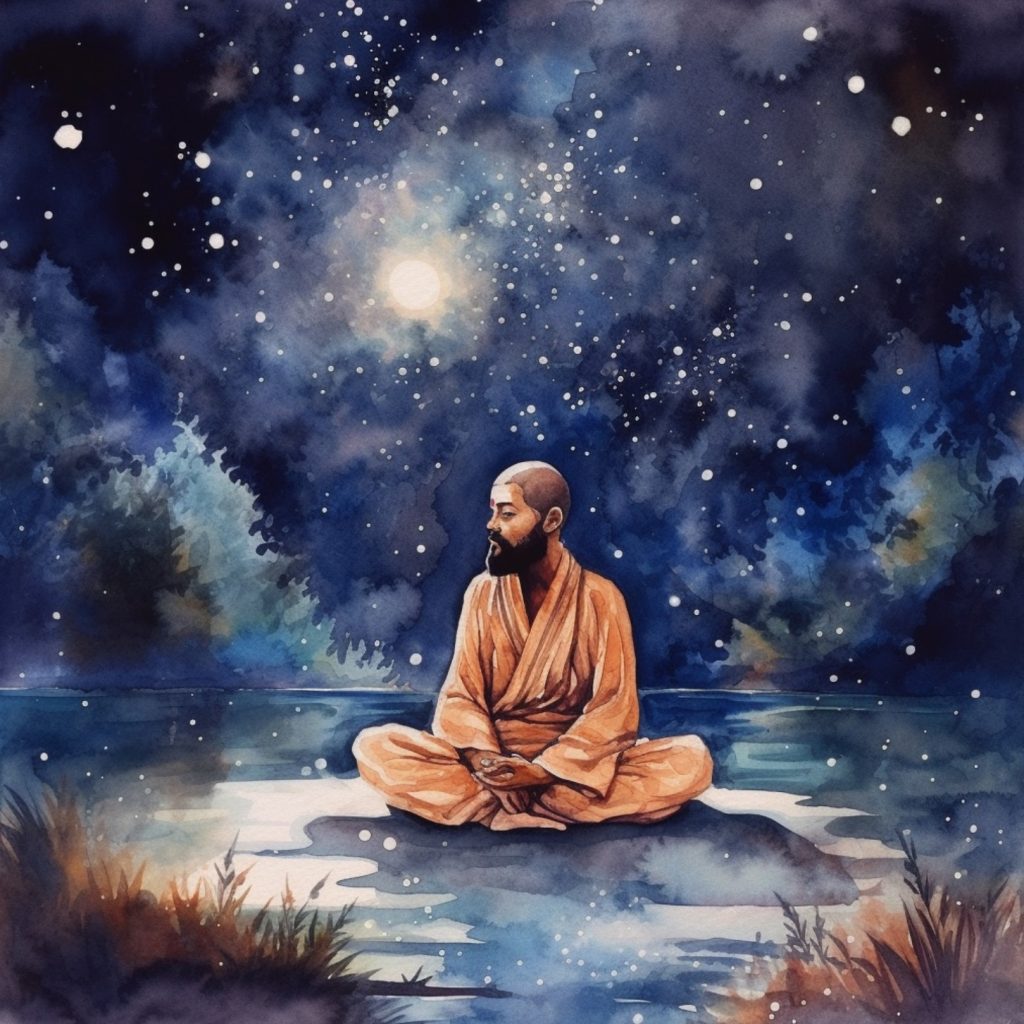
consciousness. Hindus would acknowledge this experience as Satchidananda
(existence, consciousness, bliss).
In Maha Yogi Walt Whitman K.
Nambiar elaborates a Hindu perception of this mystic adventure: "A
revolutionary transformation came over Whitman. A hackwriter and a
middling sort of poet transformed into a pet-prophet with a grand vision
and voice of power. At 27 his poetry was banal, sentimental and
mechanical. The change came presumably when he was 29, for we find strange
thoughts and phrases, mystical and axiomatic, the very stuff of Leaves of
Grass, beginning to appear in his note books of this period. We may
surmise that it was during this period, on that 'transparent summer
morning' when Whitman 'loafed on the grass,' that he has described in Song
of Myself. The experience emancipated him from all that he had been
before."
Later in the Song of Myself, Whitman states that "All
truths wait in all things. They neither hasten their own delivery nor
resist it. They do not need the obstetric forceps of the surgeon. The
insignificant is as big to me as any." Whitman's mystic illumination,
which seems indisputable, was spontaneous. Apparently, no one lead him to
it. Even when it occurred, he did not seek to reconcile it with an
established spiritual tradition. Instead, he set it to verse, the content
and style of which changed the course of American literary history,
rippling effects still further around the world. The illumined Whitman
accepted existence wholly and completely, cherishing the lessons he found
hidden yet obvious everywhere. Life to him was perfect. This is what he
tried to broadcast in his poetry.
"Pleasant and well-suited I walk.
Whither I walk I cannot defines, but I know it is good. The whole universe
indicates that it is good. I swear I think there is nothing but
immortality. That the exquisite scheme is for it, and the nebulous float
is for it, and the cohering is for it! And all preparation is for it - and
identity is for it - and life and materials are altogether for it!"
Whitman's work eventually gained enormous popularity in the West, but it
was applauded first by Eastern minds. Sri Aurobindo had great respect for
Walt Whitman and extolled him in his essay, Future Poetry. Tagore admired
him and even translated one of his poems. Swami Vivekananda paid tribute
to Whitman as a "spiritual genius." George Bernard Shaw wrote, "Whitman is
a classic. Curious that America should be the only country in which this
is not as obvious as the sun in the heavens."
O.K. Nambiar again
provides a Hindu perspective: "It is a curious fact that the Hindu mind
has shown an instant capacity for responsive incandescence when brought
into contact with Whitman's works. I remember one occasion when I read out
passages from Leaves of Grass and translated them for the benefit of a
Brahman pundit. The pundit's eyes lit up with a flash of recognition, and
he exclaimed from time to time: 'He is a realized soul.' 'That is the
cream of Vedanta' 'Those are signs of Bhava Samadhi.'"
Whitman and
America
Walt Whitman was strongly influenced by the broadening
democratic concepts that were brought to a zenith in 1829 with Andrew
Jackson's inauguration as president. Whitman was a believer in "Jacksonian
democracy" and "the splendor of the common man." He was especially fond of
President Abraham Lincoln and for three years of his life lived only
blocks away from him in Washington D.C. He writes in Personal
Reminiscences of Abraham Lincoln that "Abraham Lincoln seems to be the
grandest figure yet, on the crowded canvas of America's Nineteenth
Century." According to Henry B. Rankin in Personal Recollections of
Abraham Lincoln, Lincoln also liked Whitman. Rankin contends Lincoln
requested that a copy of Leaves of Grass be left on his office coffee
table for all guests to read freely and that time again Lincoln himself
would leisurely read passages of the book aloud to all present even though
at this time Leaves of Grass was not being well accepted by the
public.
His Enduring Legacy
Whitman continues to hold a
captive readership generation after generation, primarily because he
offers the welcome conviction that man is essentially a spiritual being
and that the world is essentially a spiritual place. He conveys this
conviction with timeless and unearthly power. All of this makes his work
hard to ignore. Even the recent movie, Dead Poet's Society, nominated for
several 1990 Academy Awards, refers to Whitman throughout and is based on
the very spirit of his outspoken and unabashed love affair with
consciousness unveiled. Today, Walt Whitman is properly considered one
America's greatest poets.
In Out the Cradle Endlessly Rocking, a
masterful poem written a short time before the end of his life, Whitman
confronts death. He is standing by the sea, listening to the waves.
"Whereto answering, the sea, delaying not, hurrying not, whisper'd me
through the night, and very plainly before daybreak, lisp'd to me the low
and delicious word, death. And again, death, death, death, death. Hissing
melodious, neither like the bird nor like my arous'd child's heart. But
edging near as privately for me rustling at my feet, creeping thence
steadily up to my ears and laving me softly all over, death, death, death,
death, death."
As for as the depth of his own experience is
concerned, Whitman himself attests: "And I said to spirit, when we become
the enfolders of those orbs, and the pleasure and knowledge of everything
in them, shall we be filled and satisfied then? And my spirit said, 'No,
we but level that lift to pass and continue beyond.'"
The Whitman
Chronicle
Walt Whitman (1819-1892) was born on Long Island, New
York. Having left school at the age of eleven, he was mostly a
self-educated man. He worked as a typesetter, a journeyman printer, a
school teacher, an editor, a stationer, a journalist, an essayist - and
finally a poet.
Whitman lived in New York City for 36 years. As a
journalist, he had access to free theater tickets, and a wide sidewalk
acquaintance in Brooklyn. He visited the theater often and especially
loved opera. "But for opera," he once remarked, "I could never have
written Leaves of Grass."
In 1855 he wrote Leaves of Grass, Which
he revised and published a total of nine times throughout his lifetime.
Although the radical form and content of this poetry eventually marked him
as a revolutionary of American literature, he was, during his life, known
more for his influence as a prophet of democracy and "an enthusiast of the
common man." Because Whitman's style of writing was rich with frequently
sensual metaphor, many critics considered him immoral. He was even
discharged as a clerk in the U.S. Department of the Interior because of
the alleged obscenity of Leaves of Grass. Yet the Transcendentalists - the
Occident's most oriental poet/philosophers - loved him from the start. He
exemplified their very American resistance to conformity in pursuit of
individual mystical experience. They gave his work credence.
He
became prominent among the bohemian element of New York before moving to
Washington, D.C. (1862-73) during the Civil War. He visited both Union and
Confederate soldiers in war hospitals and worked for a time in the office
of the U.S. Attorney General.
In the late 1860's Whitman's work
received overdue recognition as the early reactions of some American
critics began to be overshadowed. In 1870 Whitman wrote Passage to India.
This poem moved beyond America, beyond humanity, to death and "the
hereafter." In January, 1873, Whitman had his first stroke which left him
partially paralyzed. Shortly after this he moved to Camden where he spent
the last years of his life.
Whitman was, in his own words,
"Garrulous to the very last." Facing his final days with joy, he wrote
Proudly the Flood Comes In, a wondrous contemplation of death. He died
March 26, 1892.
Article copyright Himalayan
Academy.
Return to the Table of Contents
Return to Hinduism Today Home Page
|