March/April 2001
The Vedic Expierence
A modern admirer translates the ancient Hindu scriptures with
inspiration, clarity and richly authoritive scholarship
One of the best of the many translations of the Vedas
into the English language comes from an unexpected source, the famed
Catholic theologian Raimon Pannikar. For twelve years, with the help of a
team of Hindu pandits and Sanskrit scholars in Banaras, India, he
struggled to bring the ancient texts into clear, accurate and inspired
English. The result is a monumental scholarly achievement.
The following seven pages of excerpts are drawn from
The Vedic Experience, which Professor Panikkar wrote while living
at the Catholic diocese in Banaras on the Ganga River from 1964 to 1976.
The verses presented here were selected to give a sense of the variety and
beauty of content throughout the Vedas. They follow Panikkar's
creative and insightful ordering of the ancient texts into seven sections,
corresponding to seven parts of an Earth day, a human life and a cosmic
cycle. This provides a useful structure to the extremely diverse
collection of hymns which comprise the Veda. The entire text is
available at www.himalayanacademy.com/books/vedic_experience/VEIndex.html.
Panikkar's seven sections excerpted over the next seven pages are:
1. Dawn: The preparation for birth into existence,
fertile ground ready for planting.
2. Germination: The beginning, the striving, the
affirmation of identity in the realm of existence.
3. Blossoming: The attainment of plenitude, of
maturity, the zenith of a life well spent.
4. Fall and Decay: The beginning of the downward
path, the natural decline of life, the discovery that nothing resists
time.
5. Death: The destiny of all existing things, and
the natural close of a physical life cycle.
6. New Life: The marvelous reemergence of life out
of the ordeal of death, the disclosure that life is immortal, that being
is unfathomable, and that bliss and reality are capable of self-renewal.
7. Twilight: The last part of the anthology, like a
bouquet ribbon, binds the six in summary.
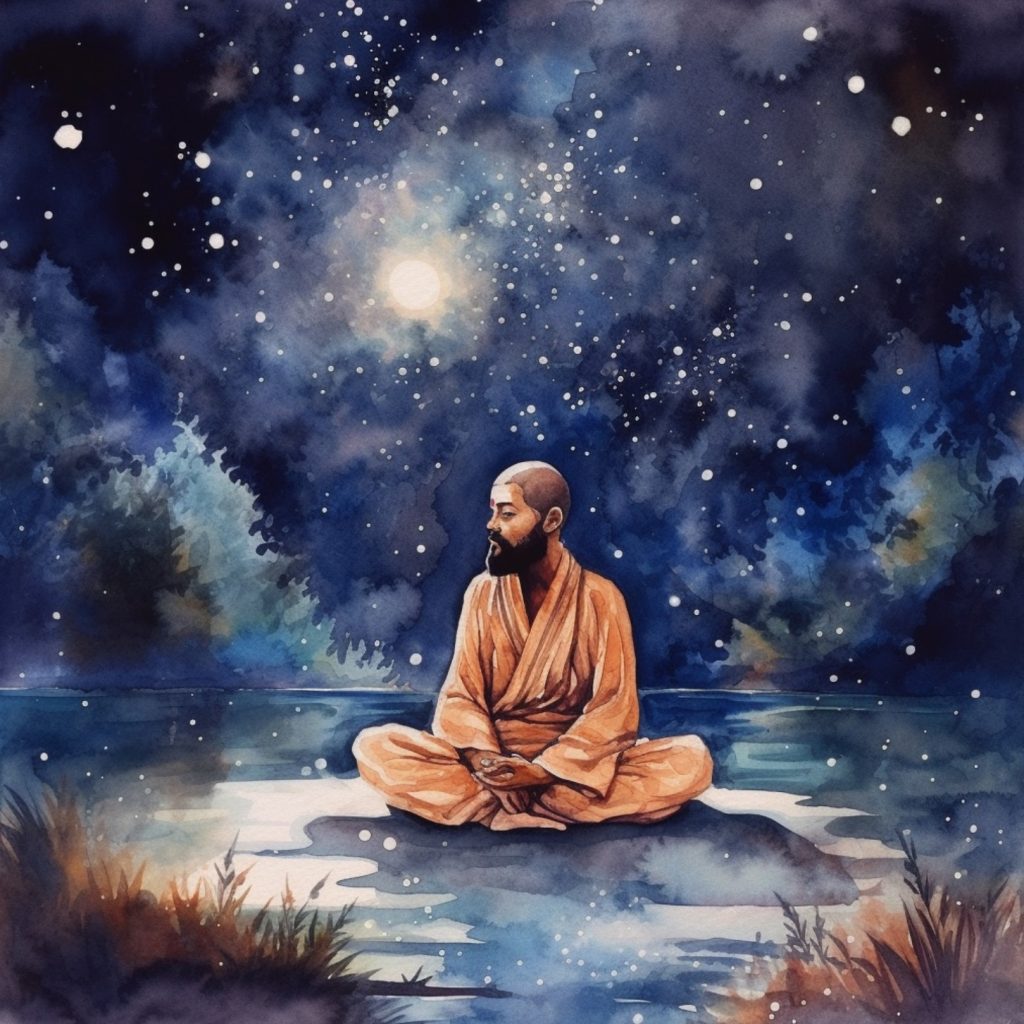
To illustrate these magnificent translations, special art
was commissioned by Hinduism Today from the renown artist, S. Rajam of
Chennai in South India.
Raimon Panikkar was born in Barcelona, Spain, in 1918 of
an Indian Hindu father and a Spanish Roman Catholic mother. Information on
his early years is sketchy. He was a brilliant student and studied
philosophy and chemistry in Barcelona, Madrid and Bonn, and theology in
Madrid and Rome. He earned an astounding three doctorates in philosophy,
chemistry and theology. He was ordained a Catholic priest in 1946, serving
as a scholar and theologian, and not, apparently, as a parish priest. In
1953 Panikkar left Spain to live in India where he taught at the
Universities of Mysore and Banaras, specializing in Indian philosophy and
Christian-Hindu understanding. He has been a professor at the Universities
of Madrid, Rome, Harvard and the University of California at Santa
Barbara.
Panikkar played a key roll in the writing of Nostra
Aetate, the "Declaration on the Relation of the Church to
Non-Christian Religions," released by the Second Vatican Council in 1965.
Though most certainly a devout Christian, he championed the concept of
respect for other faiths, so much so that some call him the "apostle of
interreligious dialogue." To this day the Catholic Church's relationship
to other religions as defined in Nostra Aetate remains a delicate
issue both inside and outside the Church. It was just after participating
in Vatican II, which changed the face of modern Catholicism, that he
departed to India to write the Vedic Experience.
Now 83, he continues to follow a demanding teaching and
lecture schedule. He has written more than 30 books and 900 articles.
Besides The Vedic Experience, these include: The Trinity
and the World's Religions; Blessed Simplicity; Worship and Secular Man;
The Silence of God: The Answer of the Buddha and The
Cosmotheandric Experience. He coined the word cosmotheandric to
convey a concept of God, soul and world similar to that found in the South
Indian perception of Pati-Pasu-Pasam. Today, Panikkar makes his
home in the mountains of Catalunya, Spain.
Dawn
At first was neither Being nor Nonbeing. There was not
air nor yet sky beyond. What was its wrapping? Where? In whose
protection? Was Water there, unfathomable and deep?
There was no death then, nor yet deathlessness; of
night or day there was not any sign. The One breathed without
breath, by its own impulse. Other than that was nothing else at
all.
Darkness was there, all wrapped around by darkness, and
all was Water indiscriminate. Then that which was hidden by the Void,
that One, emerging, stirring, through power of Ardor, came to
be.
In the beginning Love arose, which was the primal germ
cell of the mind. The Seers, searching in their hearts with wisdom,
discovered the connection of Being in Nonbeing.
A crosswise line cut Being from Nonbeing. What was
described above it, what below? Bearers of seed there were and
mighty forces, thrust from below and forward move above.
Who really knows? Who can presume to tell it? Whence
was it born? Whence issued this creation? Even the Gods came after its
emergence. Then who can tell from whence it came to be?
That out of which creation has arisen, whether it held
it firm or it did not, He who surveys it in the highest heaven, He
surely knows or maybe He does not! RIG VEDA 10.129
I magnify God, the Divine Fire, the Priest, Minister of
the sacrifice, the Offerer of oblation, Supreme Giver of treasure
RIG VEDA 1.1.1.
The Primal man is, simply, All: What is and what shall
be He is the Lord of Immortality ATHARVA VEDA 19.6.4
Germination
Praise to the Breath of Life! He rules this
world, master of all things, on which all things are
based.
Praise, Breath of Life, to your uproar! Praise to your
thunder! Praise to your lightning! Praise, Breath of Life, for your
rain!
When Breath of Life with his thunder roars o'er the
plants, then, pregnant with pollen, the flowers burst forth in
abundance.
The plants converse with this Breath, drenched by his
moisture: "Our life is prolonged, for you have made us all
fragrant."
Breath of Life clothes all beings with care as a father
his son; master of all things, whether they breathe or breathe
not.
Breath of Life is Queen, is Guide, revered by all
things; he is sun, he is moon; he is also the Father of
all.
A man breathes in, he breathes out, within the
womb. Quickened by you, to birth he comes once more.
The mighty Wind they call him, or Breeze. The future
and the past exist in him. On Breath of Life all things are
based.
Breath of Life, do not forsake me. You are, indeed,
I. Like the Embryo of the Waters I bind you to me that I may
live ATHARVA VEDA 11.4
O God, grant us of boons the best-- a mind to think and
a smiling love, increase of wealth, a healthy body, speech that is
winsome and days that are fair. RIG VEDA 2.21.6
Blossoming
When a man is born, whoever he may be, there is
born simultaneously a debt to the Gods, to the sages, to
the ancestors, and to men.
When he performs sacrifice, it is the debt to the Gods
which is concerned. It is on their behalf, therefore, that he is
taking action when he sacrifices or makes an oblation.
And when he recites the Vedas, it is the debt to
the sages which is concerned. It is on their behalf, therefore, that
he is taking action, for it is said of one who has recited the
Vedas that he is the guardian of the treasure store of the
sages.
And when he desires offspring, it is the debt to the
ancestors which is concerned. It is on their behalf, therefore, that
he is taking action, so that their offspring may continue, without
interruption.
And when he entertains guests, it is the debt to man
which is concerned. It is on their behalf, therefore, that he is
taking action if he entertains guests and gives them food and
drink. The man who does all these things has performed a true
work; he has obtained all, conquered all YAJUR VEDA SATAPATHA
BRAHMANA 1.7.2
The sacrifice is man. It is man [who offers it] because
it is man who spreads it out and because, in being spread out, it
assumes exactly the same stature as man. For this reason, the
sacrifice is man. YAJUR VEDA SATAPATHA BRAHMANA 1.3.2.1
Diffusing glory with your rays, you have scaled the
shining realm of heaven. By you are supported all things that are, O
God All-Creator, essence all-divine. RIG VEDA 10.170.4
Fall and Decay
Just as an overloaded cart lumbers along creaking, in
the same way the self in this body, loaded by the Self of
wisdom, lumbers along creaking when its breath is getting heavy.
When he becomes reduced, whether by old age or by
disease, then, just as a mango fruit or a fig or a pipal fruit
[detaches itself from its stem], so this person, being released
from his limbs, returns to Life, to the place whence he has come.
Just as, when a king is arriving, the guards, the
officers, the drivers, and the village elders await him with
food, drink, and a place for his dwelling, saying, "Here he comes,
here he comes!" even so all beings await him who knows this
[saying]: "Here comes Brahman, here he comes!"
Just as the guards, the officers, the drivers, and the
village elders gather around the king at his departure, even so all the
powers of life gather around this self at the end of his time,
when his breath is getting heavy YAJUR VEDA BRHADARANYAKA
UPANISHAD 4.3
When a man, my dear, is stricken with disease, his
relatives come near to him, asking: "Do you recognize me?" As long
as his speech has not merged in his mind, his mind in his breath, his
breath in light, and the light in the supreme Godhead, so long does
he recognize them.
But when his speech has merged in his mind, his mind in
his breath, his breath in light, and the light in the supreme
Godhead, then he does not recognize them SAMA VEDA CHANDOGYA
UPANISHAD 6.15
Only when men shall roll up space as if it were a
simple skin, only then will there be an end of sorrow without
acknowledging God. YAJUR VEDA, SVETASVATARA UPANISHAD 6.20
Death
When this atman becomes weak and unconscious,
then all the life powers collect around him. Then he gathers
to himself all the particles of light and descends into the heart.
When the person in the eye withdraws from him, he no longer
recognizes forms.
"He is becoming one," they say, "he does not
see." "He is becoming one," they say, "he does not smell." "He is
becoming one," they say, "he does not taste." "He is becoming one,"
they say, "he does not speak." "He is becoming one," they
say, "he does not hear." "He is becoming one," they say, "he does
not think." "He is becoming one," they say, "he does not
feel." "He is becoming one," they say, "he does not
understand."
The tip of his heart gets illumined and, being
illumined, the atman departs through the eye or the head or some
other part of the body. As he departs, the breath of life departs
after him; and when the breath of life departs, all other breaths
follow. He then is reunited with consciousness and departs together
with consciousness. His knowledge and his works and his
past experiences accompany him. YAJUR VEDA BRHADARANYAKA
UPANISHAD 4.4
From unreality lead me to reality; from darkness lead
me to light; from death lead me to immortality. YAJUR
VEDA BRHADARANYAKA UPANISHAD 1.3
Just as a cucumber is removed from its stalk, so from
Death's bonds may I be removed, but not from Immortality! RIG
VEDA 1.10.115
Desireless, wise, immortal, self-existent, full of
bliss, lacking in nothing, is the one who knows the wise, unaging,
youthful atman: he fears not death! ATHARVA VEDA 10.8.44
New Life
Eye cannot see him, nor words reveal him; by the
senses, austerity, or works he is not known. When the mind is
cleansed by the grace of wisdom, he is seen by contemplation--the
One without parts MUNDAKA UPANISHAD 3.1.8
.In the beginning this was Brahman, One and infinite,
infinite in the East, infinite in the South, infinite in the
West, infinite in the North, infinite above and below, infinite in
every direction. For him there are, of course, no directions such as
the East and so on, no across, no above, and no below.
Inconceivable is this supreme
atman, immeasurable, unborn, inscrutable, unthinkable, he
whose Self is space. He alone remains awake when the universe is
dissolved, and out of this space he awakens [again] the world
consisting of thought. By him alone is all this thought [into being]
and in him it dissolves again. His shining form is that which burns
in the sun; it is the multiform light that shines in the smokeless
fire and it is that which digests the food in the body. For thus it
has been said:
He who dwells in the fire, he who dwells in the
heart, he who dwells in the sun, he is One. The man who knows
this, he verily attains the Oneness of the One YAJUR
VEDA MAITRI UPANISHAD 6.17
For me there is no earth, no water, and no fire. For me
there is neither wind nor ether. The one who has discovered the supreme
atman dwelling in the heart, without parts, without a
second, the universal witness, neither being nor nonbeing,
attains the pure form of the supreme atman. ATHARVA
VEDA KAIVALYA UPANISHAD 23
That is Fullness, this is Fullness; from Fullness
comes Fullness. When Fullness is taken from Fullness, Fullness
remains. YAJUR VEDA BRHADARANYAKA UPANISHAD 5.1
Twilight
At many a dawn of shining splendor has the Lord
presided. Come on your chariots, far-ranging Spirits, come to our
sacrifice.
Suffusing light for every creature, the Inspirer God
rises. The Sun has filled heaven and earth with his radiance
disclosing his presence.
Rosy Dawn advances, adorned with the brightness of many
a beam. She pursues her way on her well-equipped chariot arousing
Men to joy.
Come, O twin Spirits, at break of day on your powerful
chariots. We offer in sacrifice this honey-sweet draught for your
delectation.
How is it that, united and unsupported, he does not
fall down? By what inner power moves he? Who has seen? A firm
pillar, he protects heaven's vault. RIG VEDA 4.14
I hail you, Goddess, Dawn of light! To her let us offer
the homage of our songs! She imparts to us sweetness, she
steadies the Heaven and lavishes abroad her radiant splendor.
Our songs have awakened this Daughter of Heaven.
Equitable, generous, she has scaled the two worlds. Toward Dawn, O
Fire, when she comes in her brightness, you advance, eager to share
her fair treasures.
The Mighty One, firm-based on Order, speeds after each
dawn and makes his debut in the worlds. Great are the powers of
Mitra and Varuna. Dawn in all directions diffuses her
splendor! RIG VEDA 111.61
Return to the Table of Contents
Return to Hinduism Today Home Page
|