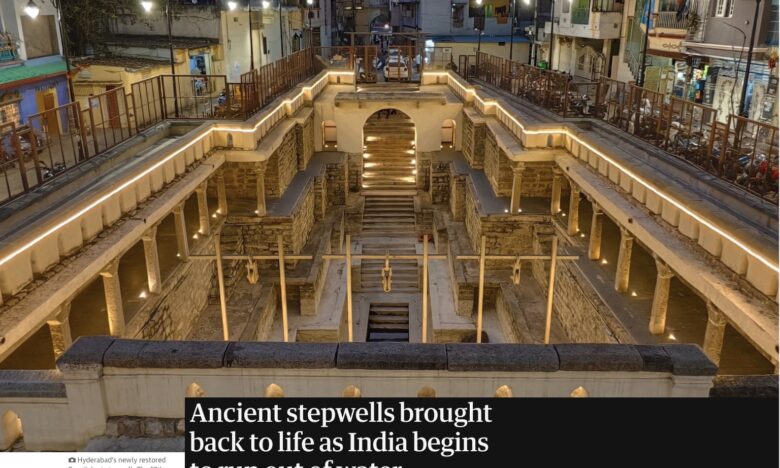
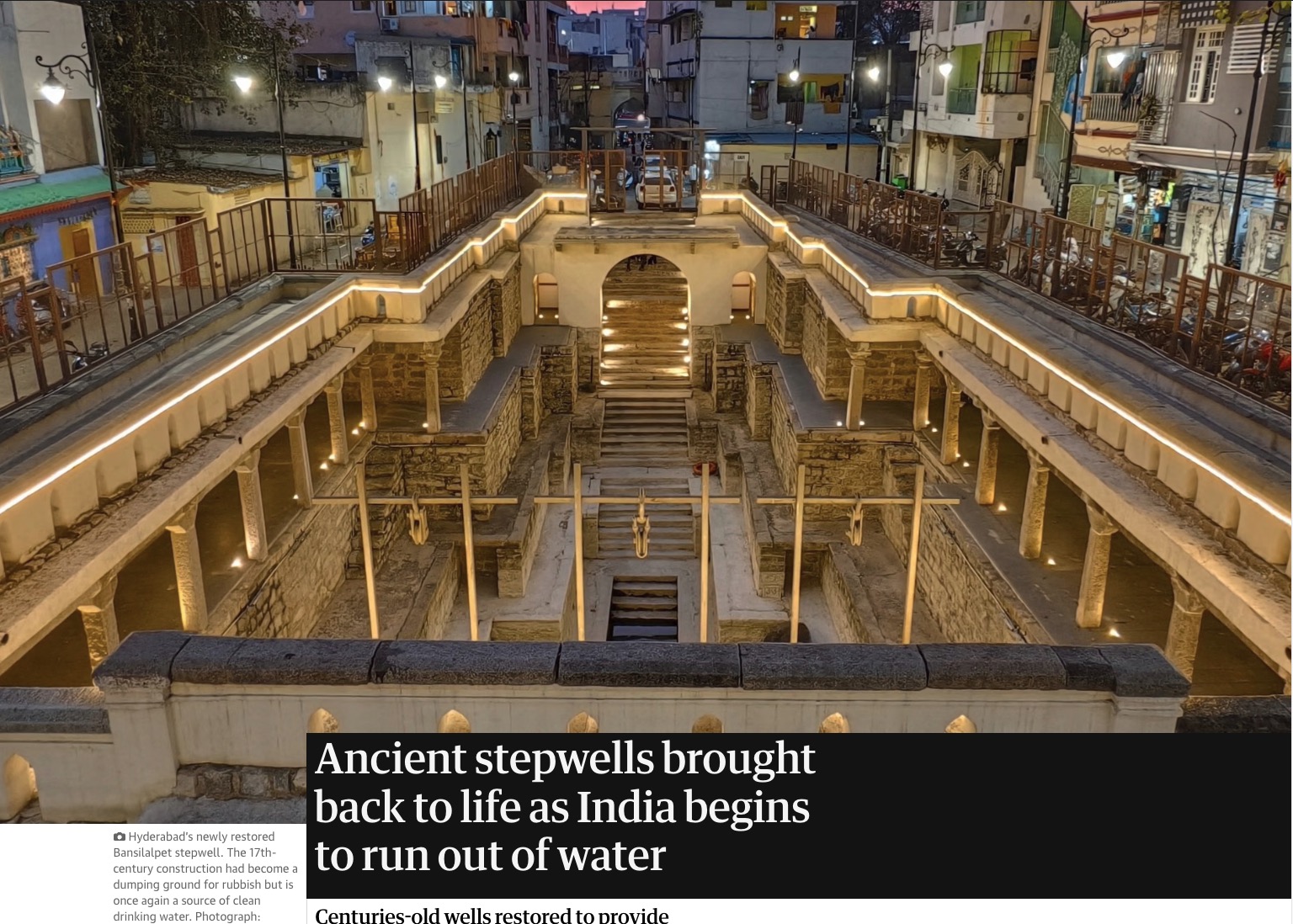
INDIA, February 26, 2026 (The Guardian): Aloud cheer and sounds of clapping reverberated around Bansilalpet, a neighborhood in Hyderabad, when the first trickle of clean water dribbled out of the ground. After an 18-month effort to clear out 3,000 tons of rubbish and restore the stone walls and adjacent area, the 17th-century Bansilalpet stepwell had become a source of clean drinking water for the first time in four decades. India is famed for its stepwells – multi-story structures built to provide access to groundwater, with steps and platforms descending to the water level. Thousands were built across the country near natural aquifers – underground porous rock saturated with water – mostly between the 11th and 18th centuries. The wells were abandoned under the rule of the British, who considered them unhygienic and largely prohibited their use. While many wells have disappeared or crumbled, the Stepwell Atlas, a collaborative effort between researchers and organizations including the Indian National Trust for Art and Cultural Heritage (Intach), lists more than 3,000. About 100 are in the southern Indian state of Telangana, with nearly half of these in the state’s capital, Hyderabad.
To date, Bansilalpet is the only stepwell in Telangana to provide drinking water, but architect Kalpana Ramesh hopes to raise enough funds to equip 25 revived wells with additional filtration systems to make the water safe to drink. “If the water from all the stepwells became potable, it would then encourage people to preserve these systems,” she says. India is facing the worst water crisis in its history. It is home to more than 1.4 billion people – nearly 18% of the world’s population – but has only 4% of the planet’s fresh-water resources. More than 600 million Indians already face high-to-extreme water stress, and the country’s water demand is projected to double by 2030. Erratic monsoon patterns, inadequate infrastructure and the expansion of water-intensive crops mean India is heavily reliant on groundwater, consuming a quarter of the global total. According to India’s Central Ground Water Board, over-exploitation of groundwater means the states of Punjab, Haryana, Delhi and Uttar Pradesh in northern India, Rajasthan and Gujarat in the western states, and Tamil Nadu, Karnataka, Andhra Pradesh and Telangana in the south are heading towards zero water availability, known as “day zero.”
More at source.
https://www.theguardian.com/global-development/2026/feb/26/ancient-stepwells-brought-back-india-run-out-water-day-zero?CMP=GTUS_email

A daily summary of world news for Hindus and non-Hindus alike