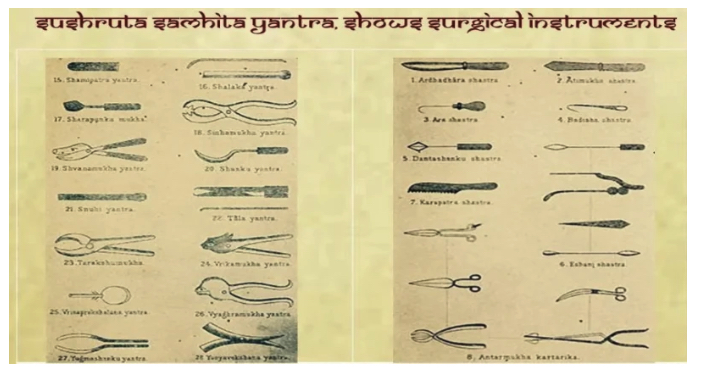
INDIA, December 26, 2025 (Organiser): Surgery is usually seen as a modern science. We associate it with machines, sterile gloves and complex equipment. But long before today’s hospitals existed, people were already cutting, stitching and treating serious injuries in organised ways. In ancient India, surgery was not only practised, it was taught, documented and regulated. One of the clearest records comes from the Sushruta Samhita, a medical text written more than two thousand years ago. The text is attributed to Sushruta, a physician whose name shines mainly because of this work. What makes the Sushruta Samhita so famous, is its strong focus on surgery. While many old medical texts deal mostly with medicines and theories, this one spends time on practical aspects such as how to operate, how to train and what tools to use.
Sushruta, who was famous around the 6th century BCE, is hailed as the founding figure in the history of surgery. His work, the Sushruta Samhita, has systematically organized ancient Indian surgical science also known as shalya tantra. This text describes many pioneering procedures that testify to high skill and resourcefulness, including advanced plastic surgery such as rhinoplasty, removal of a dead fetus and lithotomy for bladder stones. Surgery, according to Sushruta, was not to be attempted casually. The text makes it clear that a surgeon had to be trained properly and for a long time. Students were advised to practise before operating on real patients. They learned how to make cuts on vegetables, how to stitch leather and how to handle animal tissue. They were also expected to study the human body closely. This approach shows ancient surgeons understood the risks involved. A mistake could mean serious harm. Skill mattered as much as knowledge.
More at source.
https://organiser.org/2025/12/26/332011/bharat/what-surgery-looked-like-in-ancient-india-the-scientific-legacy-of-the-sushruta-samhita/

A daily summary of world news for Hindus and non-Hindus alike