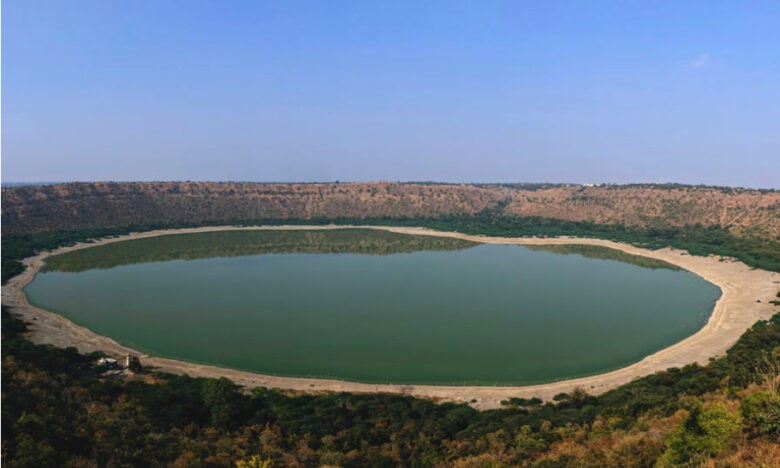
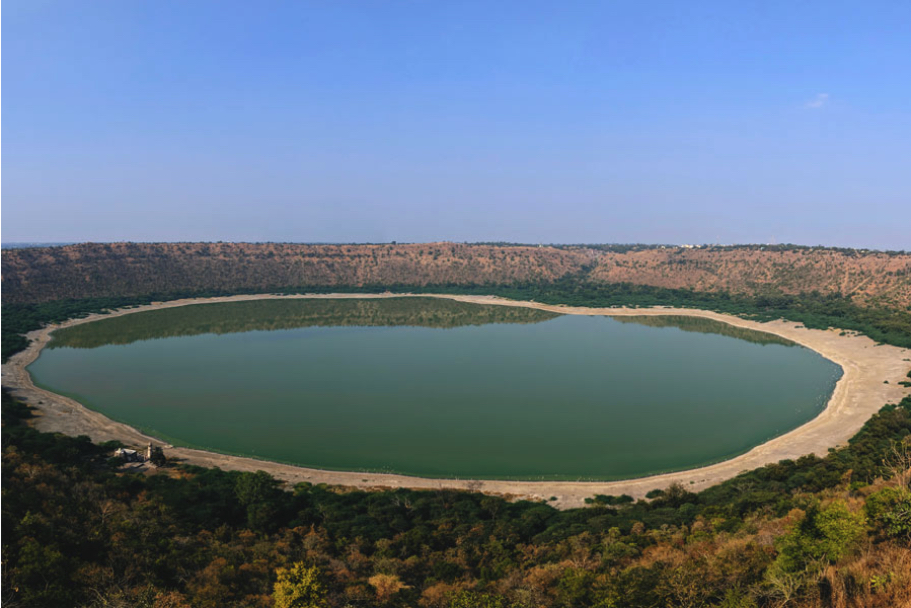
INDIA, January 15, 2026, (Telegraph India): A sharp rise in the water level of the world-famous Lonar Lake in Maharashtra’s Buldhana district has submerged several ancient temples, raising serious concerns over conservation and preservation at the heritage site. The phenomenon, observed over the past few years, has prompted the district administration to seek expert inputs from the Indian Institute of Technology Bombay to determine the reasons behind the rising water level. Lonar Lake, the world’s largest basaltic impact crater formed by a meteor strike around 50,000 years ago, is known for its saline-alkaline waters and unique ecosystem that has drawn global scientific attention. The Ramsar Site, located about 286 miles from Mumbai, houses several temples, some more than 1,200 years old. Many of them, including the famous Kamalja Devi temple, have been submerged as water levels rose.
Superintending Archaeologist Arun Malik of the Nagpur circle of the Archaeological Survey of India said there are 15 temples on the lower rim of the lake, all of which fall under the ASI’s jurisdiction. The Gaimukh temple complex has a natural spring that flows into the lake, he said. Citing studies, Malik said the water level has been rising for the past five to six years, placing the ancient shrine structures at risk. “No doubt this is a matter of research, but the water level has increased after the reserved forest came up there. If you look at the earlier images of Lonar Lake on Google Earth, you will find the water level very low,” he said. “Experts from IIT Bombay have taken samples from Lonar lake. They are trying to ascertain why this is happening and what steps should be taken. They are also trying to find out what the environmental impact is, as it is a natural place, and what is happening there is also natural,” Buldhana District Collector Kiran Patil said.
More at source.
https://www.telegraphindia.com/india/rising-waters-submerge-ancient-temples-at-lonar-lake-experts-roped-in-to-probe-cause/cid/2138893

A daily summary of world news for Hindus and non-Hindus alike