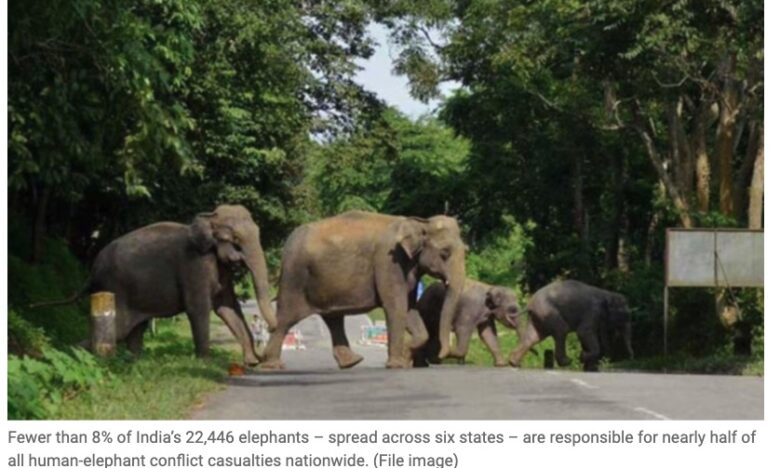
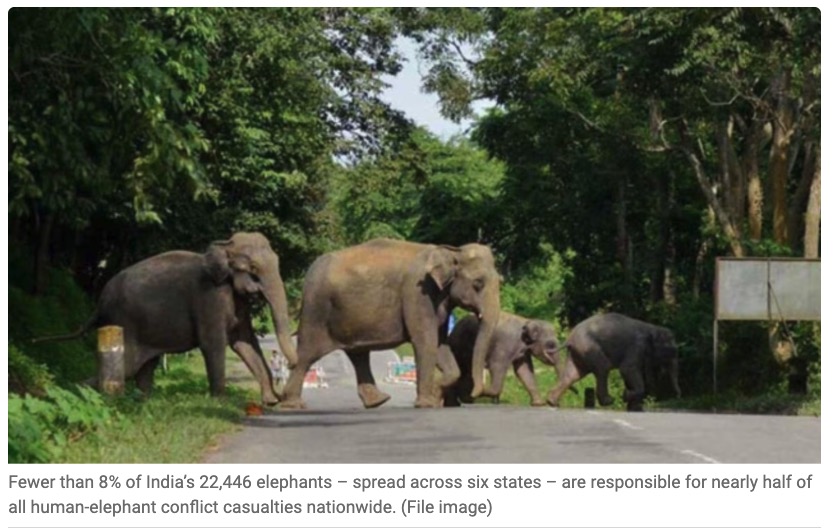
INDIA, February 24, 2026 (Indian Express): Fewer than 8% of India’s 22,446 elephants – spread across six states – are responsible for nearly half of all human-elephant conflict casualties nationwide. Most belong to nomadic herds displaced from shrinking forest habitats and forced into croplands. In fact, four of the new elephant areas, located across central India – south Bengal, Chhattisgarh, Madhya Pradesh and Maharashtra – had negligible elephant presence till herds from the other two states, Jharkhand (then south Bihar) and Odisha, started moving in around the mid-1980s. What forced these now stateless elephants out were a combination of natural and manmade triggers: serial droughts, rapid expansion of mining, and construction of reservoirs in south Bihar and Odisha. The outcome is that hundreds of elephants now depend solely or primarily on raiding agricultural fields, where they must compete with desperate farmers.
Last year, the government’s elephant population report recorded that the central Indian landscape is fragmented due to “unmitigated mining and linear infrastructure construction” etc, which has pushed elephants to new areas, “resulting in escalating conflicts with humans”. This deadly phase of human-elephant conflict, experts warn, is likely to intensify. Even as high-nutrient crops are boosting breeding in the crop-dependent herds, leading to a surge in numbers, the elephant population in the forests exceeds what these heavily degraded habitats can sustain. “Most herds of habituated crop-raiders have multiple calves. These new generations will have no memory of natural foraging. Nobody knows if they will stop visiting croplands if they come across good forest habitats tomorrow,” says ecologist Raman Sukumar of the Indian Institute of Science (IISc), who has worked extensively on Asian elephants.
Much more at source.
https://indianexpress.com/article/india/india-elephant-forests-herd-10550119/

A daily summary of world news for Hindus and non-Hindus alike