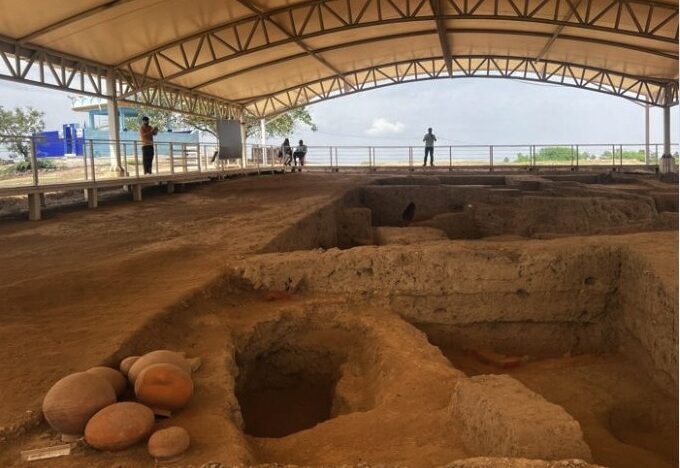
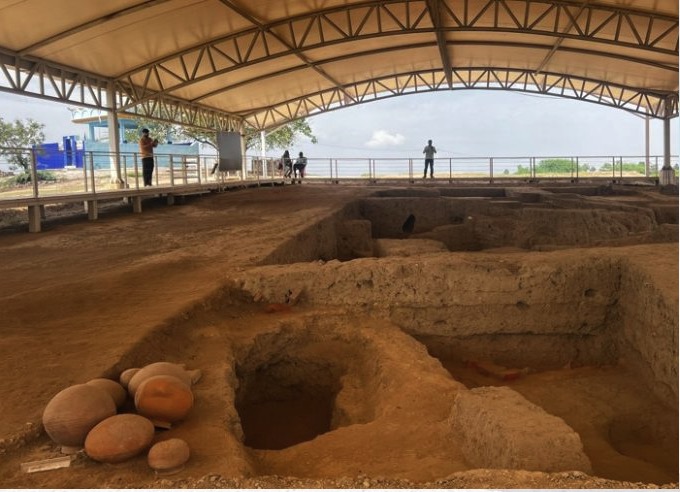
INDIA, June 15, 2026 (Travel Galore, by Padma Krishnan): Spanning over 865 acres, Rakhigarhi is the largest metropolis of the Indus Valley Civilisation (IVC), and it is a lot to explore on foot. Flourishing along the Indus River, the IVC was contemporary with two other river valley civilizations, the Nile in Egypt and the Euphrates and Tigris in Iraq. Spanning from 3300 to 1300 BCE, it had its golden age between 2600–1900 BCE. While the Egyptians were building the great pyramids and the Mesopotamians were developing writing, the Harappans from the Indus Valley were building grid-patterned cities with community baths, water reservoirs and drainage systems. Unlike the other two civilizations, they did not leave colossal monuments dedicated to rulers or Gods, and the Indus script is still undeciphered, even after almost a century of research.
Stretching over parts of Afghanistan, Pakistan and northwestern India, the Harappans developed five major urban centres: Mohenjo-daro, Harappa, and Ganweriwala in Pakistan, and Dholavira and Rakhigarhi in India. Situated in the Ghaggar-Hakra river plain of the Hisar district of Haryana, Rakhigarhi comprises two villages, Raki Shahpur and Rakhi Khas. Excavations began in 1969 and continue today. Findings show that this vast area was inhabited from the early Harappan (3200-2700 BCE) to the Mature Harappan (2700-1800 BCE) periods. The settlement reveals sophisticated urban planning: grid-patterned drainage systems, communal granaries, burial grounds, and houses built repeatedly like layers of a wedding cake. Walking around the mounds where active digging is underway, you can find the famed geometric patterns, drainage, and water harvesting systems. For travelers, Rakhigarhi offers a unique experience of witnessing archaeological excavations in real time.
More at source.
https://www.travelgalore.nz/2026/06/15/rakhigarhi-journey-to-an-ancient-metropolis/

A daily summary of world news for Hindus and non-Hindus alike