
My Daughters’ Upanayana
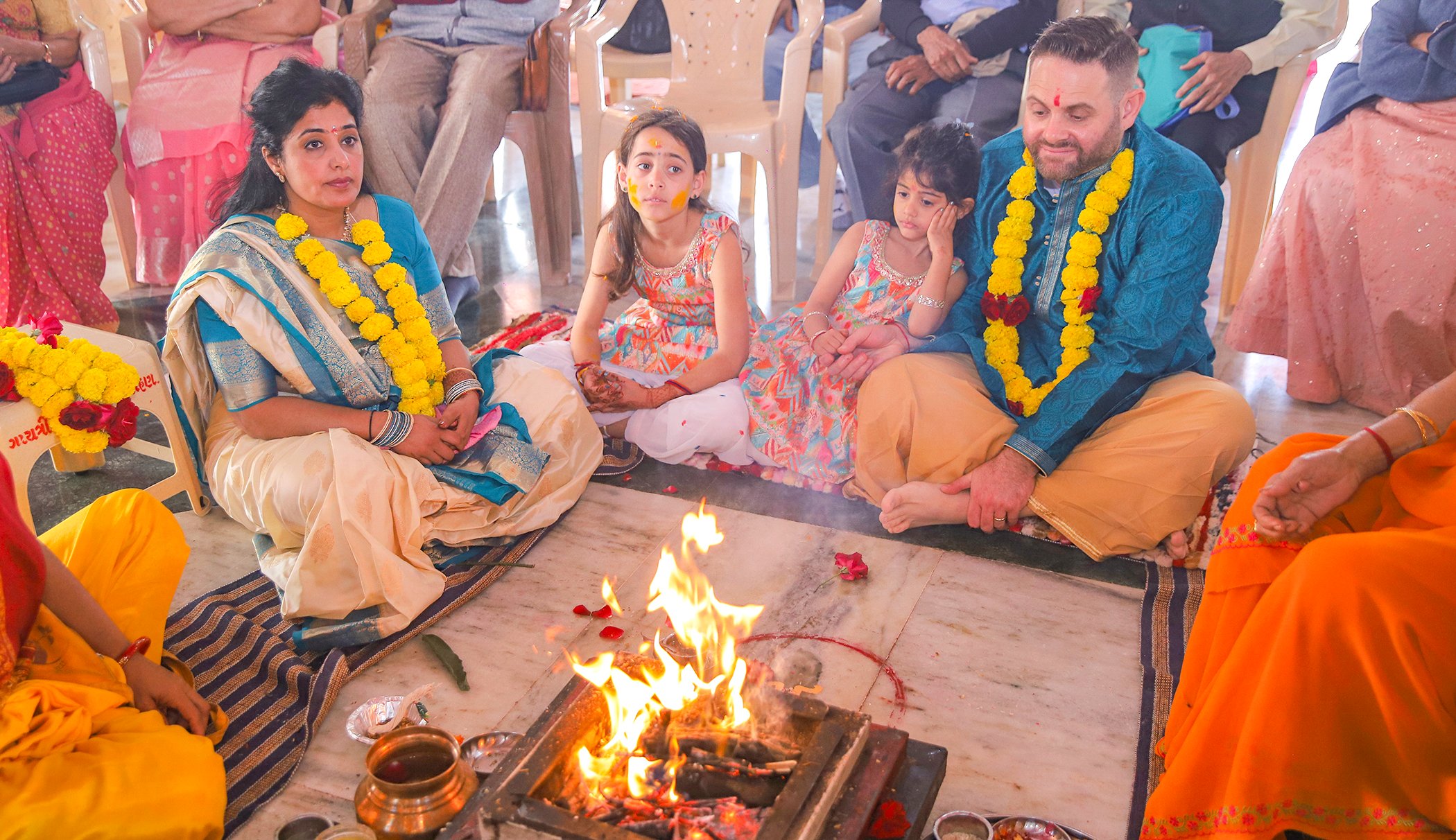
How our family celebrated the ancient tradition of girls receiving the sacred thread, witnessed by the sacred fire, family and friends
By Khyati Desai-Seltzer
Photos Courtesy Khyati Desai-Seltzer
I believe india is experiencing a time of coming home, decolonizing, awakening and returning to our roots and ancient traditions. Our family has been fully on board, trying to do our part to decolonize our thinking and traditions, or, at the very least, to question our beliefs. What is true and what did we borrow over time? What is not ours to hold on to? What was influenced by invasions, colonialism or patriarchy? So, we were thrilled when our daughters, Sunaina, now age 10 and Sahani, age 5, approached us with interest in having an upanayanam, the investiture of the sacred thread that has over time become available only for brahmin boys. The girls stood steadfast in their interest for over a year, so we investigated it.
Their interest made me recall an article in Hinduism Today of girls in South India receiving their sacred threads, referred to as a janoi in the Gujarati community. Participating in the ceremony is a mark of a commitment to learning spiritual knowledge. In my research, I learned that Gayatri Parivar, Arya Samaj and Art of Living perform these ceremonies in India and America. I was nervous to pose this idea to my traditional family, but my parents and other relatives were mostly on board. My daughters would be the first girls in our entire family of many generations to receive their sacred thread.
We waited for our girls to be old enough to understand this rite of passage. We had a deep desire to have the ceremony in India and decided to have it with Gayatri Parivar, who had performed our baby shower ceremony and other important rites of passage in our life. For us, it was important to do it while the grandparents remained in good health and could witness the ceremony and give their blessings.

In December 2024, we traveled to India and started planning for the ceremony that would take place at a beautiful mandir in rural Gujarat, about an hour outside of my hometown of Vadodara. Coming from a brahmin family, it was incredibly important to have this rite of passage in the most respectful and honorable way. For my older daughter, we purchased a book on the Gayatri mantra while both my daughters practiced reciting it daily and understanding the profound meaning.
My father, Girish Desai, who had received his sacred thread along with his seven brothers, found Gayatri Shakti Peeth in Kayovarahan to be a suitable location. His enthusiasm, though, which was a sense of pride for our daughters, led to many invitations going out to our very large network of family and friends, resulting in more than 100 attending. For us, having a small and meaningful ceremony was more important than a fancy affair, though this important rite of passage can be celebrated with fanfare.

Some relatives had reservations about attending, believing that this ceremony was meant for boys only—a belief that is historically inaccurate. In Vedic times, texts such as the Ashvalayana Grihya Sutra and Yama Smriti confirm that girls could undergo the upanayana rite and engage in Vedic learning, especially before marriage. It was over time that this changed, perhaps with influences from colonialism and patriarchy. How can Hindu youth displaying devotion to Gayatri Ma and committing to singing the most powerful mantra be a bad thing? In fact, both priestesses who performed our daughters upanayanam had received their sacred threads as well.
Doubts aside, our family members arrived in support with enthusiasm. My daughters sat through the three-hour ceremony without complaint, even though it was hot, there were many country flies and lots of smoke from the yagna in their eyes. We beamed with pride when they each received their janoi. It was a deeply profound and spiritual moment, and I could feel our ancestors around us.
My uncles expressed joy over the opportunity to participate in their first upanayanam for girls. Family members, friends and special guests came from all over Gujarat to witness, to shower the girls with blessings and gifts and to express their pride in how they conducted themselves. We were so proud of them.

It filled our hearts to see the enthusiasm of the family, as well as their dedication throughout the ceremony to help make it as smooth as possible. A heartwarming moment was the symbolic departure from home to study with a guru after the ceremony, wooden staff and sacred books in hand, only to be caught and brought back by the relatives anxious to prevent the sadness of the mother being separated from her child. This is a part of the ancient rite and observed today in various parts of India.
Our older daughter had been enthusiastically preparing for it for months by engaging in stretching and sprinting exercises. We watched her, giddy with joy, try to outrun her older uncles and aunts. They, just as joyfully, would not give up—despite the aches and pains that come with age—and eventually caught her and brought her back to us.
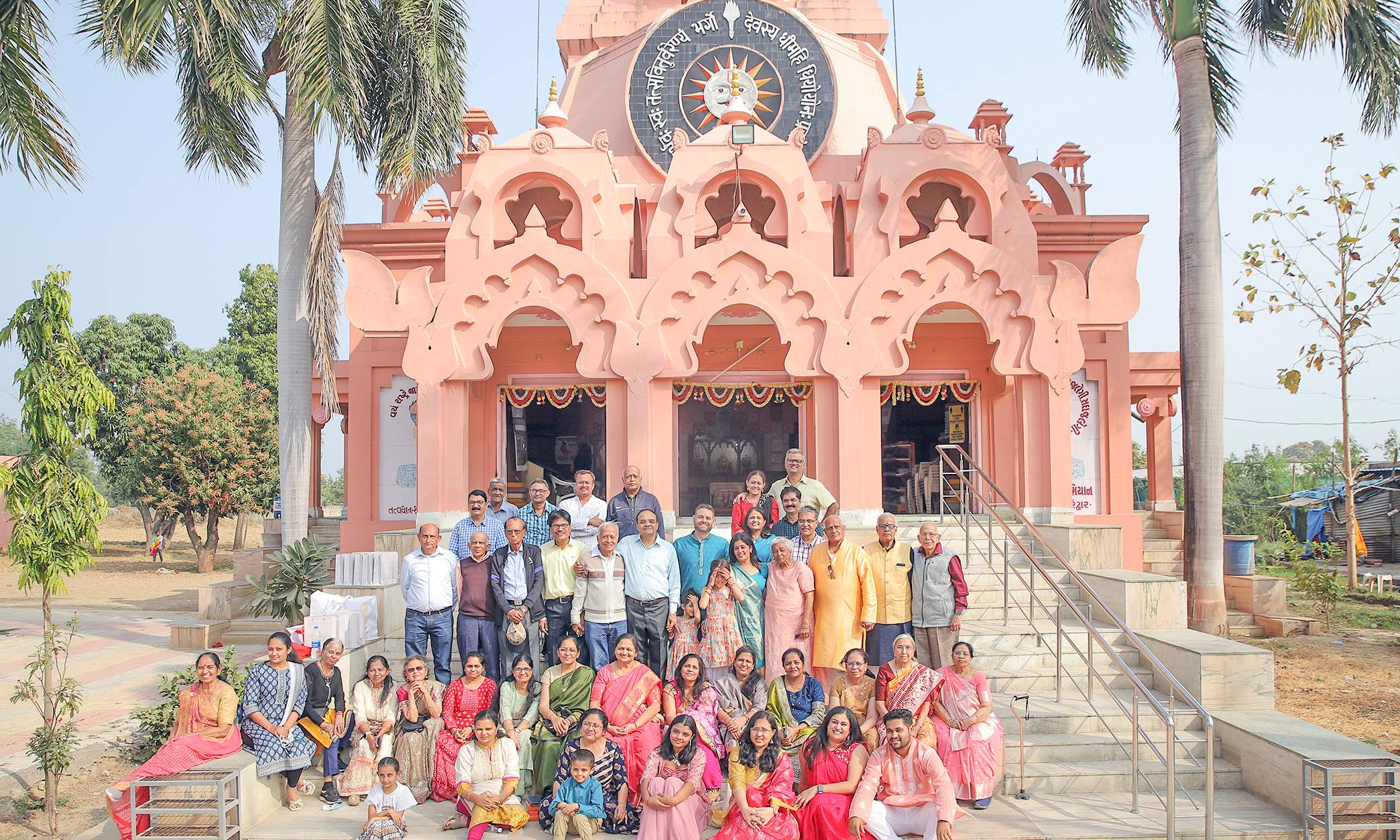
The memories of this occasion have never left us. Moments of absorbing the beauty of rural India, the grandeur of the temple, small glances of approving kindness from the priestesses, the arrival of family from all over Gujarat, family members anticipating our needs and bringing water to our daughters or a step stool for my husbands back pain, uncles and aunts running after our daughters, the entire family enjoying a delicious lunch and the famous local shrikand (a sweet yogurt dish), and visiting the other temples in the area after the ceremony were all remembered with gratitude.
We share this to encourage other families whose daughters express interest in receiving their sacred thread not to let societal norms or familial expectations discourage you from supporting a life of devotion to Gayatri Mata. The ceremony was not only for our daughters but also for us to celebrate our rich Vedic heritage every day. These three reputable organizations do great work in performing beautiful vidhis (rituals). What better way to validate and defend your daughters faith and devotion in an ever more demanding and challenging world? The time is long overdue for us to come home.∏π
The Author: Khyati Desai-Seltzer, born in India and raised in America, lives in Portugal with her husband and two daughters. She is passionate about dharma, Sanskriti, history and heritage and ensuring the next generation is inspired to learn and carry forward these traditions. She works in community development and postpartum care, sharing traditional baby massage and belly binding practices.
Comments (3)
It is delighted to see.
Keeping your children near to Dharma, is the kartvya/duty of the hindu parents. Bhagawan bless the daughters. HPA is excellently working…
What I shared with my son, whose paternal side had forgotten about Upanayanam altogether for centuries. Boys and girls evaluated on their gunas and karma, to be eligible for the Upanayanam. This is how we faced civilization erasure: In the face of centuries of foreign invasions and British colonial rule, which actively sought to dismantle Indigenous educational structures and erode local traditions, the Upanayanam served as a profound act of cultural resilience. By preserving this rite of passage, communities ensured the unbroken transmission of Vedic knowledge, ethical frameworks, and spiritual identity.
1. The Concept of “Twice-Born” (Dvija)
The Upanayanam signifies a spiritual rebirth. During centuries when ruling powers or colonizers marginalized or suppressed native practices, the ceremony instilled an identity that transcended the political climate. It reminded the initiate that while their physical body was subject to external subjugation, their intellectual and spiritual lineage belonged to a higher, eternal source.
2. Safeguarding the Oral Tradition
Invaders and colonizers (such as the British through the implementation of Macaulay’s education system) often dismantled indigenous Gurukul systems. The Upanayanam was the formal gateway to receiving these oral traditions. By initiating children, families kept the sacred texts—which were not allowed to be recorded or easily accessed by outsiders—alive in the memories of successive generations, functioning as a human library.
3. Preserving Language and Metaphysics
Central to the Upanayanam is the initiation into the Gayatri Mantra and the recitation of Vedic Sanskrit. By teaching the youth this language and prayer, the tradition preserved the intricate phonetic, grammatical, and philosophical heritage of the subcontinent. This linguistic continuity acted as a bulwark against complete assimilation by foreign languages and cultural frameworks.
4. Continuity of Ethical and Moral Duty
The sacred thread (Yajnopavita) given during the Upanayanam is a lifelong physical reminder of duty (Dharma) to oneself, society, and the divine. In eras when external authorities disrupted local governance and societal structures, maintaining the sacred thread helped individuals and communities retain their internal moral compass and distinct way of living, preventing the total erasure of indigenous values.
5. Symbol of Rejection of Cultural Erasure
Practicing the Upanayanam under threat of religious persecution or colonial assimilation became an act of defiance. It was a visible and communal declaration of adherence to the Sanatana Dharma. Every time a community performed this rite of passage, they collectively rejected the cultural hegemony of their colonizers and reasserted their own historical continuity.
At 73 you’ve reminded the age old tradition of the thread ceremony. While this has been reduced now to a mere formality before marriage, it is heartening to note that the same is carried forward in a foreign country.
Sanatan is slowly crawling up and efforts to revive this as a practising way of life still remains to be seen. 🙏