
Modern Strides in Storytelling Through Signature Styles
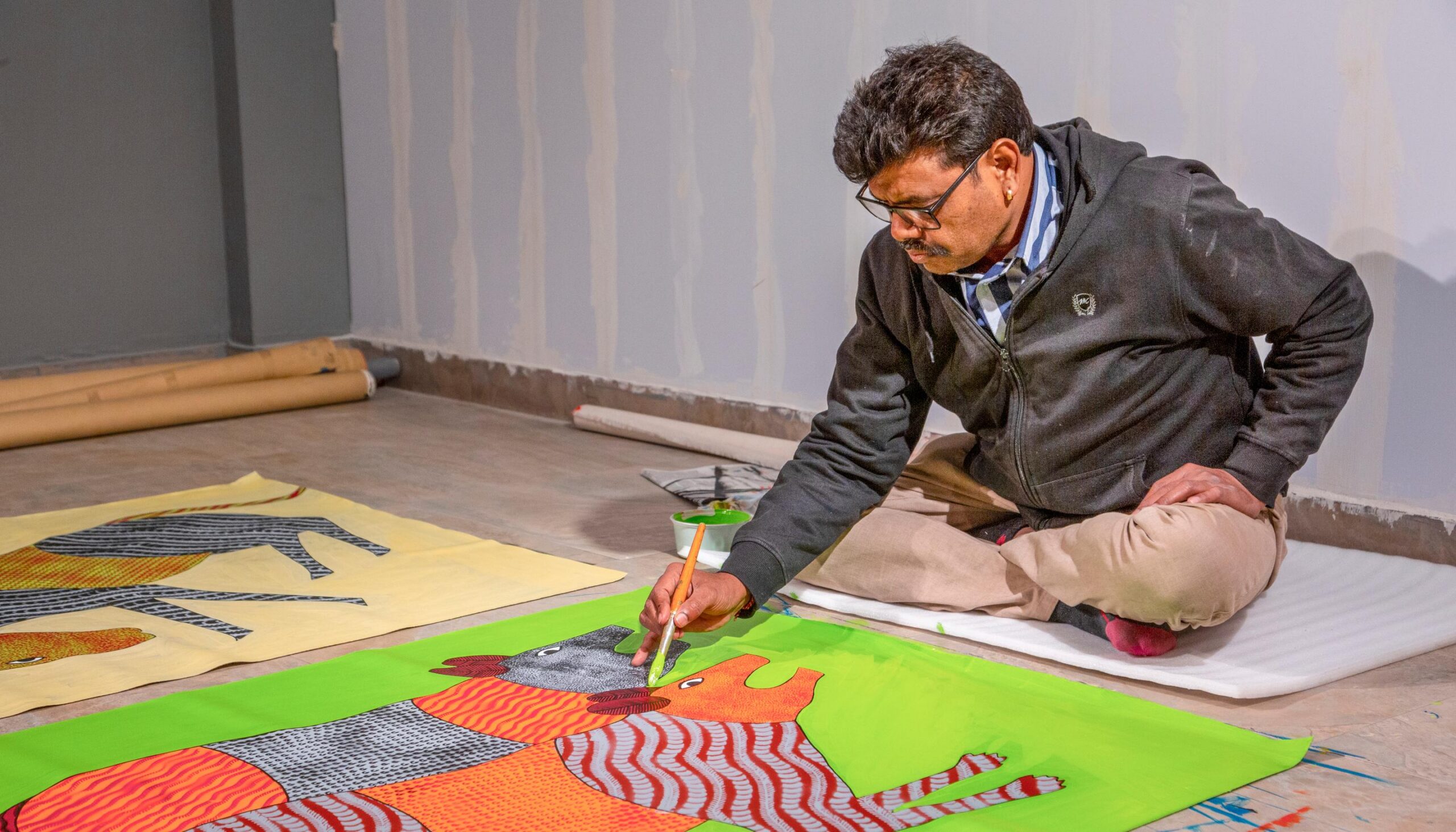
As Gond painting gains global acclaim, its artists bring mythology, memory and identity vividly into the present
The Gonds, or Koitures, are one of India’s largest indigenous communities. For weddings and festivals, their homes are traditionally decorated with digna—auspicious geometric patterns—and bhittichitra, compositions of animals, leaves and flowers. Their religious and cultural life is closely bound to nature, while Pardhan ritual specialists and bards have preserved mythology, history and genealogy through music and recitation.
Imagine a peacock—its magnificent feathers fanned out as a spectacle of blues, greens and yellows—dominating the canvas. Or picture intertwined fish, their scales colored in shades of sea green, frolicking in an ocean whose waves are intricately outlined in gentle, repetitive strokes. There are turtles and deer, lions and elegant trees in intricate shapes and forms, big cats and monkeys and an occasional depiction of human life. Gond art is difficult to forget once seen because of its deceptively effortless, highly distinct style that thrives on graceful repetitive patterns and an evolved eclectic color sensibility.
Over the last four decades, the art form has entered the mainstream and is now celebrated by museums, government initiatives and art curators around the world. Almost 250 artists in Patangarh, a village in Madhya Pradeshs Dindori district, earn their livelihoods from Gond painting. A smaller number of Gond artists are based in Andhra Pradesh, Maharashtra, Chhattisgarh and Odisha.
At first glance, the Gond style looks deceptively simple, with the repetitive use of basic forms and shapes such as lines, dots and circles. The Gond concept of andaj (egg) and pindaj (sperm) symbolizes cosmic creation. This belief is reflected in Gond art, where artists combine egg-shaped forms to create animals and birds. It is the meditative detail that goes into the paintings, the choice of colors and the skillful superimposition of shapes which create varied figures with a dexterity that makes this form eye-catching and appealing to the common person browsing through stalls at exhibitions in India.
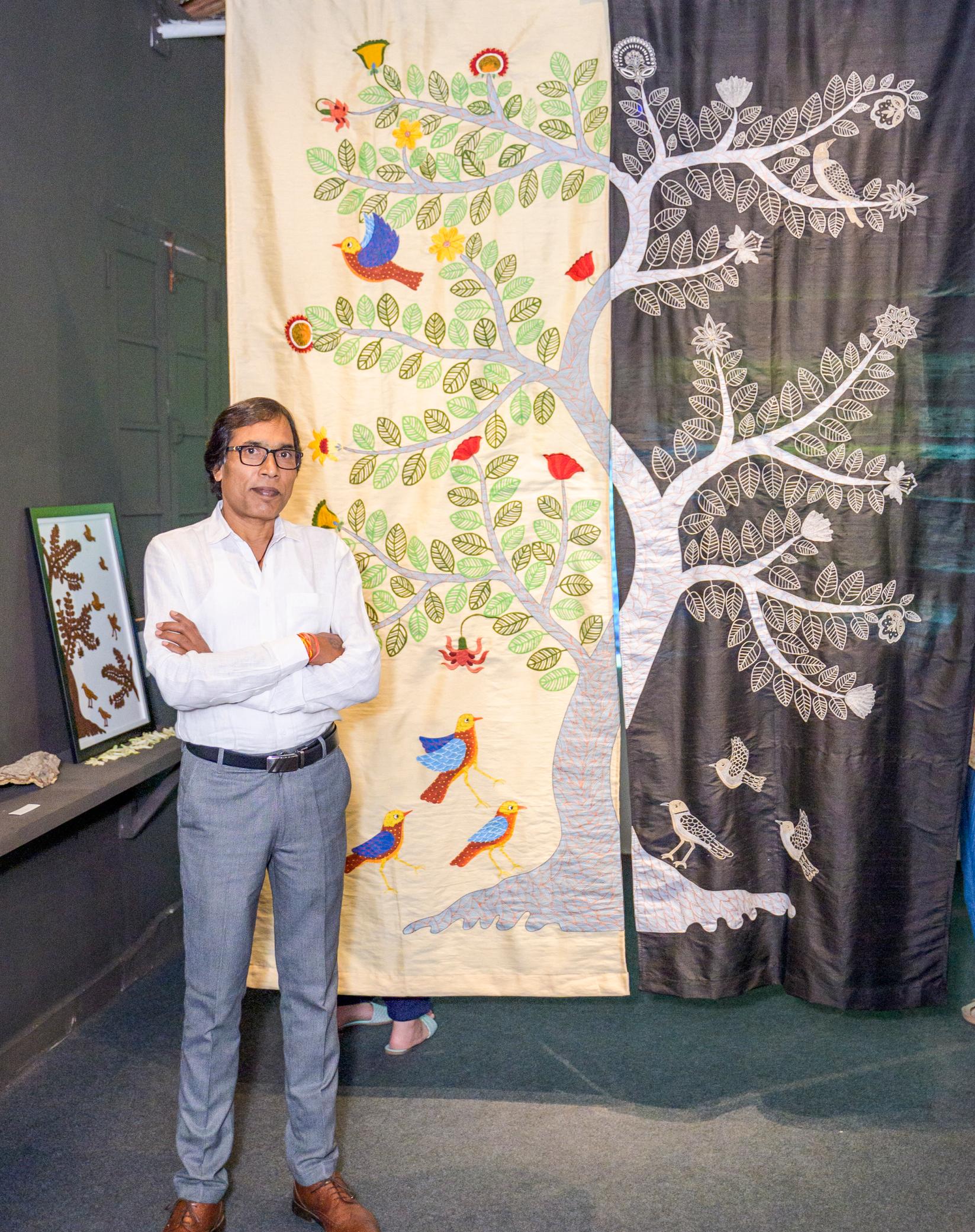
Photo: Gauri Gharpure
In cases of Madhubani or Warli art, we can only know the art, not the artist. But in Gond painting, each artist has their signature style. We can identify the artist through their art, says Padma Shri awardee Bhajju Shyam, whose distinctive motifs have become his signature style.
He depicts leaves, branches bereft of trees and tribal tattoos. He also depicts the dance of men and women holding hands with a repetitive chain-like pattern. Today, even non-tribal people are taking to Gond art, copying designs, printing them on bags, bedsheets and curtains. Only 15 or 16 original artists with distinct signature styles remain, Bhajju notes.
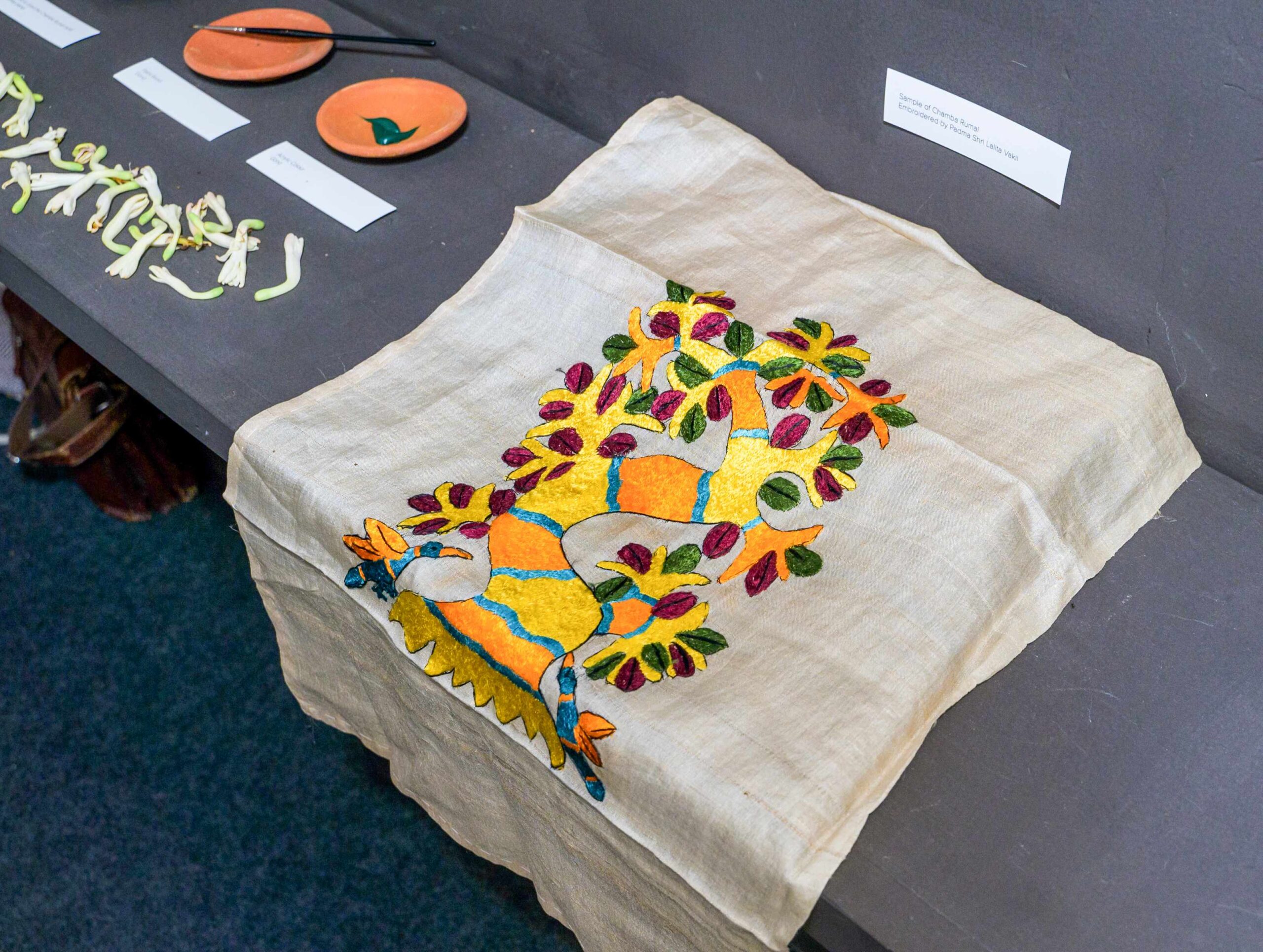
Gond art by Venkat rendered in Chamba Rumal embroidery
by Padma Shri Lalita Vakil for a Bridge Bharat collaboration.
Photo: Gauri Gharpure
When asked about stylistic innovations he has successfully experimented with, Bhajju shares how he mixed black and white painting with colors to create a distinct effect; the resultant exhibition was hugely successful, with many sales. He also uses a combination of brushes and pens. When I was in Paris, I saw artists painting white on white. That seemed very intriguing. When I came back, I tried working with white on white and eventually narrowed it down to a gray-over-white style. The series made this way was displayed in exhibitions in Cochin, Delhi and Mumbai.
Another Gond artist, Gariba Singh Tekam, is known for the big cats that predominate in his work. They are usually depicted with a conspicuous cotton-candy-like mane inspired by a Gond legend. Tekam explains, One story says a spider was asked to weave a web on a lotus leaf to make the first layer of earth. The lions mane is visualized after the spiders web. He also uses swatches of three vertical lines: In tribal culture, God is not worshiped as an ideal but rather as a variety of symbols, such as a flag, a wooden post, a trident and so on. I use the three lines to represent the top of the trident. They can also signify the earth, sky and the netherworld.
During a workshop at the Serendipity Arts Festival in Goa in December 2024, Gond artist Venkat Singh Shyam traced the art forms rich history of cosmic creation, Deities and spiritual symbolism. Though standalone Gond paintings are now popular commercially, they were originally created as thematic series narrating episodes from Gond mythology.
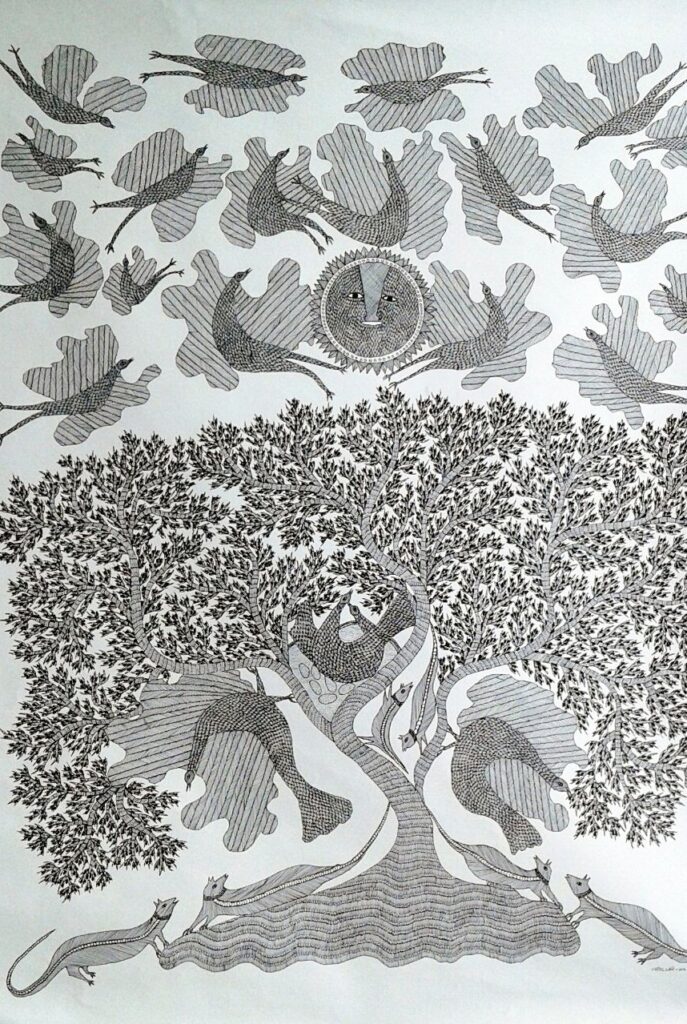
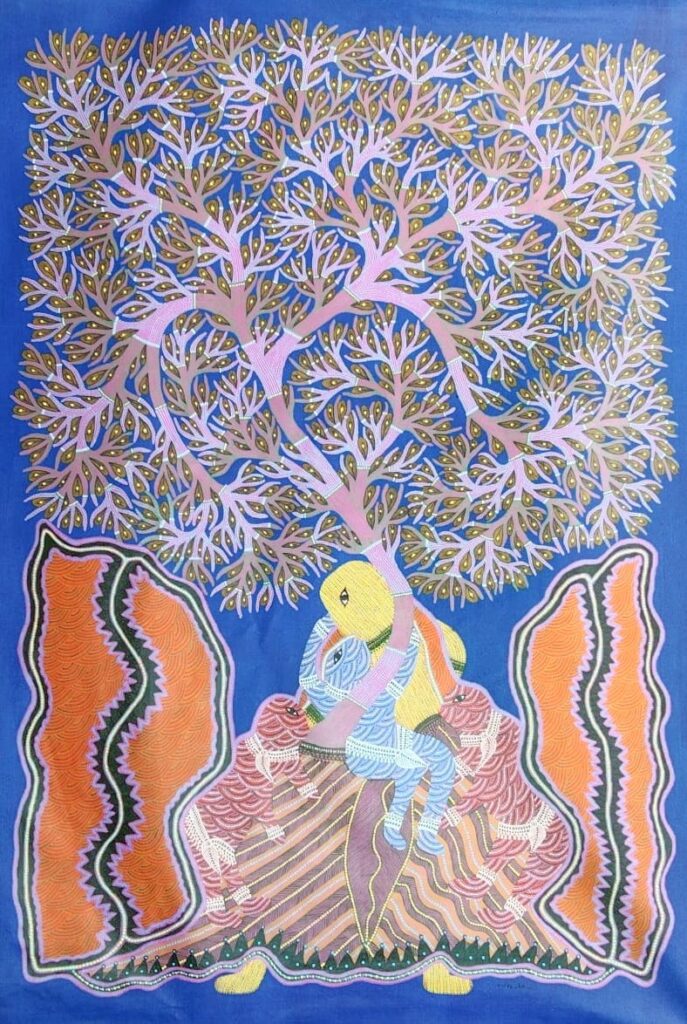
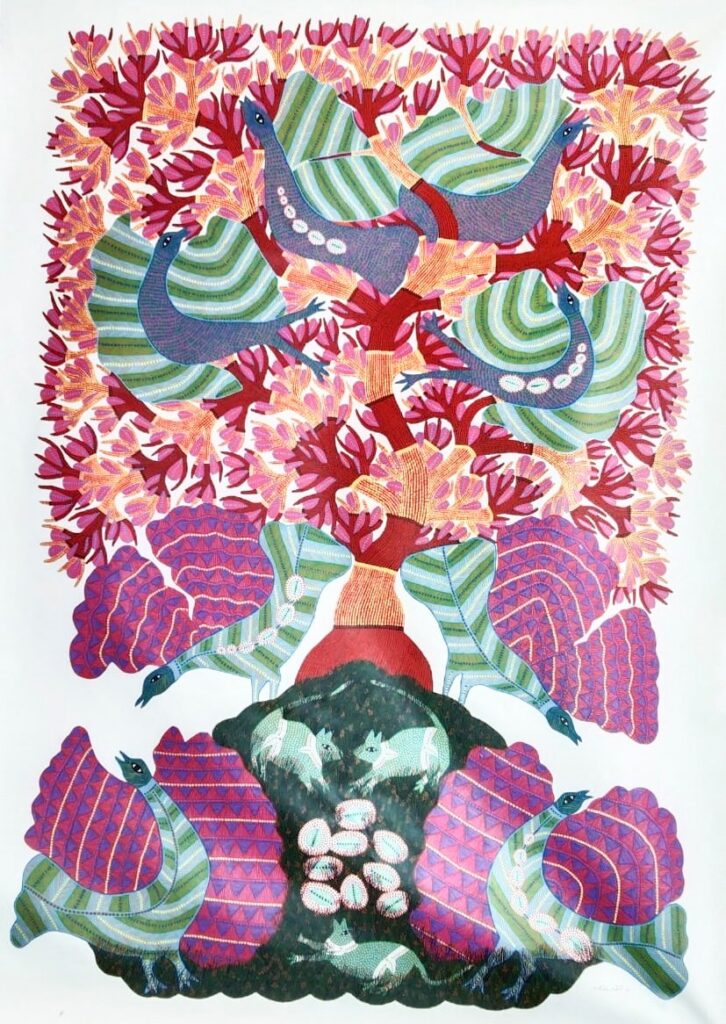
Photo: Courtesy Ram Singh Urveti

The paintings were an avenue to keep the legends of the community alive and revolved around stories of Deities and provided a unique peek into evolutionary tales as passed on by their ancestors. Most of these Deities have local references and do not fully correspond to Hindu Deities, though there are some similarities, Venkat Singh Shyam explains. Without akaar and prakar, that is, without shape and form, these are symbolic representations that one may encounter during a walk through the village or the jungle areas. For example, one may see a trident resting by a tree, a stone or a mud platform—with offerings whose nature indicates the Deity that is being prayed to.
Each Deity has a different offering, be it chicken, goat or boar. Even the color of the animals offered used to be specific to the Deities being placated. For example, a white chicken would be offered to Mahadev, a brown one to Badadev and a black fowl to Kali. Some Deities took the offering of ganja (marijuana) while some were pleased with jaggery and ghee. A particular resin, called raal that is typically used only at the time of cremation, was used for Bhairav puja, he continues.
With such a well-codified form of symbols and colors, Gond paintings almost served as open books for the community to quickly gauge the legends that the artists were portraying.
Pointing to a painting in a book, Venkat recounted a Gond myth that crows were not always black: Mahadev created a white crow from the mud on his body and sent it in search of earth. When the crow rested on a serpents head, the serpent spat venom and turned the crow black. The crow and a giant crab coaxed a pair of earthworms into giving them earth and made five balls. The crow carried one ball of earth in his beak and one in each claw while the crab took the rest in its pincers. While speaking, the crow dropped one ball into a dirty place called melagarh. Mahadev sent a wild boar to retrieve it, then created the nine planets from the five balls. Innumerable such stories are embedded in Gond culture but have increasingly taken a back seat in recent times. The younger generation of painters does not necessarily know the symbolism deeply rooted in Gond culture—and therefore in Gond paintings—rather, they could be called accomplished artists who know well how to play with colors, Venkat observes.
At 16, Venkat Singh Shyam created his first drawing on brown paper, dedicated to the Devi, using his signature dot-and-semicircle motif. The dot, he notes, represents the Paramatman or the Infinite, and the five semicircles represent the five elements. Together they form the community that is the basis of life. Each Gond artist develops a distinctive style. Some use dashes, some use wavy patterns, while some intersperse the canvas with a combination of two or more such forms.
Venkats uncle, Jangarh Singh Shyam, recognized Venkats innate talent and invited his nephew to Bhopal to study painting under him. Jangarh himself had been discovered in the early 1980s through Bharat Bhavan, a multi-arts complex and museum, funded by the government of Madhya Pradesh. There, under the tutelage of the institutions first director, Jagdish Swaminathan, Jangarh developed the distinctive style now known as Jangarh Kalam. As Jangarh exhibited around the world, his success helped bring Gond art into the mainstream and inspired other members of the community to become professional artists.
These careers form a clear lineage. Swaminathan mentored Jangarh, who in turn mentored his nephew Venkat and helped his maternal relative Ram Singh Urveti establish himself in Bhopal. Venkat and Urveti then developed distinct careers of their own.
Urveti began painting alongside Jangarh under Swaminathans mentorship. Urveti reminisces about time spent with Jangarh and about growing up in a poor family, when he took odd jobs ranging from cutting logs in the jungle to steering bullocks in fields. He recalls a time when Swaminathan threw a party and invited Jangarh to sing tribal songs. I will sing, Jangarh said, but who will play the tabla? he asked me. We always complemented each other on the tabla and the harmonium. Everyone started singing and dancing, even Swaminathanji, Urveti recalls.
After Jangarh moved to Bhopal, he helped Urveti find work in the Forest Department. A year later, Jangarh recommended him for work at the Indira Gandhi Rashtriya Manav Sangrahalaya, or National Museum of Humankind. I started by tilling and planting saplings. Now, it has been 32 years that I have been employed at the museum, Urveti says.
Trees remain central to Urvetis work. Speaking by phone from Bhopal, he said, I cannot paint without trees. Something seems incomplete. It is fitting, then, that his contribution to the book The Nightlife of Trees, published by Tara Books, has gained international acclaim. The publishers explained the concept to me over the phone and I identified native trees to depict in the book. I painted a lot; it was great fun, he says of the project, which includes works by Bhajju Shyam and Durga Bai. From stories of jungles, kings and queens, brothers and sisters, I have tried to capture everything I can.
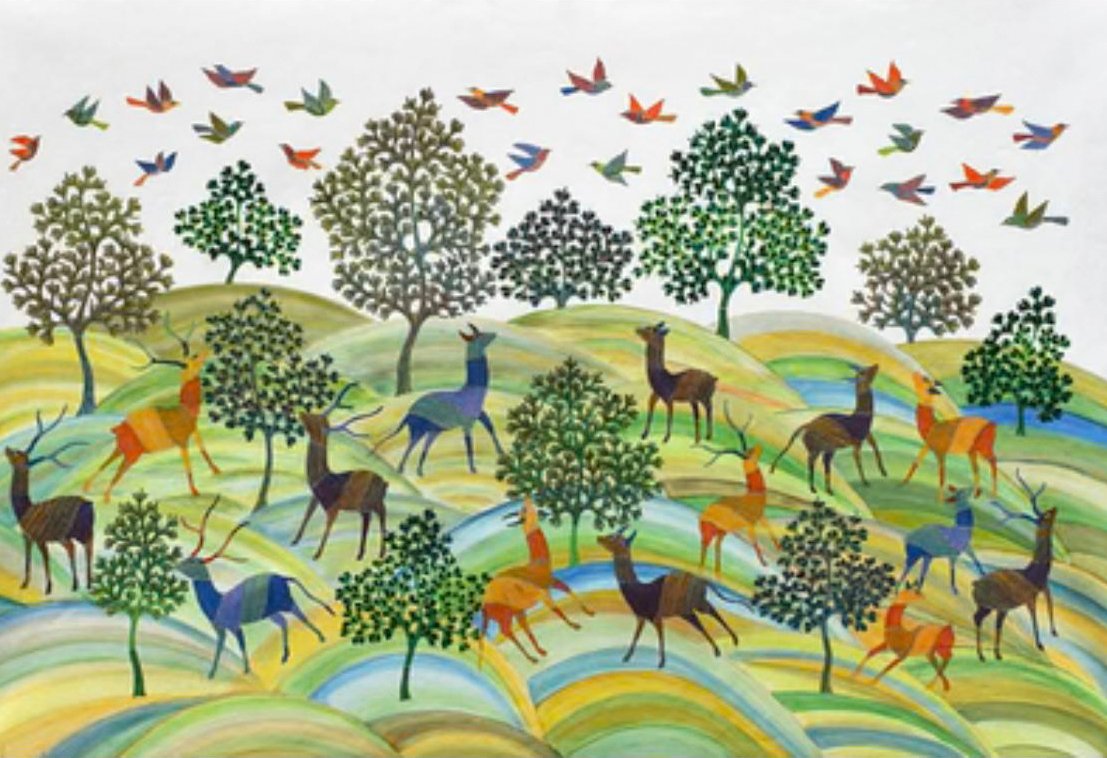
Photo: Gauri Gharpure
Urveti has also created 100 paintings depicting the Gondi Ramayana. The series includes the story of Badadev opening his third eye. (Mahadev is referred to as Badadev in Gond culture.) His signature style for black-and-white work draws on designs of ornaments worn by tribal women. For paintings, he repeats symbols depicting bows and arrows. He notes that many young artists find the style easy to replicate. Some actually are better at it than us! But they dont know the history, they cannot tell one legend from the other. Copywork is not going to last.
Urvetis 2024 exhibition at Delhis Ojas Art Gallery was a major success, and his latest book was launched at the Jaipur Literature Festival. I have made a series of 45 paintings that trace the history and origins of our native place, Patangarh. I was curious how the area became a settlement and why its original name was Patan, not Patangarh. There is information about our community and customs, from birth and marriage to worship and our 17 festivals. I like asking questions. There is so much we dont know. Art comes from there. We try to innovate and go beyond what is seen and what has been done. There is not enough information on the origin of our communities. Even when I see the collections at the museum, I notice many artifacts still dont have names or explanations of their use, Urveti observes.
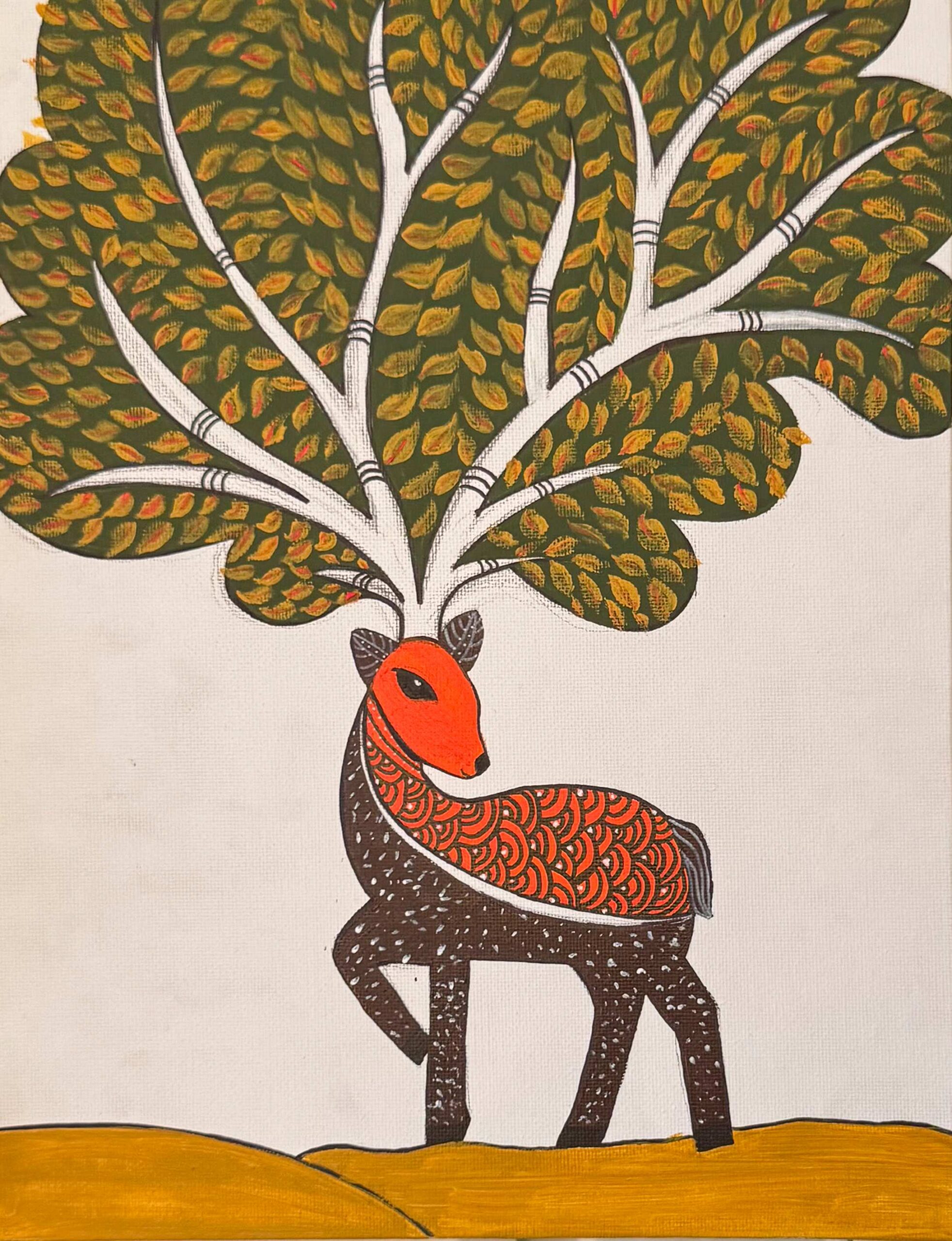
Photo: Gauri Gharpure
After Jangarhs death, Gond painting almost died, Venkat recalls. The circumstances surrounding Jangarhs suicide remain contested: some accounts cite depression, while some artists point to exploitative conditions at the residency.
Venkats own career, however, had begun to recover before his uncles death. After giving up painting, leaving Bhopal and ending up in Delhi, he worked a succession of demanding, low-paying odd jobs. In 1998, Jangarh sent Venkat and Bhajju Shyam to meet Hervé Perdriolle, a French art critic and curator of Outsider Art Gallery. The meeting proved pivotal for Venkat: he began receiving assignments and has not looked back since.
Venkats art has changed through the years. I used to draw a lot of our indigenous Deities initially. But no one would buy those paintings. Perhaps the customers used to think, Why should I put your Deity in my living room? So, I moved to depict the more generic birds and animals that hold no deep symbolism or mythology as such, he explains. The shift is ironic, given how animated Venkat becomes when discussing Gond history and the renewed interest in reviving the Gond script. He stresses, I want the masses to know more about our history beyond our art.
Some may say Gond art has moved from community symbolism toward colors and forms shaped by popular tastes. However, Venkat poses a counter-question: What exactly do you mean by traditional? We live in contemporary times, working on contemporary themes, using modern material: our art cannot be called traditional. Venkat adds an existential dimension to the debate over how fixed notions can impose unrealistic ideals that may be detrimental to the art and the artist. For example, visual storytelling of tribal legends, while upholding traditions, may unwittingly create a disconnect with a largely modern audience. Depicting flora and fauna with refined techniques and incorporating elements of modern urban life, on the other hand, can bridge that gap and broaden the art forms appeal. Venkat wants the Gond legends to survive in the community and perhaps reach a larger modern audience. However, at this time it appears that restricting Gond art to traditional subjects may hinder the art forms continued growth.
Venkat Singh Shyams visual memoir Finding My Way features 170 paintings. His 16-painting series on the 2008 Mumbai terror attacks reflects his own experience of surviving the tragedy. He has been commissioned to create a series of paintings for a museum in Mumbai. The works address the dislocation of indigenous people due to mining and dam projects and explore how forced migration creates urban conflict and ecological upheaval. Imagine there is a sudden shift. You no longer have the fruit trees or the land where you practiced agriculture. It takes immense time to establish a new ecosystem. I want to bring attention to this ongoing problem, Venkat says. He also illustrates childrens books and teaches online. Gond arts contemporary success has brought artists opportunities for travel, exhibitions, talks and workshops. More than financial stability, I would say the benefits have been immense in terms of the exposure we have gained, which has broadened our worldview, Venkat reflects.
About The Author

Gauri Gharpure studied journalism at Columbia University on a Fulbright grant. She has published two poetry collections and is working on her third book. Contact: gauri.gharpure@gmail.com
Comments (3)
Dear Gauri, such a wonderful article explaining the history and cultural significance behind the art form. A thoroughly researched and thoughtfully represented writeup.
Beautifully captured the art and beliefs of the Gond community and how painting is used as an expression of the same. Gives an insight into something which we, in cities, don’t get a chance to know.
Gouri Dear,
So beautifully written and so revealing. Your write up is without a single bump. I wish, I could write like you do.