
Quotes & Quips
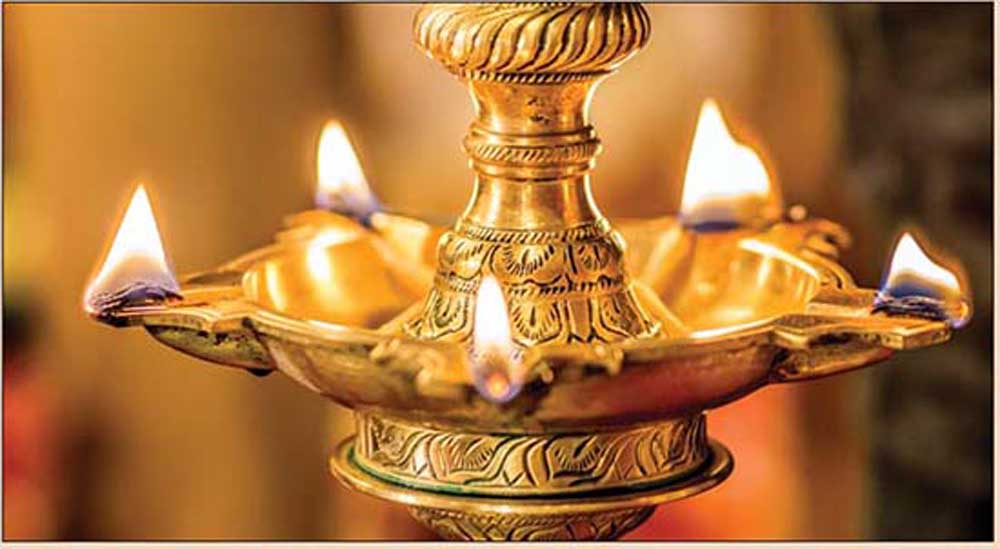

One of them doomscrolls. The other looks on without scrolling.”
Mundaka Upanishad 3.1.1
The suffering that ignorant men inflict upon themselves
can hardly be contrived by their enemies.Tirukural, 843
The season of failure is the best time for sowing the seeds of success.
Paramahansa Yogananda (1893-1952)
When all the desires that cling to the heart are loosened, the mortal becomes immortal.
Katha Upanishad 2.3.14
The winds of grace are always blowing, but it is you who must raise your sails.
Sri Ramakrishna (1836–1886)
Spirituality is neither the privilege of the poor nor the luxury of the rich. It is the choice of the wise man.
Swami Chinmayananda (1916-1993)
What are you going to do with the money you accumulate? Can you increase your lifespan even for a day? Give generously when you can.
Satguru Siva Yogaswami (1872-1964), renowned Sri Lankan guru
Association with sages should be made because thoughts are so persistent. The sage has already overcome the mind and remains in peace. Being in his proximity helps to bring about this condition in others; otherwise there is no meaning in seeking his company. The guru provides the needed strength for this, unseen by others.
Ramana Maharshi (1879-1950)
Every beauty seen here on Earth resembles, more than anything else, the merciful fount from which we all exist.
Michelangelo (1475-1564)
All things are our relatives; what we do to everything, we do to ourselves. All is really one.
Black Elk (1863-1950), medicine man of the Oglala Lakota tribe
Be humble, for you are made of the earth; be noble, for you are made of the stars.
A Serbian saying
Living begins when one contributes something that will bring about more happiness, more wisdom and more freedom. Until then, one merely drags one’s life.
Swami Dayananda Saraswati (1930-2015)
If you want peace of mind, do not find fault with others.
Sarada Devi (1853-1920)
If you hate a person, you hate something in him that is part of yourself. What isn’t part of ourselves doesn’t disturb us.
Hermann Hesse (1877-1962), German novelist
If you use your mind to study reality, you won’t understand either your mind or reality. If you study reality without using your mind, you’ll understand both.
Bodhidharma, fifth-century Buddhist monk
All knowledge that the world has ever received comes from the mind. The infinite library of the universe is in our own mind.
Swami Vivekananda (1863-1902)
Who loves and who suffers? He alone stages the play, and He alone beholds it.
Anandamayi Ma (1896-1982)
The timeless in you is aware of life’s timelessness and knows that yesterday is but today’s memory and tomorrow is today’s dream.
Kahlil Gibran (1883-1931), Lebanese-American writer, poet and artist
You are already the Self, you are just not aware of it. Do not put it off based upon some concept that we are not ready, we are not worthy, we need more of this or that. None of those principles apply when it comes to Self Realization.
Satguru Bodhinatha Veylanswami, publisher of Hinduism Today
Maya is the classroom, karma the teacher and anava the student’s ignorance.
Satguru Sivaya Subramuniyaswami (1927-2001), founder of Hinduism Today
Did you know?
An Early Theory of Atoms

Around 2,500 years ago, a thinker in India argued that all matter is built from eternal, indivisible particles. His name was Kanada, and the Hindu darshana (school) he founded is called Vaisheshika.
The name itself hints at the project. Vaisheshika comes from vishesha, meaning “particularity,” and the school’s ambition was to catalog reality by sorting everything that exists into a few basic kinds: the stuff the world is made of, the qualities that stuff has (like color or weight), the motions it undergoes and the relationships that bind it all together. Kanada’s master list of “stuffs” includes nine categories, from earth and water to space, time and the soul. Four of them—earth, water, fire and air—he argued are not continuous but made of atoms.
Kanada’s word for the atom is anu; the fuller term paramanu (from parama, ultimate, and anu, minute) is the term his commentators would later make well known. His proof is pure logic: if matter could be divided forever, a mustard seed and a mountain would each contain infinitely many parts—and so be equal in size, which is absurd. Division must stop at something indivisible. As Sutra 4.1.1 puts it: sad akaranavat nityam, “that which is existent and uncaused is eternal.” In this ancient framework, the atom has no cause and no parts; it simply is.
Kanada allowed that atoms combine, but it was later thinkers—above all Prashastapada (~500 ce)—who envisioned how that might be. Two atoms combine into a dyad (dvyanuka), and three dyads into a triad (tryanuka), also called trasarenu, literally the “moving mote” you see dancing in a shaft of sunlight. In the developed theory, only at the triad does matter become large enough to see. Its minimal, roughly spherical form—parimandala—is itself eternal, a point Kanada states in his own works.
None of this was physics for its own sake: the Vaisheshika Sutra opens by declaring that its aim is dharma and that liberation follows from correctly knowing these categories. Vaisheshika and the logic-focused Nyaya school were two of the six orthodox systems of Hindu philosophy and over time fused into a single tradition.
Of course, the parallels to modern science shouldn’t be overstated. Kanada reached his atoms through reason and insight, not experiment. He embedded them in a holistic overview of the evolution of the human soul, not modern chemistry or physics. But the core intuition—that the solid, continuous world is really a lattice of invisible, indivisible units combining by fixed rules—is one of the most remarkable feats of reasoning in the ancient world, an idea European chemists wouldn’t confirm for another 2,000 years.

Leave a Comment