
Sacred Shrine, Heartbeat of the Home
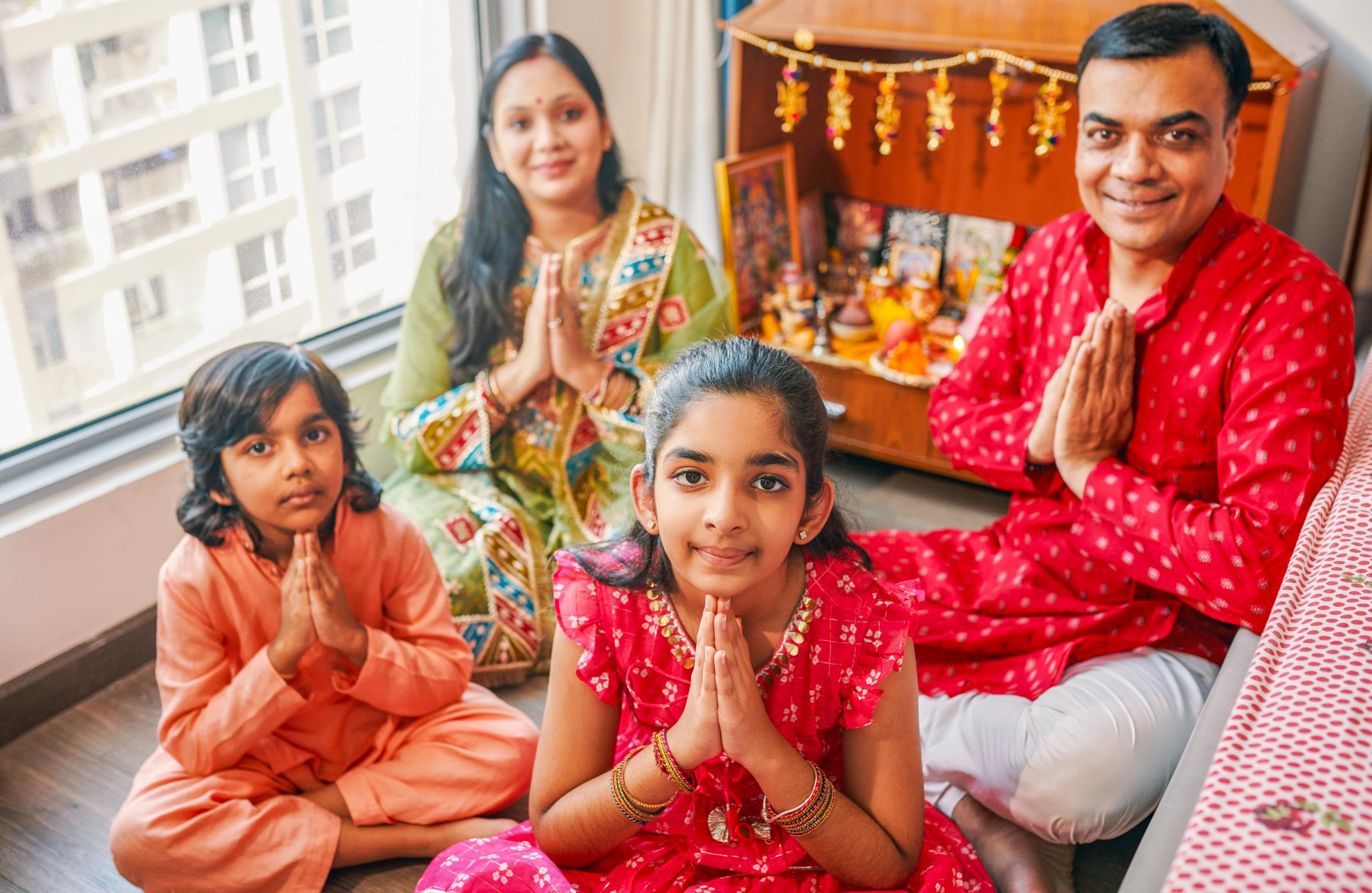
For many practicing Hindus living outside India, stepping across the threshold of their suburban home or city apartment means stepping between two worlds. Outside, modern Western life—with its long commutes, corporate deadlines and the bustle of day-to-day errands—dominates. Inside, however, a small, vibrant and deeply sacred space serves as the household’s spiritual anchor: the home shrine, or mandir.
In this feature article, the author brings both scholarly depth and a devotional understanding of the home shrine’s power—offering devout Hindus guidance they can put to immediate use in their own worship.
By Aarti Patel, Pennsylvania
While public hindu temples have garnered attention with growth in size, number and architectural grandeur across the global diaspora over the last 50 years, Hindu daily devotion has been offered within devotees’ homes for millennia. Domestic sanctuaries, or home shrines, represent spiritual anchoring and cultural continuity. Home shrines are living, breathing epicenters of spiritual energy.
To understand the centrality of the home shrine to a practicing Hindu’s religious life, one must consider both its physical components and the theological foundations that give it meaning, because in Hindu practice, the two are inseparable. The Agamas (a corpus of sacred texts encompassing theology, temple architecture, iconography and ritual practice) categorize ritual worship into two distinct forms: parartha puja and atmartha puja. The two are distinguished by who performs the worship and for whose benefit, not where it takes place. Parartha puja—literally “worship for the sake of others”—is performed by a qualified, Agamically trained priest or pujari on behalf of another person or the broader community. It takes three forms: nitya (daily), naimittika (occasional, for special causes) and kamya (commissioned by a patron for a specified desired outcome). The daily temple arati, for instance, is simultaneously atmartha and parartha: the qualified pujari performs it for his own spiritual self (atmartha) as well as for the benefit of all beings and the congregation (parartha).
A special abhisheka commissioned by a devotee for a specific request, by contrast, is kamya parartha puja alone—the pujari acts purely as an intermediary for the patron’s sankalpa (stated intention). Parartha puja is not restricted to temples: when a pujari visits a home to conduct a mahapuja, vastu puja or grihapravesh ceremony, he is performing parartha puja within the domestic space.
Atmartha puja—“worship for the sake of oneself”—is puja performed by an individual for their own spiritual protection, growth and liberation. It is most naturally expressed in the home shrine and is available to any initiated practitioner, priest or householder.
Practitioners describe how, over years of sustained daily worship, the home undergoes a transformation. The murti (sacred image), a form of God enshrined within the home, to whom family members offer devotion through various practices—arati (the waving of lighted wicks before the murtis), thal (the offering of food) and the singing of devotional hymns—creates an atmosphere of sanctity. The peace-giving presence of God and the joint performance of these acts shape how family members relate with one another and extend patience and forgiveness in moments of strain.
When a family moves into a home, whether for the long or short term, they consecrate a dedicated space for devotion and invite God to reside there permanently. Before the rite of murti pratistha, the carved stone or cast image is a reverently crafted object, shaped in anticipation of the divine form it is to become. Through the murti pratistha ceremony, God manifests in that form—and from that moment, the murti is genuinely a form of God, just as the avatara is a form of God. Just as one does not say that Krishna’s form was a shell containing a separate divine presence, one does not separate the murti from the God who has manifested within it. It is this living divine form that the devotee approaches, serves and relates to as a present and beloved member of the household.
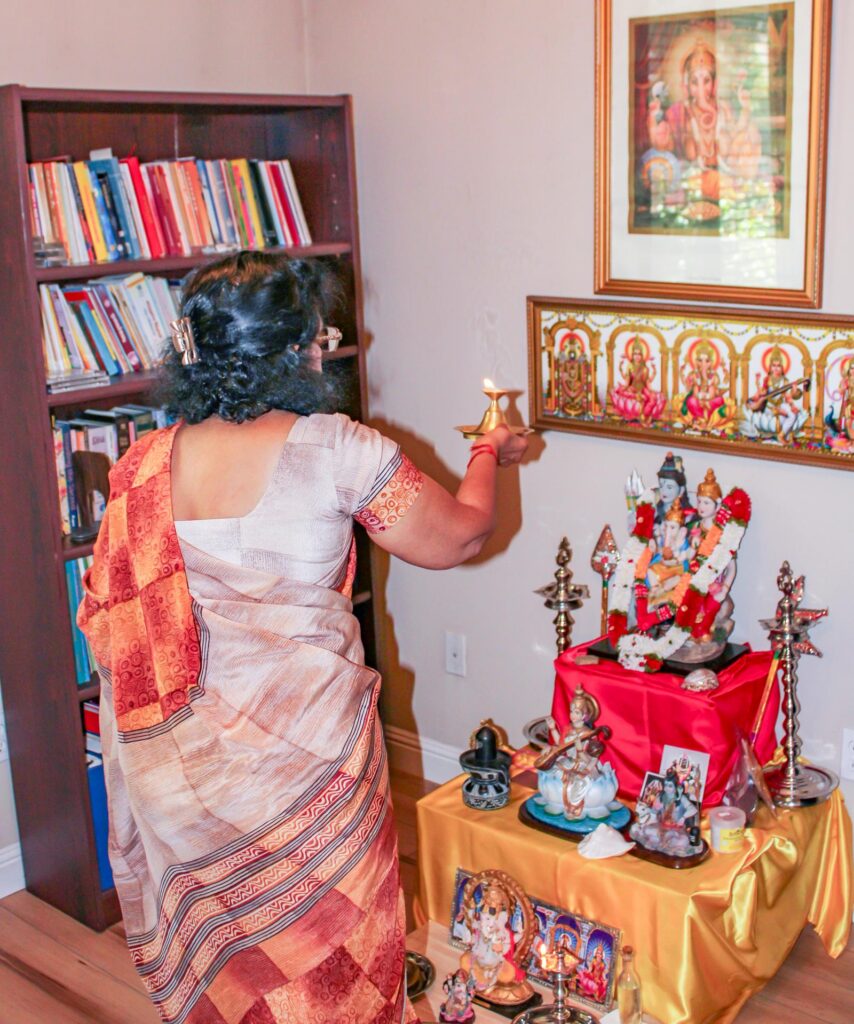
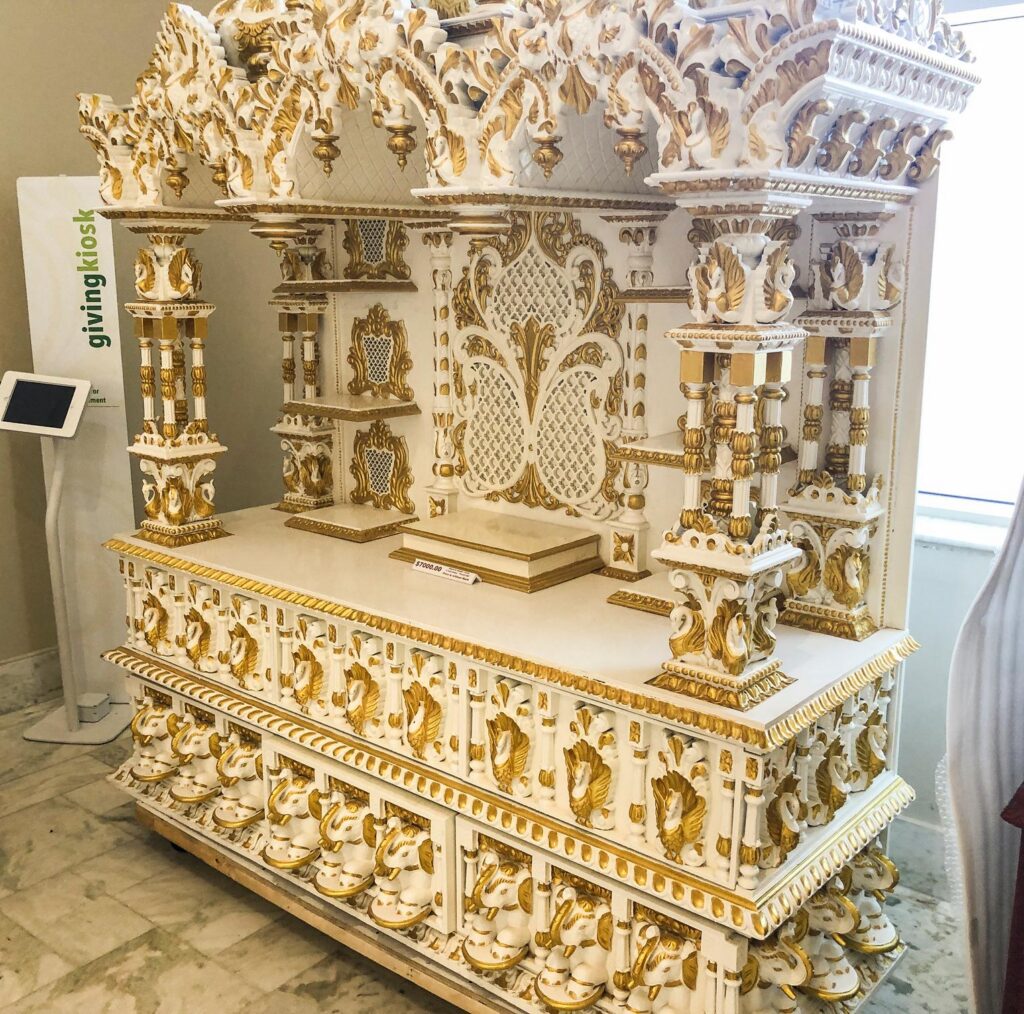
All home shrines share similar features, such as wood carving or metal engraving, but each shrine is individualized depending on tastes and tradition, including the size and specificities of murtis, fresh or synthetic flower garlands, additional lighting or handmade or purchased coverings.
Bringing the Murtis to Life
While the consecration ceremonies in public mandirs can last several days and involve many specialized priests or swamis, a home shrine requires its own deeply intimate process of consecration. A beautifully carved piece or printed imagepurchased from a boutique, ordered online or shipped across the ocean from India becomes a murti, a form of God, when the devotee performs a localized ritual of consecration.
The process begins with panchamrita snana—ritual bathing of the murti in a mixture of milk, honey, yogurt, ghee and water, tending to the Deity with the same devotion one would offer a distinguished guest. Each substance is chosen for its sacred character.
Following this process comes the act of avahana (invocation). Using specific bija (seed) mantras and prayers, the family requests the Deity to descend and take up residence within the physical form. God’s manifestation in the murti is an act of divine grace that the household receives with reverence and joy. The offering of arati at the conclusion of the ceremony, is the devotee’s initial act of worship before God now present. From this moment, the murti is a living, beloved form of God in the home, receiving daily care, attention and devotion.
Vastu Shastra for Modern Spaces
Maintaining a traditional home shrine within the constraints of modern domestic architecture—whether in a suburban house, a city apartment or a high-rise flat—is aided by understanding the principles of Vastu Shastra (the science of architecture) and employing a degree of creative adaptation.
Vastu Shastra understands the cosmos as a web of energetic currents, and how we orient our living spaces determines our alignment with these currents. In widely observed Vastu conventions, the northeast quadrant of the home—the Isana corner—is considered particularly auspicious for a home shrine, as it draws on the stabilizing energies of the North and the illuminating energies of the East. That said, Vastu prescriptions are not uniform across all schools, and specific guidance may vary depending on the Deity being enshrined, the orientation of the home and the devotional tradition of the family. Families are best served by consulting classical Vastu principles and the specific conventions of their own sampradaya (spiritual lineage) when determining placement.
This is where adaptation and creativity become necessary. Homes of modern architecture are rarely built with the Vastu Shastra in mind. A devout Hindu family moving into a suburban home in Maryland, an apartment in London, a flat in Singapore or a townhouse in Toronto must engage in spiritual problem-solving.
One of the most ambitious adaptations is the conversion of a family room, a walk-in closet or a flex-room into a dedicated temple room—apart from the high-traffic areas of the house, offering a level of quiet privacy.
In smaller spaces, like apartments or town homes, families often create a sacred space in an office, living room or kitchen by installing a free-standing cabinet—wooden or marble, ornate or simple. Doors are closed during non-worship hours to protect the sanctity of the interior space.
Vastu specifies other considerations to keep in mind. A shrine should never share a wall with a bathroom, be placed directly under a staircase (where heavy foot traffic constantly passes overhead) or be located inside a master bedroom. If a bedroom is the only option—as is often the case for college students or young professionals in smaller or shared living spaces—the shrine should be shielded by a curtain or closed cabinet doors, demarcating the boundaries of the sacred area.
While synthetic materials are more readily available in modern furniture, natural materials like teak wood, rosewood or marble are most fitting for sacred use and offer continuity with the craft traditions in which shrines have long been made.
Engaging Cosmic Elements
A Hindu home shrine is designed to be a microcosm of the universe. At the heart of its ritual structure are the pancha bhutas, the five elements—space, air, fire, water and earth—that constitute all of creation. Their presence in the puja carries a profound theological logic: since all of creation proceeds from God and is sustained by God, the offering of all five elements is the devotee’s gesture of returning the entire cosmos to its source—an act of surrender, gratitude and recognition of God’s sovereign presence in all that exists. The puja also draws on the sense corresponding to each—sound, touch, sight, taste and smell—so that the devotee is drawn into the presence of the Divine not merely intellectually, but with their whole person.
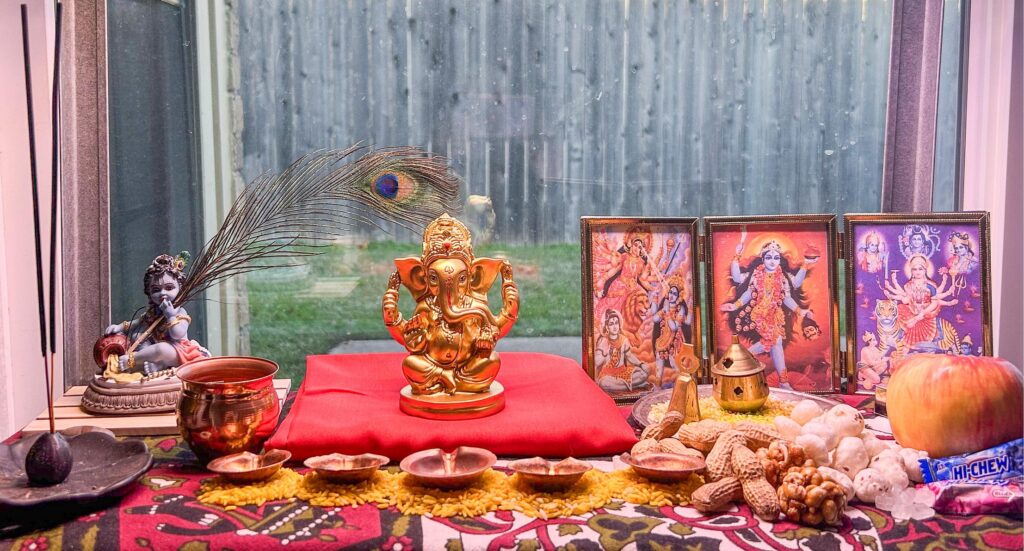
The arrangement of the shrine itself follows a sacred order. At the center sits the family’s Ishta Devata, the form of the Divine to whom they feel the closest personal affinity—such as Krishna, Durga Ma, Shiva, Bhagwan Swaminarayan or Rama. Around the Ishta Devata are often placed other Deities: the Kula Devata (the ancestral family Deity), Ganesha, the Lord of Beginnings and Remover of Obstacles; and, in many traditions, the guru.
When a devotee steps before their home shrine to perform puja, they use sacred implements to invoke the five elements in a systematic choreography of bhakti.
Akasha (Space): The element space is invoked by the ringing of the brass ghanta (bell) or the blowing of a conch shell. The crisp, metallic strike of the ghanta shatters wandering thoughts, focusing the mind on the present moment.
Vayu (Air): The element air is engaged through the burning of dhupa (incense), whose smoke carries resin fragrance into every corner and lends a lingering perfume for the devotional ritual.
Agni (Fire): The element fire is manifested by lighting and waving a lamp (diya) of oil or camphor during the arati. In Vedic tradition, fire is the great purifier and the messenger who carries offerings between the human and the Divine. The upward-reaching flame symbolizes the soul’s yearning for liberation, while its luminance represents the destruction of avidya (ignorance) by the light of divine wisdom.
Apas/Jal (Water): Pure water is presented in a panchapatra (copper or brass cup), using a small spoon called an achamani. Water, symbolizing cleansing and receptivity, is offered to the Deities for drinking and washing, mirroring the hospitality extended to honored guests.
Prithvi (Earth): The solid material world is represented by the physical offerings placed at the feet of the Deities: fresh, fragrant flowers, chandan (pure sandalwood paste), kumkum (vermilion powder) and naivedyam, such as fruits, nuts and freshly cooked food.
Multi-Generational Anchors
In a bustling suburb of St. Louis, Missouri, USA, three generations make up the Shah household. Their home could not accommodate an independent room for their shrine, but they chose to turn their family room into a shared space. The family—grandmother, parents and two children—gather daily, perform arati and afterward sing bhajans (devotional hymns) or listen to the grandmother read verses from the Bhagavad Gita. Although the family visits the local mandir weekly, their home shrine remains the steady center of their daily sadhana.
College Student Adaptations
For first-year college student Shakti, living in a campus dorm meant adapting her shrine to her single room and following a “no open flame” safety rule. She allocated a space on her bookshelf for her murtis which she could cover with fabric at night. In place of incense, she purchased an oil diffuser, and in place of the diya she used battery-operated tealight candles. In her off-campus apartment in her second year, Shakti set up a more complete worship arrangement.
The constraints of her circumstances had been real, but she did not abandon her daily sadhana. She recalled the verse from the Bhagavad Gita (9.26) in which Lord Krishna speaks of accepting even a leaf, a flower or water when offered with love—understanding it not as a license to replace prescribed forms at will, but as an assurance that sincere devotion, sustained even under genuine constraint, is received by God. Her experience pointed to a principle the tradition holds dear: that form and intention together constitute proper worship, and that when circumstances temporarily limit the form, the orientation of the heart keeps the devotee connected—while the aspiration to restore proper practice remains. Shakti’s story reflects what countless Hindu families in the diaspora know from experience: that the desire to maintain one’s connection with God, however imperfect the conditions, is itself an expression of bhakti.
Bringing the Temple Home
Increasingly, Hindu families in the diaspora draw on the presence of traditional mandirs to enrich their devotional life at home. For example, a visit to the Sri Venkateshwara Temple in Pittsburgh, PA, the Swaminarayan Akshardham in Robbinsville, NJ, or the Shri Sanatan Hindu Mandir in Wembley may serve as a pilgrimage rather than simply a brief excursion.
When families bring home prasadam (food that has been offered to the Deity) from the temple and share it among themselves, the devotional power of the temple finds its continuation in the household.
The home shrine stands at the center of that daily rhythm—not as a beautiful object to be admired from a distance or a symbol of heritage displayed for others, but as a living presence that draws the household back each day into relationship with God. How deeply the shrine takes root in a family’s life is shaped by how faithfully and lovingly it is approached.
Inner and Outer Worship
Morning worship follows a recognizable pattern with certain foundational elements, while additional rituals are performed on certain occasions:
Snanam (Ablutions): The devotee bathes and dresses in fresh, clean clothes before entering the shrine space.
Shuddhi (Cleansing): Offerings from the previous day are removed—flowers, burnt incense ash, etc. The murtis are wiped clean or ritually bathed with water, milk or rosewater, selected for their purifying and nourishing properties.
Naivedyam (Food Offering): Fresh water, fruits, nuts or other foods are offered to the murtis.
Chanting and Japa: Sitting facing north (associated with the abode of the Divine) or east (associated with the source of light and creation), devotees recite Vedic hymns and other holy stanzas, or perform silent japa, using a strand of holy rudraksha, tulsi or sandalwood beads.
Arati: A lit diya is waved before the murtis, accompanied by the singing of hymns praising God’s glory.
Pradakshina: The devotee circumambulates the murtis, understanding the Divine as indwelling within the self, and as the center around which their life is ordered.
Pranam: The devotee prostrates before the murtis—the body itself becoming an offering, the whole self laid before God.
In performing these steps—pouring the water, lighting the lamp, placing flowers at the feet of God—the devotee is not simply going through motions. Each physical act is an expression of love, through which the ordinary objects of the world—water, flame, flower, food—become transparent to the Divine presence that pervades them. The hands that offer are the same hands that will go out into the world; the vision cultivated before the shrine quietly reshapes how everything else is seen.
These actions also serve as the foundation for manasi puja (mental worship). With sustained daily practice, a devotee can close their eyes in any environment—a busy office, college campus, train or hotel room—to visualize their home shrine with clarity and perform the entire ritual and offer bhakti within the sanctuary of their own mind. The physical home shrine, therefore, serves as the tangible ground from which an interior devotional life takes shape. It shows the outer ritual to be itself devotional, and at the same time a means by which an inner practice is formed and sustained.
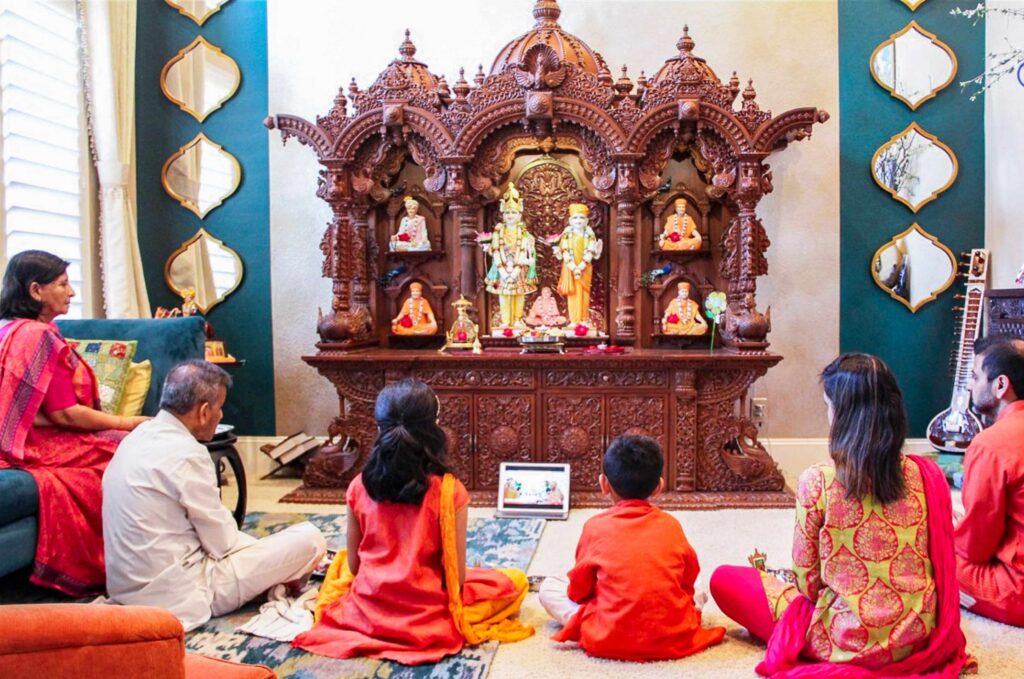
An Anchor of Continuity
To understand the role of the home shrine within the modern global diaspora, it is helpful to view it through the lens of historical adaptation. In addition to its role in cultivating a devotional disposition, the household shrine has historically served as a primary anchor for religious continuity during periods when public temple networks were unavailable, inaccessible or disrupted.
A powerful example of this resilience can be found in the indentured labor migrations of mid-19th to early-20th century. When hundreds of thousands of Hindus were transported under indenture contracts from India to faraway regions like Fiji, South Africa, Guyana, Trinidad and Mauritius, they arrived in regions without established traditional temple infrastructure. In these unfamiliar environments, public worship was not an immediate option.
During these transitional decades, worship in the home shrine was among the practices that maintained the thread of cultural and spiritual identity. In the quiet of their living spaces, individuals, and eventually their families, dedicated corners or spaces for prayer. They lit simple lamps and recited verses from memory.
This capacity to sustain devotional life across displacement and disruption is among the oldest and most tested qualities of Hindu practice. Whether in the face of the profound uprooting that brought earlier generations to unfamiliar shores or the quieter but persistent pressures of modern secular life, the home shrine has remained steady as the intimate, daily place where faith is not proclaimed but simply lived, carried forward from one generation to the next.
Conclusion
A house, however grand or lovingly built, is fundamentally a structure of walls and rooms. But when it contains a consecrated ghar mandir—daily approached, daily worshiped, daily loved—something more than architecture is present. The home becomes a devalaya: an abode of God—not by virtue of its beauty or scale, but because of the divine presence that has taken up residence within it and the devotion that greets that presence each morning.
In a world that pulls insistently toward external achievement and relentless activity, the home shrine speaks a different language entirely—one of stillness, gratitude and quiet certainty that the purpose of human life runs deeper than accumulation or recognition. It does not compete with the community mandir, nor with festivals or the study of scripture—it is the intimate daily ground from which the whole of devotional life grows.
As Hindu communities continue to take root and flourish across the world, the home shrine remains one of the most enduring expressions of that vitality—the place where the tradition is not merely preserved but lived, loved and passed forward.
For children growing up in the diaspora, it is among their deepest inheritances—not consciously claimed so much as quietly absorbed through years of mornings spent in its presence. Long after the lessons of school have faded and the passing trends of popular culture have been forgotten, they will remember the warm, golden glow of the morning diya, the sweet fragrance of incense drifting down the hallway, and the steady, reassuring sound of their parents’ voices raised in the prayers and hymns of the tradition.
Hindus Reflect on Their Home Shrines
Did your parents or grandparents have a shrine? What are your earliest memories of that shrine and its place in their lives?

Rajeshwari Parasivam: Growing up, my mum was a Buddhist (I converted to Hinduism in adulthood), so we had a shrine in a quiet corner of the living room. She spent a lot of time in front of a big fat Buddha. As children, it seemed that food was always coming to the house, and it would be presented to the Buddha. We would also pray to our ancestors. Those practices were part of our life at the shrine, and everybody was participating. But there was no meditation, nothing like that. It was just praying, offering, asking to be blessed, and being with our ancestors.
Sullochina Lulla: My father was a very devout Hindu. He was a Siva follower. He fasted on Mondays for most of his life. In India, we were in a very small house with two or three rooms, so we couldn’t designate a whole room for puja. But one side of the bedroom was kept as a puja place. We had a little wooden cabinet with pictures of Lord Siva and other Deities, but the Siva Lingam was especially important to my father. Every Monday after his bath, he would bathe the Siva Lingam and offer some flowers, whatever he could afford, and do puja, although we were not brahmins or from a traditionally Saivite family. In India, in those days, there was a lot of casteism. We were working-class people, but somehow, my father had become a Siva follower.
Describe your home shrine space. Does the entire family worship together?

Thushyanthan Amirthalingam: When we owned a house, the shrine had a dedicated room. Now that we’ve moved and space is really tight, it is part of a larger living area. However, the shrine itself sits behind intricately carved doors in the living area. Before we had kids, my wife and I would worship together, but now with the kids, it’s kind of hard, because of their schedules and such. But we do introduce them to worship occasionally.
Kumar Sivakumaran: The shrine in our house is a fully dedicated room. We have a raised platform for our Deities: a Siva Lingam, Lord Siva, Lord Ganesha, Lord Murugan, Saraswati and Lakshmi. My children are grown up and they’re not with us. My wife and I sometimes pray together and sometimes on our own.
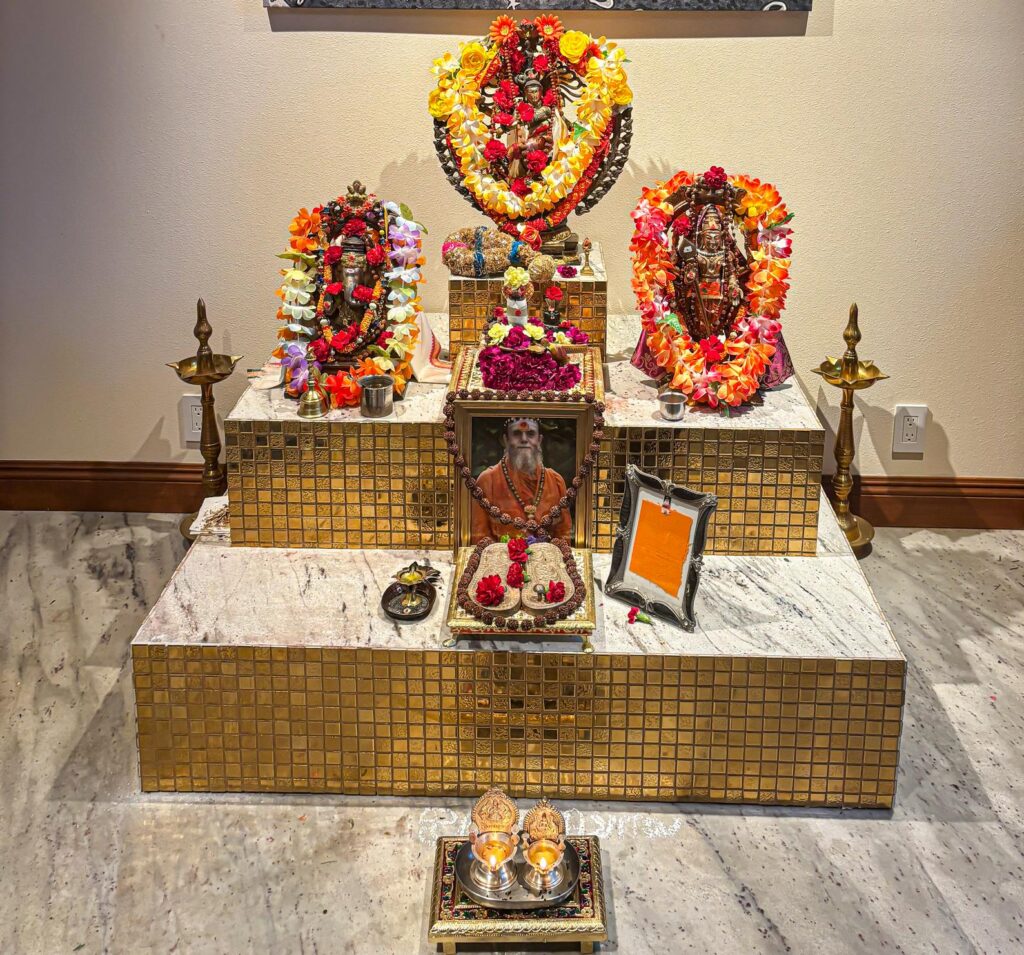
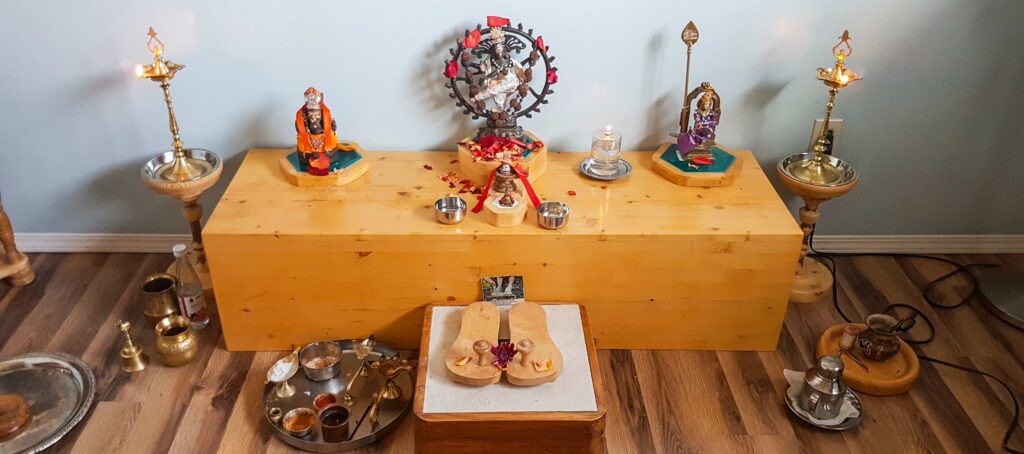
Anonymous: Our home shrine is a fully dedicated room. Deities on the main altar include Lord Ganesha, Lord Murugan and Lord Siva arranged in a traditional manner. Additionally, our Satguru’s picture and padukas are located on the main altar. The altar is illuminated with oil lamps and is often adorned with freshly picked flowers. Our family typically prefers to worship individually in the room; however, the entire family worships together on special occasions, such as Ganesh Chaturthi.
What activities do you perform at the shrine?
Kumar Sivakumaran: We use it for daily worship, especially in the morning, as soon as we get up and also in the evening. In the mornings, it’s usually between 7 and 8am, and in the evening between 6 and 7:30pm. We do a regular, simple puja in the shrine. Basically, I sit, meditate, chant hymns, light a dipam, show the lamp to the Deity, and after that I apply vibhuti.
Rajeshwari Parasivam: Every morning I do my sadhana, and it feels very peaceful, so I go there and spend time and relax. I even do my hatha yoga there. I read sacred texts. I do puja every day, though I sometimes skip on weekends, following a format I found online.
Sullochina Lulla: I use it for daily worship. I do my meditation in that room, and my prayers—also the evening arati. Even if I don’t have time for my full worship, like when I’m traveling, I make sure that I first go to the shrine and get blessings, even if my flight is at 5am.
Any restrictions for the shrine, such as no shoes?
Kumar Sivakumaran: We don’t even use shoes inside the house, so there’s no way anyone can walk into the shrine room with shoes on.
Thushyanthan Amirthalingam: Because the shrine is part of our living space, we use a small floor mat to mark its boundary. Even though the kids run around in the area, my wife and I remain conscious of it, as though the shrine were protected by an invisible barrier. We stop and think, “Oh, we have our shoes on. We can’t walk into that space.”
Have you adjusted your worship over the years?
Ravi Nadesan: Very little. I’ve refined, if you will, the actual puja that I do: the arati, the affirmations and the prayers that I say on a daily basis to the point that it’s almost automatic.
Thushyanthan Amirthalingam: Within the last five years, we moved to two different places. So, previously, we had the shrine in my office, then a puja room. Next we moved to a different space where keeping the proper north- or east-facing orientation was a bit difficult. Also we have added new murtis. Previously, we just had a Ganesha murti and a much smaller Murugan murti and Siva Lingam. Two or three years ago, we added a large Siva Nataraja, 16 inches tall. We also got Ganesha and Murugan murtis, which were about half the height of the Nataraja, and a new Siva Lingam. My wife decorated our shrine with the dipam and kuthuvilakku to complete the space.
Sullochina Lulla: We’ve been in this house for 40 years and have not really made any particular changes. Of course, I have added decorations to the shrine, which change according to the occasion.
What has been the impact on your spiritual life?

Kumar Sivakumaran: It is a place where I can sit down for some time and meditate, which helps calm my anxieties and lower my stress level. It was an especially important refuge during the COVID lockdowns, when we couldn’t go to the temple, as it gave an alternative place to worship and pray.
Ravi Nadesan: The shrine room is the cornerstone of my home and the very base of my daily sadhana. I’ve maintained this practice since 1978. We all have a lot of struggles in our lives, and the shrine room and daily routine of sadhana provide stability.
Rajeshwari Parasivam: I live with my two brothers who don’t feel protected if they don’t hear the sound of the puja in the morning—like something is missing. So, when I say that I am going into the shrine room, they say, “Yes, yes.” So, they are very happy. As soon as the puja is finished—performed by me or streamed from powerful temples—there is something very divine happening, not just in the shrine room but throughout the house. We really feel the love pouring from all the pujas that we hear. It completely changes the atmosphere of the house. There’s a certain sanctity that we share. All this changes our family life. If a voice is raised, it means that I haven’t done my puja well enough, so I know that I have to go back and ask for the protection of Lord Ganesha, and He sends it right away.
How do neighbors and friends react?

Ravi Nadesan: Most of my friends are Hindu or connected with the Hindu community. They understand the importance of a home shrine and recognize it as a personal practice. They’re all very positive. Even family members who don’t practice Hinduism know that I am a Hindu. They understand the struggles I’ve been through and recognize how important the shrine room has been as a stabilizing factor.
Kumar Sivakumaran: None of our neighbors are Hindu. Occasionally, some workers have visited the house, but none of them go into the shrine room. We don’t allow anyone else to go into the room. While doing puja, we ring the bell, but none of our neighbors have ever called us about it or asked why we were ringing a bell or anything like that. They haven’t called 911 or the police.
Rajeshwari Parasivam: They react very well. When I first set up my shrine room in 2014, my neighbors helped me move the furniture. They laughed, you know—they’re French. But it was accepted. Everything went well. Everybody on an island is exposed to the same weather and circumstances, so everybody prays and everybody respects each other’s religion. It’s fine.
Sullochina Lulla: My neighbors and I don’t visit one another. You know, the higher the standard of life, the more isolated we become. In my earlier homes, when I was struggling financially and trying to save enough money to buy my own house, we lived in an apartment and neighbors would visit and also respect my shrine. They would even bow down. Even when I was a resident at a hospital and shared a room with another resident, I had designated one area of the room as a prayer spot and my roommate respected that.
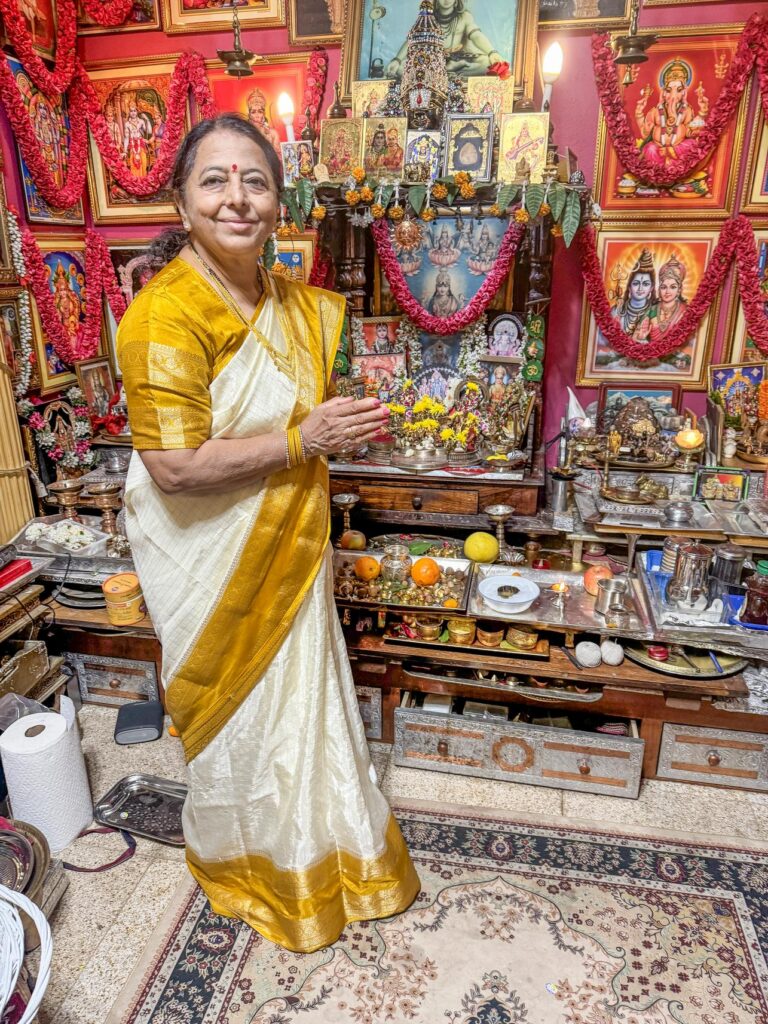
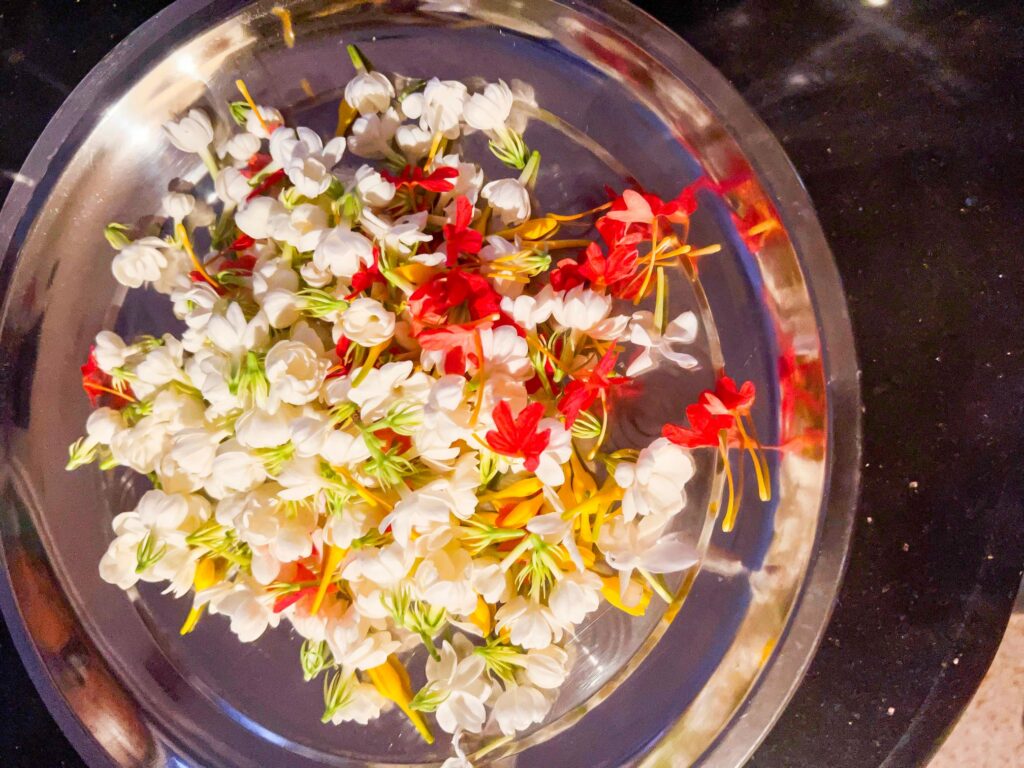
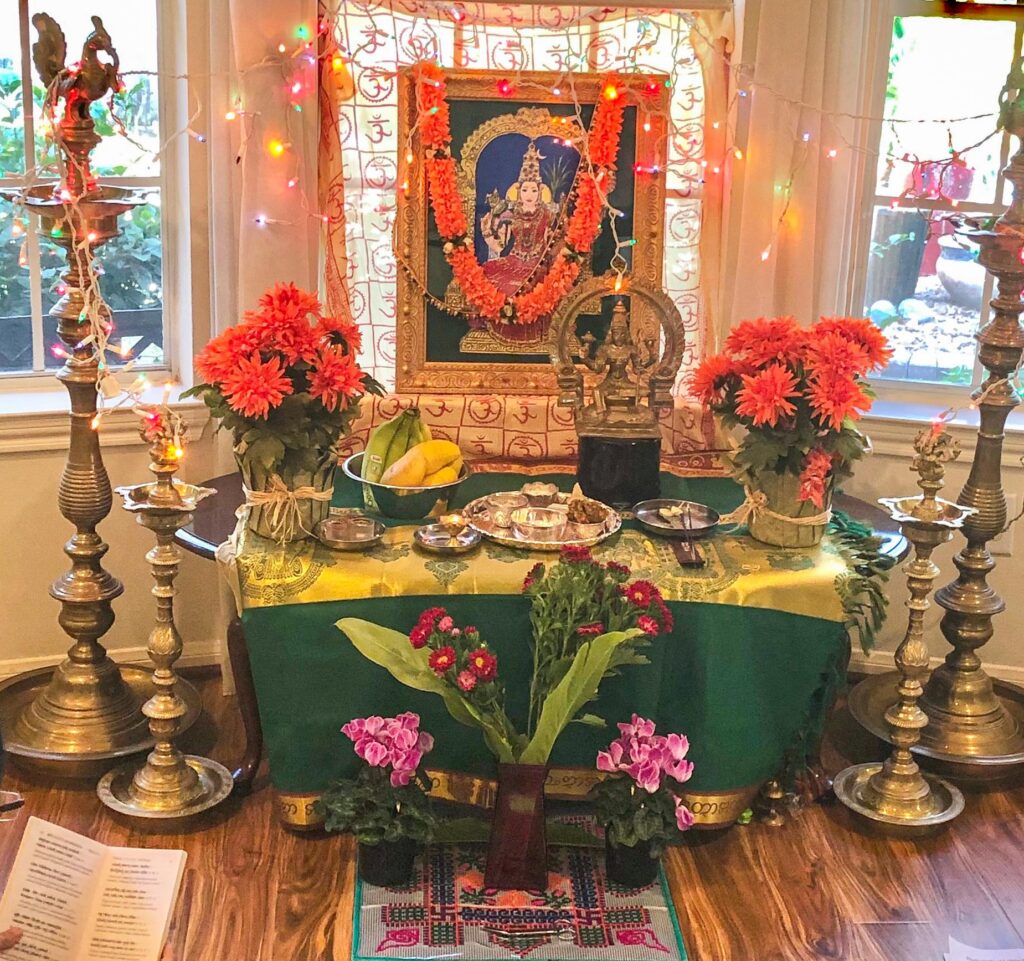
Shaila Rao relates her home worship: “I am originally from South India. We left India about 50 years ago. We built our home in California and have always had a shrine at home. We always pray with our family. Now, my routine is to pick flowers from my garden and offer to God. We perform Sri Satyanarayana puja every Ekadasi, which comes every 15 days. Apart from that, every day we offer all the 16 upacharyas.” . Photo: Shaila Rao
Living Vedanta Through Our Daily Home Puja
By Mr. and Mrs. Uday Acharya
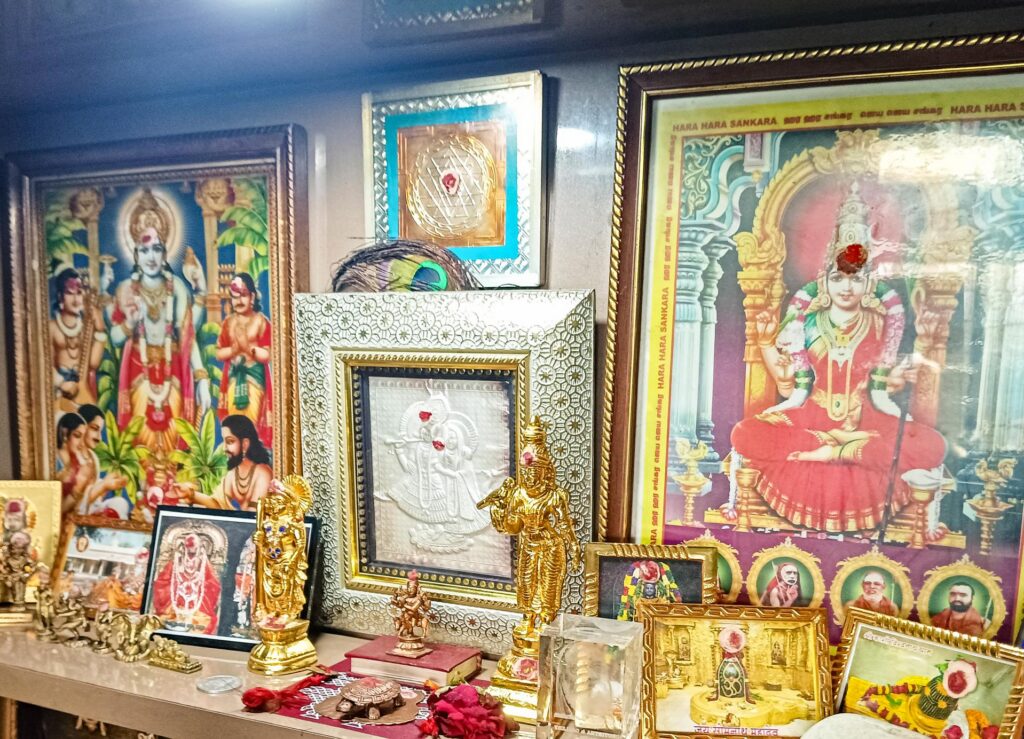
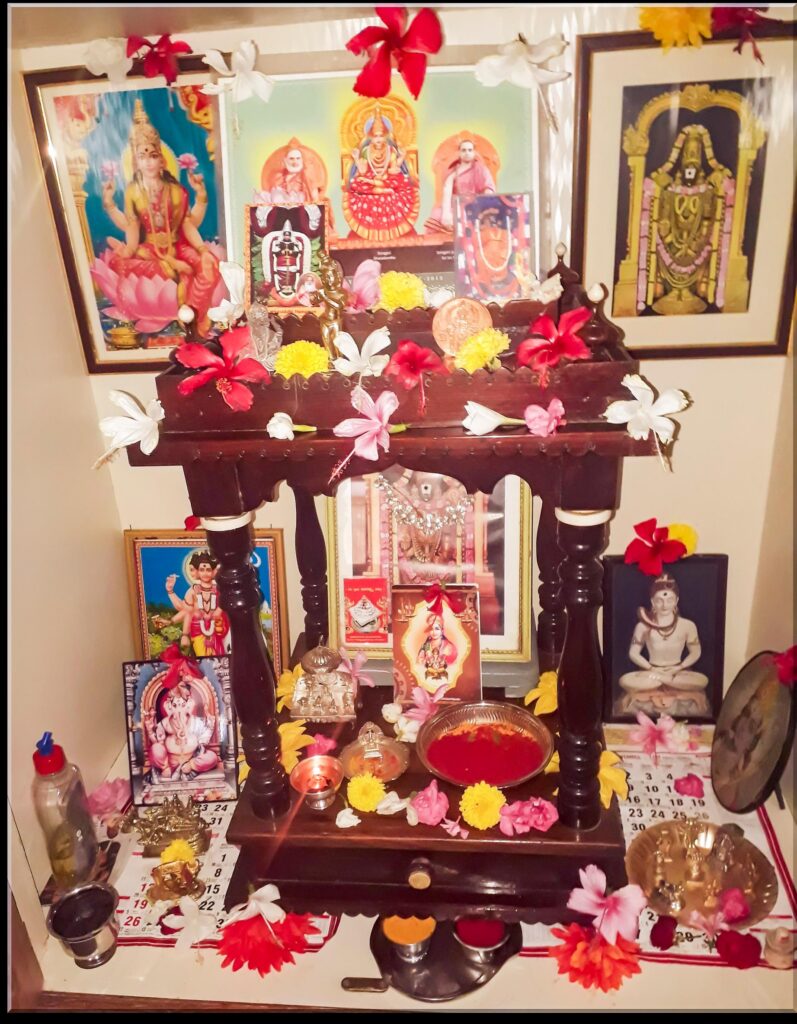
For my wife and me, residents of navi mumbai, originally from South India, our home shrine (photo above) is not merely a place of prayer—it is the living heart of our household, our personal temple. I am a full-time Vedanta teacher and disciple of Swami Dayananda Saraswati, and this sacred space bridges the profound philosophical truths of the Upanishads with the intimate daily discipline of devotion.
We believe our home belongs entirely to the Lord, who presides over all our mundane and spiritual activities. He is the center of our existence, around which everything in our lives revolves. Our altar tells the story of a lifelong pilgrimage, housing beautiful Deities that have come to us from sacred temples across the length and breadth of India. While Lord Krishna is invoked as our main Deity, the Divine Mother, Devi, holds a place of special prominence. We revere her as Annapoorani, who blesses our home with sustenance; as Lakshmi, who grants both material and inner wealth; and as Saraswati, the source of supreme spiritual knowledge. Flanking them are Lord Ganesha and Lord Hanuman, who dispel obstacles and fear.
Our dinacharya, or daily routine, is anchored by lighting the sacred lamp at dawn and dusk. We spend about 45 minutes each day reciting various stotras—a dedication that intensifies during festivals and on special occasions. Our morning begins with the Surya Namaskara mantras and Aditya Hridayam, welcoming the light of consciousness. We then chant traditional puja mantras to Ganesha, Devi, Vishnu, Hanuman and Siva, followed by japa of the Gayatri and Mahamrityunjaya mantras.
As twilight falls, the lamp is lit once more, accompanied by the soulful chanting of the Hanuman Chalisa, the Margabandhu Stotram for protection and the sublime Rajarajeshwari Stotram. Our daily worship also includes offerings of sacred Gangajal, incense, light, fresh flowers and fruits, followed by Mantrapushpam and the concluding Karpura Arati.
Most importantly, our prayers are never just for ourselves. Every day, we sit before the Deities and consciously remember everyone we know who needs help—whether they are facing issues involving health, career or relationships, or the profound grief of bereavement. We close our worship with the universal Vedic prayer for harmony beginning Sarve bhavantu sukhinah—may all beings be happy and free from suffering.
This continuous communion transforms our home from a physical structure into a spiritual sanctuary, keeping our teaching, learning and living aligned with the Divine.
Saiva Sect Shrines
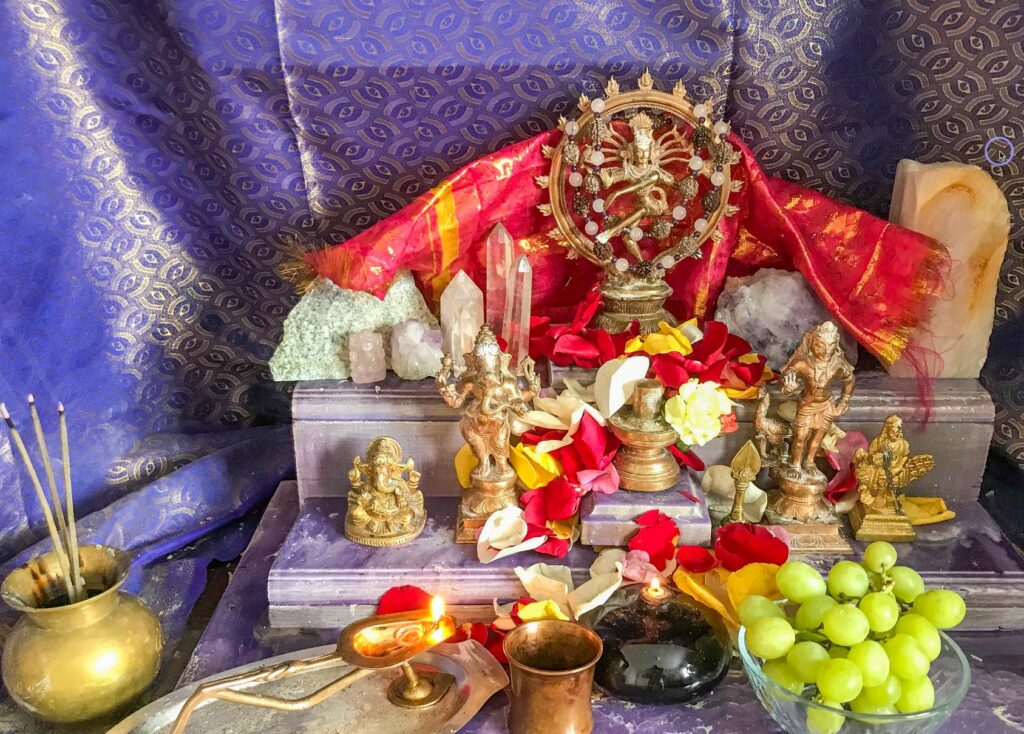
Shakta Sect Shrines
Vaishnava & Smarta Shrines
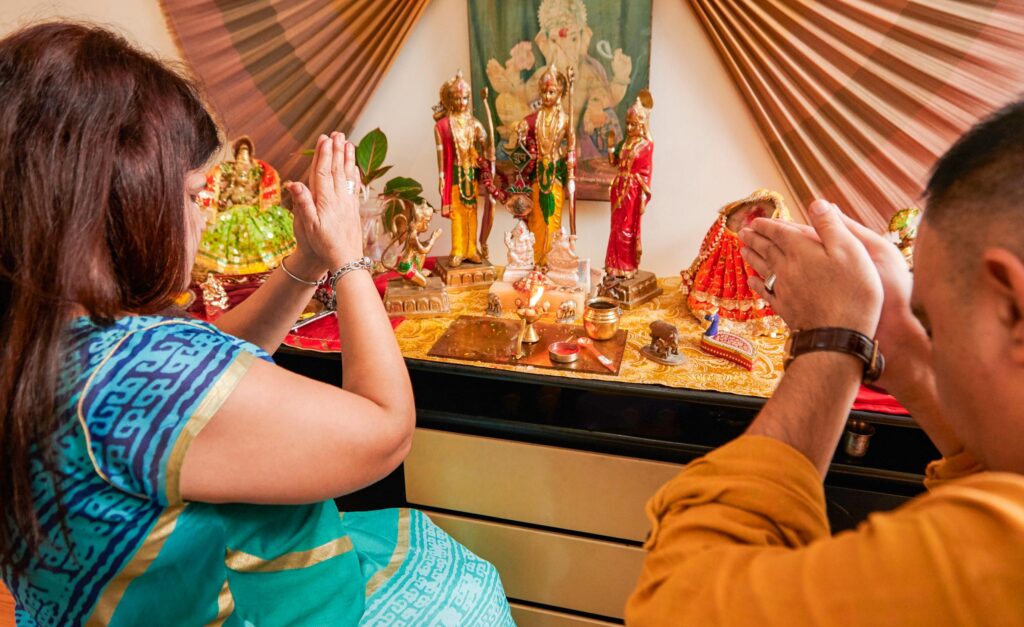
Shutterstock
About The Author

Aarti Patel is an Assistant Professor of Religion and South Asian Studies at Penn State University, Abington. Her research focuses on domestic religiosity and home shrines in the United States and Canada.
Leave a Comment