
Seek to Know
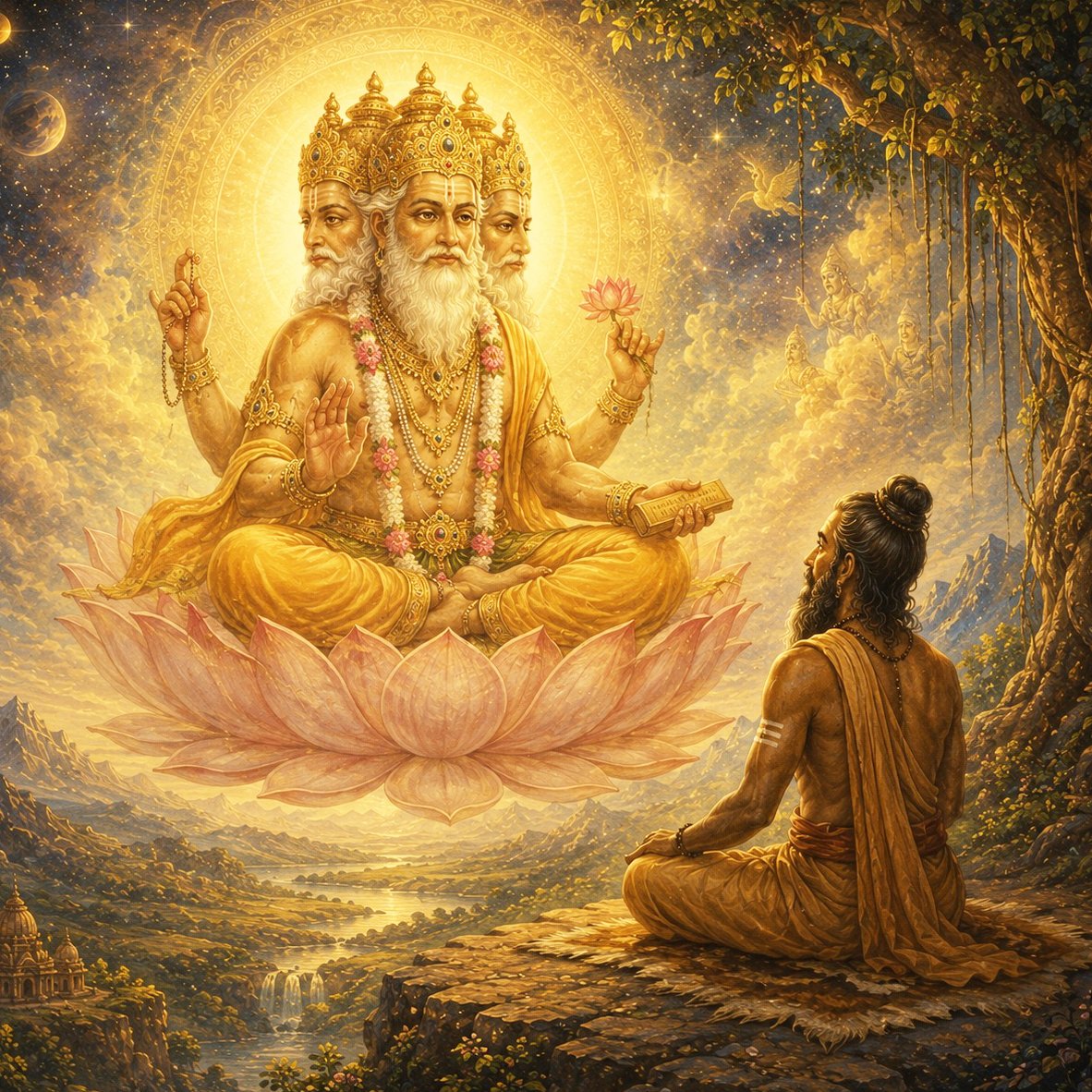
How Self-knowledge leads the seeker to the state of absolute freedom
Sarvepalli Radhakrishnan (1888-1975) was an Indian philosopher and statesman, India’s first Vice President (1952–1962) and second President (1962–1967). This text is adapted from his translation of The Principal Upanishads.
The following text is the Kaivalya Upanishad from the Krishna Yajurveda, in which Brahma teaches the sage Asvalayana the knowledge of the Self by which the sincere devotee attains liberation.
Then Asvalayana approached the Venerable Lord Brahma and said: Teach me, Venerable Lord, the knowledge of Brahman, sought constantly by the wise, hidden, that by which the knower is freed from impurities and attains the Supreme Self, greater than the great. 1
Brahma said to him: Seek to know That by faith, devotion, meditation and concentration. Not by work, not by offspring or wealth; only by renunciation does one reach life eternal. 2
It is higher than the heavens and shines in the cave of the heart. Those who strive for it enter into it. 3
The ascetics who have well ascertained the meaning of Vedanta, who have purified their natures through renunciation, dwelling in the worlds of Brahma, at the end of time become one with the immortal and are all liberated. 4
In a solitary place, seat oneself in an easy posture with a pure heart. Straighten the head, neck and body, control all the senses, and bow with devotion to the teacher. 5
Meditate on the lotus of the heart, devoid of passion, in the center of which is the pure, the sorrowless, the inconceivable, the unmanifest, of infinite form, the blissful, the tranquil, the immortal, the source of Brahma. 6
He who is without beginning, middle or end, who is one, all-pervading, who is wisdom and bliss, who is formless, wonderful, who has Uma as His companion, the highest lord, the ruler, who is the three-eyed, who has a dark throat, who is tranquil; by meditating on Him the sage reaches the source of beings, the witness of all, who is beyond all darkness. 7
He is Brahma; He is Siva, He is Indra, He is the imperishable, supreme, the Self-Lord. He is Vishnu, He is life, He is time, He is fire, He is the moon: 8
He is all, what has been and what shall be. He is eternal. By knowing Him one conquers death. There is no other way to liberation. 9
By seeing the Self in all beings and all beings in the Self, one goes to Brahman, not by any other cause. 10
Making ones body the lower firestick and the syllable Aum the upper firestick, by kindling the flame of knowledge, the knower burns the bond of ignorance. 11
The same Self veiled by maya attains a body and performs all work. In the waking state he finds satisfaction in the enjoyments of women, food and drink. 12
In the state of dream, the Self experiences happiness or sorrow in the worlds created by his own maya. In the state of dreamless sleep, where all things disappear, overcome by darkness, he experiences happiness. 13
Again, through his connection with the deeds of his past life, he wakes and sleeps. He revels in the three states of consciousness and from him all this varied world is born. In Him who is the support, who is the bliss, who is indivisible wisdom are merged the three states of consciousness. 14
From Him are born life, mind and all the senses; sky, air, light, water and earth, which is the support of all existence. 15
He is the supreme Brahman, the Self of all, the chief foundation of this world, subtler than the subtle, eternal. That thou art; Thou art That. 16
Knowing that the world appearing in the waking, dream and dreamless states is Brahman, who I am, one is freed from all fetters. 17
In the three states of consciousness whatever appears as the object of enjoyment or the enjoyer or the enjoyment, I am different from them, the witness, pure consciousness, the eternal Siva. 18
From Me all proceed, in Me all exist and to Me all return. That Brahman without a second am I. 19
I am subtler than the subtle, greater than the great. I am this manifold universe. I am the ancient, the Person. I am the Lord of golden hue. I am Siva. 20
I am without hands and feet, of inconceivable powers. I see without eyes. I hear without ears. I know all. I am of one form. None knows Me. I am always pure consciousness. 21
I am the One to be known through the many Vedas. I am the maker of the Vedanta and the knower of the Vedas. Merit or demerit I have none. There is no destruction for Me, no birth, body, senses or intellect. 22
I have not earth, water, fire, air or ether. Knowing the nature of the Supreme Self, dwelling in the cave of the heart, stainless, without a second, the witness, free from the duality of being and non-being, the renunciate obtains the pure nature of the Supreme Self. 23
Whoever reads the Satarudriya (Sri Rudram) becomes pure as fire, he becomes pure as air, he is no longer swayed by greed, intoxication or violence. He is released of the notion of action and inaction. Therefore one should strive to become freed from these things. He who has become free from the delusions of worldly life should meditate on this Upanishad constantly. 24
By knowing these truths—which destroys the ocean of births and deaths—he obtains the state of kaivalya. He obtains the state of absolute freedom. 25
About The Author
Sarvepalli Radhakrishnan (1888-1975) was an Indian philosopher and statesman, India’s first Vice President (1952–1962) and second President (1962–1967). This text is adapted from his translation of The Principal Upanishads.
Leave a Comment