|
|
 |
May 1979
First English Translation of the "Tirumantiram" Published by Dr. Natarajan
Leading Indian Economist and Scholar Issues Saint Tirumular's Classic on Saiva Siddhanta
After many years of painstaking
work by Dr. B. Natarajan of Madras, South India, the first of a ten volume
set of sacred books containing the first complete English translation of
Saint Tirumular's Tirumantiram, or "Holy Hymn," has reached the West. The
Saiva Siddhanta Church became aware of Dr. Natarajan's efforts when his
initial translations of a few verses were discovered in the library of the
East/West Center in Honolulu. Further inquiries revealed that the work,
though incomplete, had been laid aside. There was no other effort being
made in the world to bring the ancient classic into English, partly due to
the monumental extent of the task. Therefore, the Church arranged with Dr.
Natarajan to assist financially both in the hiring of additional scholars
as well as in the actual production costs. Master Subramuniya met with Dr.
Natarajan in Madras in 1977 and the work soon continued with renewed
determination. The final manuscripts arrived in the United States last
month (on the very day that the American English translation of another
Saiva Tamil scripture, the Holy Kural, was printed). The bound volumes of
the First Tantra arrived on April 21st.
The First Tantra is the
only book in the set that has been printed so far. The book itself is
titled Tirumular Tirumantiram, Holy Hymns. The dedication is shared by His
Holiness Arul Nandi, late of Kasi Mutt in South India, "who inspired," and
"His Holiness Master Subramuniya of Sivashram, Hawaii, who fulfilled." The
book was published by B. Natarajan through ITES publications in Madras of
which he is the Chairman, and printed by Kalakshetra Publications Press,
also in Madras. Together they have produced a commendable job. The
228-page volume is hardbound and cased in a hand-woven earth-colored silk,
then embossed with the title in maroon and the front illustration in
black. The dust cover and fly pages are in a deep ochre, similarly
printed. This lovely book is a herald of the care taken by its producers
from the exacting typography (in Tamil and English to complicate the task)
to printing and casing in. There is even a red silk book mark bound into
the spine. It is a fitting garland that Dr. Natarajan has so lovingly and
painstakingly placed at the Feet of Lord Siva.
The title of the
scripture may better be understood with the help of a few words taken from
Dr. Natarajan's notes which will appear at the end of the Proem or Preface
- this being the first of the ten books when they are completed although
the First Tantra has been printed first. Tiru in Tamil means "holy." The
word Mantiram (from the Sanskrit mantra) is used in two senses, general
and specific. In the general sense it conveys the meaning of devotional
prayer composed in special words, e.g. Vedic Hymns. In the special sense a
mantra is that which is composed of certain letters arranged in a definite
sequence of sounds of which the letters are the representative signs.
Here, a mantra may, or may not, convey on its face its meaning. Bija or
seed mantras such as Aim, Klim, Hrim have no meaning according to the
ordinary use of language. Tirumular uses the word Mantra is both senses.
The title he gave his book originally was Mantra Mala or "Garland of
Mantras." Here it conveys the sense of a Book of Prayer. Later in
subsequent Tantras he elaborately speaks of specific mantras for specific
deities and special rituals and expounds in full the meaning of the Primal
Mantra OM and the Five-lettered Siva Mantra - Nama Sivaya - and the ways
of intoning it in different contexts. Literally Mantra is composed of two
syllables, Man or "mind" and Tra or opening or liberation. That is, Mantra
is that which leads to blossoming or liberation of mind or
heart."
It would be difficult to overstate the importance of the
Tirumantiram in Saiva Siddhanta philosophy. In the first place it is the
earliest full statement of Siddhanta, "the end of ends," composed roughly
2,000 years ago. Secondly, it is perhaps the most complete and profound
exposition of the subtle theology of Sailva Siddhanta ever written, so
filled with the esoteric and the abstruse that it has not through its long
history been read or studied outside of the conclaves of scholars - though
in the last two decades this trend has shifted as evidenced by Dr.
Natarajan's work. Within the context of other Saiva scriptures, the
Tirumantiram is the tenth of the twelve Tirumurai or "Holy Books." The
Tirumurai are collected works written for the most part during the first
millennium A.D. by various Saivite saints and then gathered together in
the eleventh and twelfth centuries. They constitute what might be looked
upon as a Saiva Hymnal in which all forms of spiritual expression from the
advaitic principles of nondualism and Self-realization to devotional
praises to God, Siva, as the Creator, Preserver and Destroyer of all Three
Worlds of existence may be found. The Tirumurai have come to be regarded
as the very lifebreath of the devotional strength of Saivism, and they are
sung daily in the temples of the Deities throughout South India and
elsewhere in the world where Saivites worship. The remaining Tirumurai
consist of the Devaram hymns of the Samachariyas (Saints Appar, Sundarar,
Sambandar and Manikkavasagar), the Periya Puranam of Saint Sekkiyar, the
Devaram Hymns and other works.
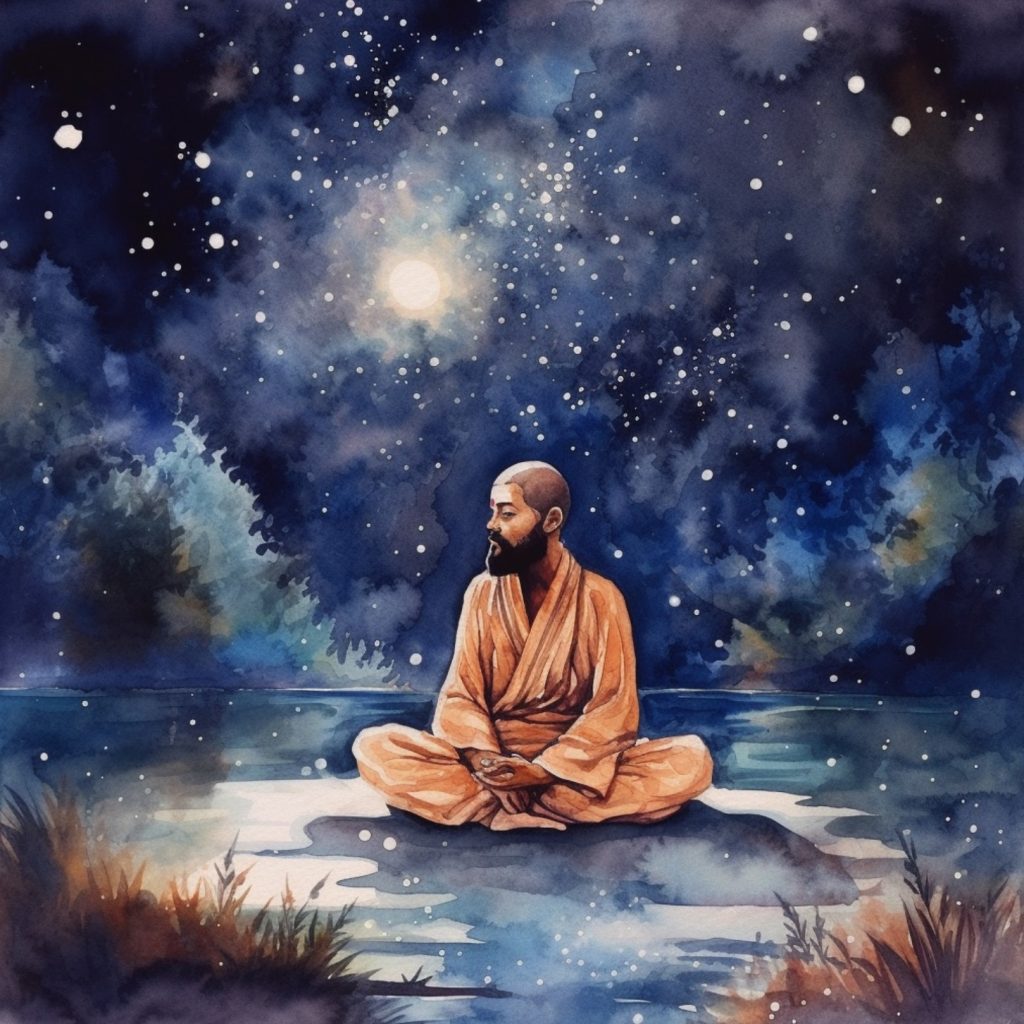
The great rishi who wrote the
Tirumantiram and thus became the first to define the metaphysical, moral
and mystical aspects of Siddhanta, was originally from the North of India,
from the Himalayas. It is said that he was sent to the South of India to
bring the pure teachings to the culture there which had drifted from the
traditional wisdom. The journey must have been long and arduous, probably
entirely by foot.
One day, while in the Southern village of
Tiruvavaduthurai, the siddhar came upon the dead body of a cowherd. This
cowherd was Mulan, a much loved but little educated husbandman of cattle,
who were now wailing at the loss of their caretaker. The rishi was
overtaken by the pathetic sorrow of the animals whose future was now
uncertain, and, leaving his body in a hidden place not far away, he
entered and revived the expired form of the peasant Mulan. After caring
for the cattle, the rishi tried in vain to return to his body, but it was
not to be found. He took this to be Siva's Divine Will and in faith
accepted his new South Indian "incarnation." Mulan's wife immediately
sensed that her husband was not himself, as indeed he was not. For one
thing he refused to enter the house but remained seated in deep meditation
under a Bodhi tree (banyan) elsewhere in the village. There the sage
passed the balance of his life recording the Saiva Agamas in Tamil, a
Dravidian language. According to some legends, Tirumular remained in a
contemplative state of consciousness for 3,000 years. He came into outer
consciousness once each year to write down a single four-line verse. At
the end of his silent vigil humanity was left with the Tirumantiram. Thus
he earned the love of his people and the honored name of Tirumular, or the
"holy Mular."
What is contained in this ancient scripture, never
before available in its entirety in English? Dr. Natarajan has called it
"a book of Tantra, Mantra, Yantra and Yoga, of prayer and philosophy at
once. It is the only authentic work in Tamil on Yoga - Kundalini Yoga
especially. It expounds the teachings of Agamas as old as the Vedas...It
proclaims the oneness of Godhead and the means to God-becoming by man - of
Jiva merging in Siva, the Soul in the Oversoul." Structurally the
Tirumantiram is comprised of nine Tantras (books) and a preface. Each
Tantra covers a different aspect of the Saivite path. The Proem or Preface
commences with an invocation to Lord Ganesha in the traditional manner and
offers a synopsis of the work. Putting aside for a moment our description
of the First Tantra, let us turn to a brief summary of the others. The
Second Tantra deals with the mythology of the Deities, with the cosmology
of Hinduism, how the world was created, is sustained and will be
destroyed, and of the categories of the soul. The Third Tantra explores
the mystical science of yoga, yama and niyama, pranayama, asana,
pratyahara or withdrawal of the senses within, dharana or concentration,
dhyana or meditation and samadhi or Self-realization. In this way the
scripture proceeds to unravel in the most wonderful and insightful ways
profound realms of the soul's journey to Godhead, including the
relationship of Vedanta and Siddhanta, the Guru/disciple tradition, the
Tattvas or components of material and spiritual existence, the chakras or
psychic nerve ganglia within the nerve system of man, the pranas of the
body and the states of consciousness through which the soul naturally
passes as it unfolds. If these seem to be difficult and weighty topics,
they are. The Tirumantiram is not known for its ability to popularize
these deep matters; it is known for its utter authority in areas where
authority is seldom recognized. Its abtruse is seldom recognized. Its
abtruse character makes Dr. Natarajan's accomplishments all the more
remarkable and our pursuit of understanding its depths all the more
rewarding.
The First Tantra begins with a synopsis of all that is
to follow, and what follows is 24 chapters or 223 of the 3,000 verses of
the saint's exegesis. The chapter titles themselves are revealing of the
subjects: "Transitoriness of Body" (also of wealth, youth and life), Not
Killing, Poverty, Dharma of Rulers, Glory of Giving, In Praise of the
Charitable, Siva Knows Those Who Love Him, Learning, Non-learning,
Rectitude and others. For those who are familiar with the Holy Kural these
chapter headings will seem familiar, and they are. The topics of this
initial tantra and of the great work by Saint Tiruvalluvar are indeed
similar, indicating that one certainly knew of the other's work.
In
the presentation of the verses themselves the new edition offers three
versions of each - first the original Tamil, then a transliteration into
Roman script and finally in English rendition itself. There is a single
verse per page throughout.
In his synopsis which opens the book Dr.
Natarajan has provided readers and students a useful prose version of each
verse. While the verses themselves can be cryptic, the prose version is
straightforward, making clear the often unstated inferences of the saint.
Many will certainly find that reading the prose of the synopsis along with
the verse in the main text will greatly enhance appreciation of this
scripture. A few examples of both will serve to show their relationship as
well as give a sampling on the First Tantra.
Article copyright
Himalayan Academy.
Return to the Table of Contents
Return to Hinduism Today Home Page
|