|
|
 |
January 1996
My Turn
Going from Good to Better
By Muni Lakshmanan
Hinduism is not a founded religion. It has no creed and no dogma. In this
sense, Hinduism is unlike many religions. Is there, then, any distinguishing
feature of Hinduism? Yes: its universality, its acceptance of everyone,
of whatever path, of whatever faith, agnostic and atheist included. "Truth
is one, sages call it by different names" is an old Hindu saying. Another,
on which many Hindus meditate every morning is, "As the different rivers
having their sources in different places all mingle their water in the ocean,
so, O God, the different paths which people take through different tendencies,
various though they appear, crooked or straight, all lead to Thee."
Thus a Hindu respects all religions in their pure form.
If a man thinks his religion is the best for all, he is to
that extent short of the true religious spirit. But if he thinks that his
path is the best for him, he is both right and wise. Human temperaments
are different. We all started at different points of the circumference of
a vast circle and, on the pilgrimage that life is, we are moving towards
the center of the circle. Our paths have got to be different--of necessity.
And yet, they are all the same--all leading towards the center.
The tenet behind the Hindu view, that every path is good enough,
is that all progress is from good to better, not from bad to good. Nobody
is in a hopelessly bad position as such. There is no sinner.There never
was any. The popular notion of "sin" is something that someone
manufactured for the market of ignorance. Everyone may be subject to passing
thoughts of evil, but no one is a "sinner" as such. As all evils
derive from pride, there is no evil beyond pride, and even this prime evil
cannot be called "sin." This concurs with the Hindu placement
of evil in the flux of human affairs, namely that all appearances of evil
are instant convulsions or retarded consequences of pride (ego-sense). True
knowledge begins where ego ends, says sage Ramana. To "end" ego
does not mean to destroy it; it is to transform ego from ruling to serving.
All effort to achieve this, however long or hard a struggle it might be,
must ever be in the sustained spirit of truth-seeking, never yielding to
any frustration or worry.
Great spiritual masters like Vivekananda have particularly
warned us against ever slipping into the tragic notion that we are sinners.
What we have to conquer is pride, nothing more. Free yourself from the dark
layers of ignorance, then you can see the light. Cleanse the waters of the
pool of your mind of the dust of ego-sense, calm the surface of the pool
from the waves of ego-wandering, then you will see through the calm, clear
pool into the bottom, into yourself. How to conquer ignorance? By orienting
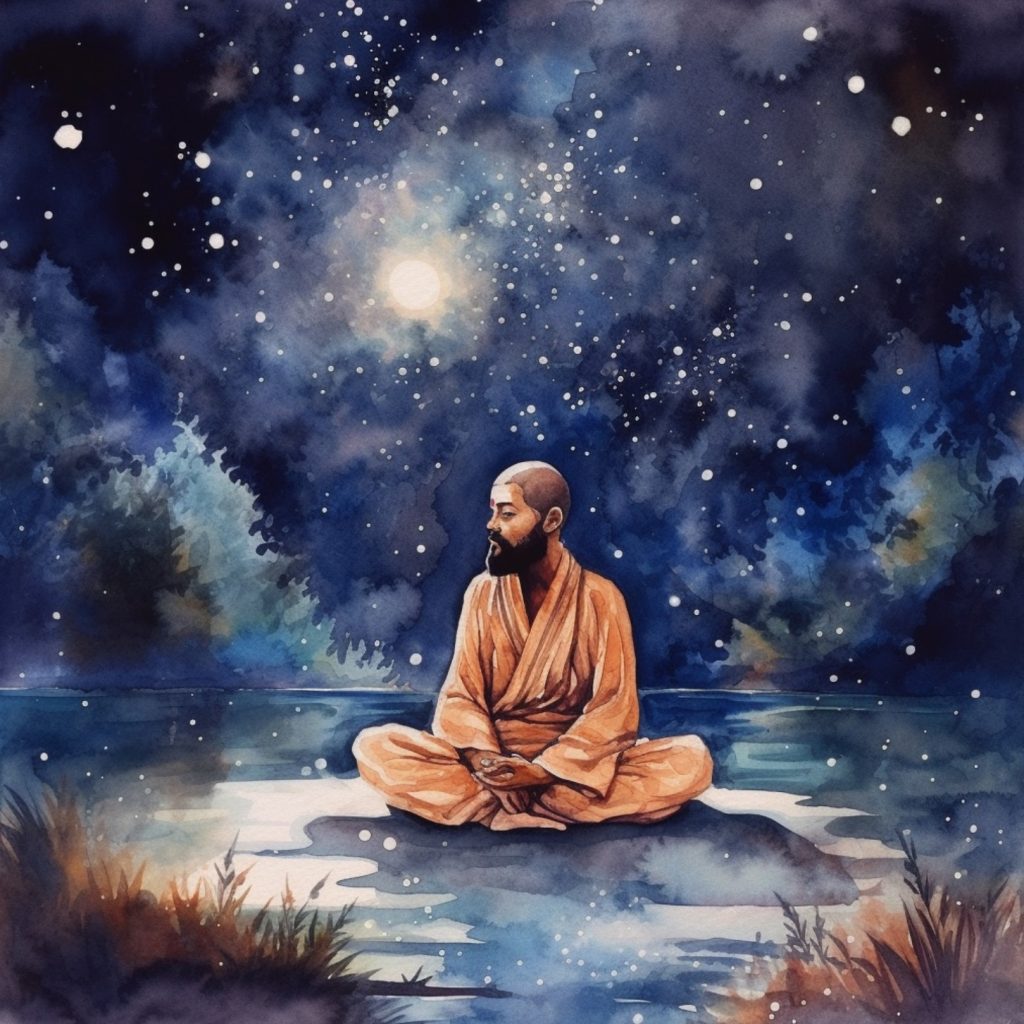
life and living Godward (truthward) through meditation. Perhaps the greatest
contribution of the Hindu sages and saints to humanity is the discovery
and disclosure of the power of meditation. Christopher Isherwood wrote in
1951: "Vedanta starts you off with a single proposition which is no
more than a working hypothesis: 'The Atman can be known. We don't ask you
to believe that. All we ask is that you make a serious effort to get some
spiritual experience for yourself, using the techniques of meditation which
we shall teach you.'"
Truth is beyond language and logic. It cannot be expressed.
It cannot even be understood; it can only be realized. A philosopher in
ancient India, who was reputed to solve any metaphysical problem posed to
him, suddenly started saying that he could no more understand anything.
Then he entered into decades of silence. It was held that he had "lost
his wits." After thirty years, one fine morning he shouted with joy
of great discovery, "I have understood, I have understood!" People
flocked around, asking him if he would let them share the truth he had understood.
"Surely," he said. "I have understood that It cannot be understood."
Time and again, great philosophers, from Socrates to Wittgenstein, have
reaffirmed that the most sought after answers can be found only in silence,
by contemplation, by realization. And so, any apparent contradictions in
religious literature should necessarily be there, and they should not bother
us. Their resolution will dawn from within, in due course, on the journey
of the spirit.
Muni Lakshmanan is a retired Mathematics professor residing in Pennsylvania
USA. He served UNESCO as an Adviser in Mathematics and was raised under
thThe neighbors gathered togeth Mission.
The neighbors gathered together wailing loud and long,
denied him now a name, called him corpse, and bore him to the burning ghat
and the body burnt, then did a ceremonial dip--and memory of him fades away.
--Tirumantiram 145.
Return to the Table of Contents
Return to Hinduism Today Home Page
|