![]() |
||
June 1996How Did Man Arrive on Earth?
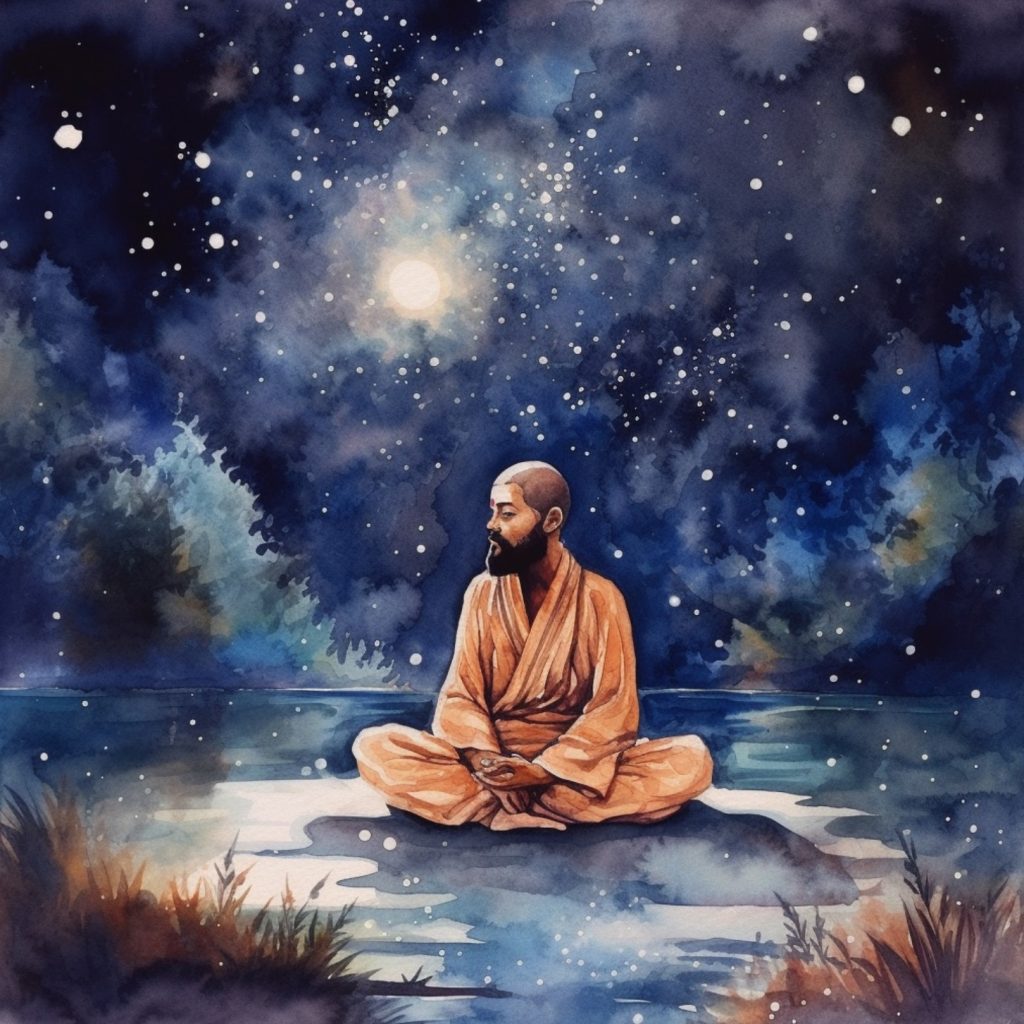
How did humankind come to inhabit a blue marble spinning in black space? INTRODUCTION Every culture on Earth has pondered the question, "How did we get here?" Profound, divine answers have been formulated through the ages. Several, drawn from the world's oldest and newest cultures and religions, are summarized or retold on this and the next two pages. Today we seem to be on the verge of completely losing our sense of divine origin and purpose as more and more people accept the verdict of Darwinian science--that we are the chance result of billions of years of evolution from single-celled creatures, to sea-born creatures, to reptiles, birds, mammals, to apes and finally to man. We need not accept at face value this Godless judgment on our origins. Hinduism and other religions hold that there is more to existence than this mere physical reality, and that a transcendent intelligence inheres and instructs the development of this universe, including the observed processes of evolution. This page introduces their poignant quotations from legends and ancient texts. On the fourth page, we briefly present the likelihood of intelligent life elsewhere in our galaxy, and explore the intriguing possibility that man did not originate on Earth at all, but came here from another planet. WHAT THE RELIGIONS TEACH The Australian Aborigines are likely the oldest tribe on our planet, with a known continuity of cultural history going back over 50,000 years. They speak of the "Dreamtime" of the distant past when the Gods walked on the Earth and created people, sacred places, animals and the ways of human society. They believe a jiva or guruwari, a "seed power," is deposited in the Earth, "a symbolic footprint of the metaphysical beings whose actions created our world," states Australian author Robert Lawlor. "We have been here since the time before time began," explains an Aboriginal elder. "We have come directly out of the Dreamtime of the great Creative Ancestors. We have lived and kept the Earth as it was on the First Day. All other peoples of the world came from us." " Hinduism has several creation accounts, of which the central is found in the Rig Veda [see next page] of the Cosmic Man, Purusha, who was sacrificed by the Gods to create man. The Purusha is a divine emanation of God, and can be understood in at least one sense as the individuation of consciousness, the personal aspect of God. It is this individuated consciousness that is offered and divided by the Gods to create all of the physical universe, men, animals and plants. Three-fourths of the Purusha remains "ascended high" and only "one fourth took birth again down here," as the hymn explains, meaning what we see is only one-fourth of reality, the remaining being in divine form. Further elaborations of the creation are told in the Puranas, Dharma Shastras and other Hindu scriptures. Manu Dharma Shastra I.11-119, for example, describes the creation of heaven and earth, of the soul, and of individual creatures. Manu, son of the first being, performed tapas, very difficult austerities, to create ten great sages who then created seven other Manus, who are progenitors of the human race in each age. Sikhism follows Hindu traditions of origins. The Chinese [see next page] have, in the story of the first man, Pangu, a close parallel to the Hindu Purusha. Buddha taught that this world will come to an end, but that in time a new world will evolve again. Certain karmas will cause souls to again seek life in the body, others will follow and become more and more attached to the body, developing passion, selfishness and other evils. The Buddhist scripture Saddharma Pundarika mentions that there are so many worlds beyond this one that no one "should be able to imagine, weigh, count or determine their number." The Jains hold that the world, souls and time are uncreated, unbeginning and unending. The world exists through its own being and is divided into heaven, earth and hell. Christians and Jews believe in the making of man by God on the sixth day of creation (some 4,000 years ago) out of clay and in His own image, as told in the Book of Genesis [see next page]. The Muslims believe, similarly, that Allah created Adam, the first man in Paradise, then the first woman, Hawa (Eve). There they lived a perfect life in a perfect universe, far vaster than ours. They were cast to Earth when they committed the first disobedience of God, after a jealous Satan tricked them. Their children are the ancestors of mankind. The Zoroastrian religion of Persia also holds to the creation story of Adam and Eve. There are mystical traditions within Christianity, Islam and Judaism whose teachings go beyond Genesis. For example, the Sufi master Shaykh Muhammad Nazim al-Haqqani taught, "Do you think there was only one Adam? No. There was not one Adam. In fact, there have been 124,000 Adams. Allah is not stingy; He is generous. His creation is endless." Sufi mystics also hold that there are many inhabited worlds in the universe. The Jewish Kabbalah tradition teaches of man's descent from the highest spiritual world through a series of planes ending with his reincarnation in a physical body. The Shinto teaching is that the Japanese people are descendants of the Gods Izanagi and Izanami, who were ordered to "Make, consolidate and give birth to this drifting land [of Japan]." This they did and then produced the many Gods, fire, water and men. Among the Gods, the most important was Amaterasu, the Sun God, whose descendent was Jimmu, the first emperor of Japan. The African Dogon tribe teaches that the primal Cosmic Egg was shaken by seven huge stirrings of the universe. It divided into two birth sacs, each containing a set of androgenous twins who were fathered by the Supreme Being, Amma. From one set of twins was born the Earth, from the other, mankind. Theosophy holds that there are countless universes, each the home of numerous solar systems with planets where beings are evolving. Human history is recounted in terms of seven succeeding "root races." The first, descended from residents of the moon, dwelt on a continent named the imperishable Sacred Land. The second, known as the Hyerborean, inhabited a vast territory in the vicinity of the North Pole. Since neither of those races had physical bodies, they reproduced by spiritual means. The third root race lived and died in Lemuria; the fourth in Atlantis--both now at the ocean bottom. The fifth and present root race is the Aryan; the sixth and seventh have yet to appear. When they do, humanity will have run its course on Earth and will move to another planet to begin the cycle again. Both the Mayans [see next page] and the ancient Babylonians taught that the Gods created man to honor them. "I will create a savage, 'man' shall be his name," declared the victorious God Marduk in Enuma Elish. "Verily a savage man I will create. He shall be charged with the service of the Gods that they might be at ease! Let one of the [lesser] Gods be handed over. He alone shall perish that mankind may be fashioned." Sidebar: Could We Have Come From Another Planet?The scientists who developed the Greenbank Equation at left make a convincing case for the existence of intelligent life elsewhere in our universe. Sentient life throughout the cosmos provokes the question, "Could man have originated elsewhere and migrated here, either physically or spiritually?" Most religious traditions that address this question speak of the migration as purely spiritual, but at least one claims the journey was physical. Below are some of mankind's reflections about how we came to be here.
Signs of a Common Heritage The American Indians of California, for example, tell of how God sent an animal down through the waters to bring up the Earth, in the same way that the Boar incarnation of Lord Vishnu rescued the Earth from beneath the waters. The Chinese Pangu is amazingly akin to the sacrificed original man in the Purusha Sukta. In many cultures, man was originally immortal, and only at a certain time did he start to die--just as Yama in Hinduism was the first man to die, and then became the Lord of death. Another common element is the breath of God being infused into man, bringing him to life.
Did We Come from the Sky? Hindu scriptures often speak of the many lokas or planes of existence and dvipa or islands. They talk of beings coming from other lokas to this loka, possibly even of spaceships in which they could travel. These lokas, however, are more commonly interpreted as other dimensions of existence rather than physical planets. His Divine Grace A.C. Bhaktivedanta Swami Prabhupada, founder of ISKCON, addressed this question in his commentary of Srimad Bhagavatam: "According to Vedic understanding, the entire universe is regarded as an ocean of space. In that ocean there are innumerable planets, and each planet is called a dvipa, or island. The various planets are divided into fourteen lokas. As Priyavrata drove his chariot behind the sun, he created seven different types of oceans and planetary systems, known as Bhuloka." Srila Prabhupada also stated that according to the Vedic tradition there are 400,000 species in the universe with humanlike form, many of them advanced beyond us. Other parts of Hindu scripture refer to travel to other worlds. The Rig Veda hymns on death speak of man's soul traveling to the sun and the moon, then returning to Earth. Certainly the most dramatic example of a people who believe they came from another planet is the Tana Toraja tribe in the Celebes Highlands of Java, Indonesia. They declare their ancestors came from the Pleiades on space ships. In fact, they continue to build their homes to look like those ships today. This tribe had no contact with the outside world until this century, and had no way of knowing that space travel was even possible. On a purely materialistic basis, scientists have made the case for at least the very first elementary life coming to Earth from outer space, probably arriving frozen solid inside a meteor. This hypothesis is called panspermia, meaning the migration of living spores from planet to planet throughout space. There is a class of meteors called carbonaceous chondrites with organic compounds in them and microscopic particles resembling, but not identical to, fossil algae of the kind that live in water. There is another school among the scientists which includes Nobel Laureate Francis Crick, co-discover of the DNA molecule. Crick advocated a theory of "directed panspermia"--the possibility that an older civilization sent a mission to start life on our newly evolving planet. A single capsule of several elementary organisms would, he claimed, suffice to bring life to Earth. "This might suggest," Crick said, "that we have cousins on planets which are not too distant." In modern times the concept of coming from other planets is advocated by the Theosophists. The first two of their postulated seven root races had nonphysical bodies. They teach that when the last root race has appeared, humanity will have run its course of evolution on earth and will move to another planet to begin the cycle again. We can now see that there is hope for a more secure future when we put together in our inner mind all the information that we have gathered on these four pages. A future that maybe, yes, maybe there is telepathic communication going on, more than we know. A future that yes, maybe, just maybe there are beings from outer space, physically, astrally and in refined bodies of the soul eager and willing to populate--or if we are not careful in our nuclear age, repopulate--the little spinning planet we have come to know as home. The wise look to the past to know the future. We do hope that by looking at our beginnings we have helped in some way the peoples of the world to forge a fulfilling future. Maybe, just maybe, all the answers are not to be found in our intellects. Some may exist in the old creation stories, or be projected to us from inner and outerspace.
Sidebar: SETI - The Search for Extraterrestrial Intelligence --
|
||
Express your gratitude for Hinduism Today by donating to the Hinduism Today Production Fund. Help provide complimentary copies to orphanages, libraries, temples and deserving individuals by donating to the Hinduism Today Complimentary Subscription Fund. Contact Us Copyright © 1979-2008 Himalayan Academy. All rights reserved. |