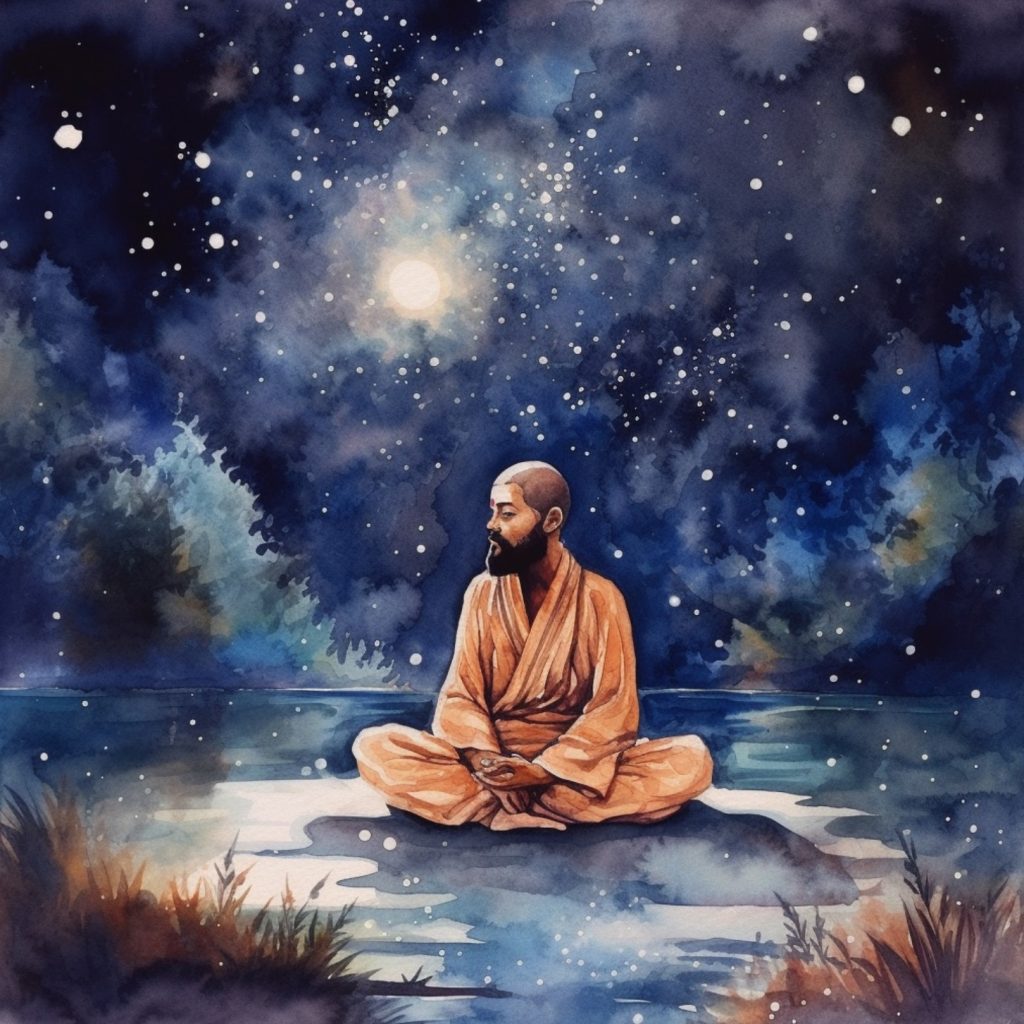
|
|
 |
July 1989
HINDU ETHICS
Universal Dharma:
Nature
is the most efficient and exquisite designer. From the nautilus spiral of
a sea shell to the twin hemispheres of the human brain to the glowing
rings of Saturn, nature's works never cease to evoke human wonder. We
usually see the surface of nature, yet the surface is always supported by
an underlying structure: the cellulose framework of a leaf, the lipid
membrane of a cell, the nuclear synthesis of the stars. Ethics is the
supporting structure of Hinduism. Within its framework of good conduct lie
the joys of spiritual living and the depths of God
consciousness.
Hinduism sees nature as an energy-extension of God,
a continuous crystallization of His omniscient Mind into the body of the
physical cosmos. The universe's orderliness is part of an overarching
divine pattern that the Hindu rishis called rita (pronounced ri as in rip,
ta as in tub). The seers psychically saw that rita is the law of being, a
universal presence that governs nature, human ethics, conduct and
justice.
Rita, one of the most frequently used words in the
3,500-year-old Vedas, evolved into the watershed Hindu concept of dharma:
"an ordered and purposeful pattern." This pervasive cosmic code extends
into every facet of human endeavor. No activity or pursuit is outside of
its realms-its only boundary is karma. Yet, karma itself belongs to
rita.
The Vedas clearly state the connection between human conduct
and the kindness or cruelty of nature. Virtuous living is rewarded by a
more intense awareness of nature's beauty, by abundant harvests and benign
climate. This profound relationship between ethical conduct-both personal
and as a society-and nature repeats itself over and over in the body of
Hindu scripture. They warn how moral and religious lassitude would result
in disaster, calamity and pestilence. This century's spate of disasters
and rampant, exotic diseases are a vivid reflection of the state of our
collective consciousness. The rishis counsel us that our thoughts and
actions psychically contribute to the shaping of planetary nature, weather
and geological activity. One Upanishadic seer even tied the explosive
percussion of thunder into his ethics teaching to a pupil: A human, a deva
and an asura (negative being) sought Brahman for advice on
self-improvement. Brahman simply uttered dha, the first syllable in three
Sanskrit words meaning self-control, charity and compassion. The kind-eyed
rishi then said the thunder roll would ever remind humanity of "dha, dha,
dha."
Without ethics, Hinduism would collapse under the gravity of
instinctive action and selfish intellect. No Hindu could walk the path to
nobility and Godness. Indeed, Hinduism does collapse for people who
neglect or refute the codes of personal, societal and spiritual conduct
our faith long ago recognized as part of the very fabric of the universe.
Hinduism is not simply a religion one is born into, but a life pattern one
constantly upholds, as Dr. S. Radhakrishnan, India's brilliant
scholar-statesman, observed. The Rig Veda, mankind's oldest scripture,
advises men to "think of wealth and strive to win it by rita and by
worship." The mystic Atharva Veda tells newlyweds, "Enjoy good fortune by
observing rita and always bear yourselves according to rita." When an
individual chooses immorality over morality, he transgresses dharma. It is
as if he or she has suspended or dropped out of dharma. Yet the laws that
Hindus know as fact still function: karma returns in full measure what we
have created by thought, word and deed. Only good conduct, grace and
penance can soften the impact of our karmic creations.
It is easy
and healthy to be nostalgic about the 35-centuries-old Vedic/Agamic
period, when the earth was considered sacred and kept unpolluted,
households were virtuous, commerce fair and war a last resort. The power
of virtuous living was so ingrained in Hindu culture that when Alexander
the Great stabbed into India with his Greek legions (twelve centuries
after the Vedas), his generals recorded that the Hindu armies were
impeccably honest. Not one act of licentiousness marred the Hindu
bivouacs. This remarkable testimony only has one counterpart in today's
world: the Hindus of Bali. So implicit is their faith in the virtues of
the Ramayana and Mahabharata scriptures that crime among the Balinese is
virtually non-existent.
How far did the virtues of rita and dharma
extend? One Upanishad dialogue records a king answering a rishi's question
on his kingdom's welfare, "In my kingdom there is no thief, no miser, no
drunkard, no man without an altar in his home, no ignorant person, no
adulterer, much less an adulteress." The Hindu code of living includes
civil, marital, spiritual and educational concerns-all the components of
enlightened society.
Our Human Duties:
Some people, who are
unaware of our scriptural heritage, will say bereft of ethical guidelines.
How erroneous this is may be seen by the Hindu ethical principle that one
must not cheat or harm another, even in one's dreams. Denying ethics gives
excuse to deceit and even lying to one's guru to advance in position and
life. But a scan of Hindu scripture reveals that creeds of conduct exist
in the historical canons of every Hindu sect. And every great Hindu
thinker, from King Janaka to Sankara, Manikkavasagar and Jnanesvara to
Mahatma Gandhi and Bhagavan Ramana Maharshi, offers primacy to ethics as
the bedrock of social and spiritual progress.
Ethics begins with
the keepers of the home and family. The Vedas list five primary duties of
the householder: study of and teaching the Vedas; daily worship of the
Gods through rituals; bestowing honor upon ancestors; being kind to
domestic animals; extending hospitality to guests and the
impoverished.
In the Taittiriya Upanishad is given one of the most
eloquent and sweet-voiced creeds. It became the traditional farewell
advice from guru to pupil: "Speak the truth. Practice dharma. Do not
neglect the study of the Vedas. Do not neglect your duties to the Gods and
ancestors. Treat your mother and father as God. Treat your teacher as God.
Treat your guest as God."
Gradually an amalgam of all the counsel
of the Vedas and Agamas coalesced into what became known as the Pancha
Nitya Karmas, "five constant duties."
Pancha Nitya
Karmas
Dharma (Virtuous Living)
Proper conduct follows the
laws of dharma and includes the teaching of one's favorite moral
scripture, remaining celibate until marriage, obeying sthree dharma for
women and purusha dharma for men. It is goodness in thought, word and
deed.
Upasana (Worship)
Personal worship in the home shrine
includes performance of puja, sadhana, japa and religious study. Regular
devotions in the home and temple bring forth love of God and prepare the
mind for the practices of meditation.
Utsava (Holy Days)
The
observance of Hindu festivals in the home and temple, including Guru Puja
days, brings deep communion with God during highly spiritual times of the
year. Utsava includes fasting and attending the temple on Fridays, the
Hindu holy day.
Tirthayatrai (Pilgrimage)
At least once each
year every Hindu must make a pilgrimage to a holy place, near or far. This
is a time when all worldly matters are set aside and God becomes the
central and singular focus of life.
Samskaras
(Sacraments)
Sacraments are special ceremonies which mark our
passages in life and sanctify these cycles of experience. They include the
rites of birth, learning, marriage, death, monastic vows for monks and
more.
Perhaps the most pervasive of Hindu ethical obligations are
the yamas and niyamas recorded in sage Patanjali's 2,200-year-old Yoga
Sutras. Patanjali served as a codifier of yoga, not a discoverer.
Therefore, the yamas and niyamas reflect moral do's and don'ts that are
old beyond reckoning. And they are leavened through Hinduism like yeast
through bread. They are found in the Kaula schools of Shaktism, the
Ramanuja, Madhva, Vallabhachariya and Chaitanya schools of Vaishnavism;
Siddha Siddhanta, Pratyabhijna, Lingayat and Saiva Siddhanta of Saivism;
and in the Smarta Sampradaya. As yama means "to rein" and niyama "to
unleash," the yamas harness the base nature and the niyamas cultivate the
high soul nature.
Yamas/Niyamas
Yamas
1.) Ahimsa: be
non-violent in thought and action, restraining arrogance and
anger.
2.) Satya: refrain from lying and betraying promises and
confidences, avoiding injustice.
3.) Asteya: do not steal or
covet.
4.) Brahmachariya: relinquish lust and all wrongdoing,
forsake drunkenness and evil company.
5.) Aparigraha: discipline
desire and greed.
Niyamas
1.) Saucha: be pure in body, mind
and speech.
2.) Santosha: seek contentment and serenity in life,
loving your fellowman.
3.) Tapaha: perform occasional penance,
tapas and sacrifice, remaining steadfast in hardship and forbearing with
people.
4.) Svadhyaya: study with open mind the scrip-tures and
books of wisdom.
5.) Isvarapranidhana: Cultivate devotion through
daily worship and meditation, giving charitably without thought of
reward.
Ahimsa/Vegetarianism:
If the entirety of Hindu
thought was stored in a computer and a data search was done for key
concepts, one would surface that is primary among ethics: ahimsa,
"non-violence." From ahimsa Hinduism imparted to the world the practice of
vegetarianism. When Hinduism and Buddhism migrated out of India, much of
Asia became vegetarian. The American Dietic Association states, "Most of
mankind for most of human history has lived on vegetarian or
near-vegetarian diets."
Hindus are vegetarian because they revere
all animal/fish bodies as vehicles for various astral and soul beings, and
know that diet can either heighten or lower one's consciousness. Exposure
to Christian schooling by many Hindus has distorted this paramount
knowledge. Hindu scripture speaks clearly and forcefully on vegetarianism.
In the ancient Rig Veda, we read: "O' vegetable, be succulent, wholesome,
strengthening; and thus, body, be fully grown." The Yajur Veda summarily
dictates: "Do not injure the beings living on the earth, in the air and in
the water." The beautiful Tirukural, a widely-read 2,000-year-old
masterpiece of ethics, speaks of conscience: "When a man realizes that
meat is the butchered flesh of another creature, he must abstain from
eating it." The Manu Samhita advises: "Having well considered the origin
of flesh and the cruelty of fettering and slaying of corporeal beings, let
one entirely abstain from eating flesh," and "When the diet is pure, the
mind and heart are pure." In the yoga-infused verses of the Tirumantiram,
warning is given of how meat-eating holds the mind in gross, adharmic
states: "The ignoble ones who eat flesh, death's agents bind them fast and
push them quick into the fiery jaws of Narakaloka [lower
consciousness]."
Vegetarianism today is practiced by nearly a
billion people, including 10 million Americans and 1.6 million Britons.
Many people become vegetarian by conscience. European geniuses-Leonardo Da
Vinci, Isaac Newton and Albert Einstein-were vegetarian by conscience. As
the health and ecological sciences have recently discovered, vegetarianism
is man's best and natural diet.
Physiology: The intestinal length
of carnivores (meat-eating animals) is three times the body length to
allow for quick removal of flesh wastes that putrefy in the intestines.
Man's intestine length, like other herbivores, is six times his body
length and is designed for digesting vegetables, grains and fruits.
Carnivores don't chew their food. Herbivores, including man, chew their
food and have a similar pH value in their saliva. Our digestive system is
closest to fruit-eating primates.
Health: The meat industry injects
and feeds livestock with some 2,700 drugs to sustain and fatten them.
Those drugs are passed to the meat-eater. Meat itself is directly linked
to arterial and heart disease and cancer, man's major killers. Meat urea
stiffens human joints. Powerful hormonal secretions are released by
livestock at the moment of slaughter. These are absorbed by meat-eaters
and directly affect their mental and emotional tranquility. Conversely,
medical evidence demonstrates that a balanced vegetarian diet provides all
the right kinds of protein, minerals, amino acids and nutrients that the
body requires. In 1961, the prestigious Journal of the American Medical
Association stated that 97% of heart disease can be prevented by
vegetarianism. Current studies show the vegetarian diet as
cancer-preventative, and that vegetable protein and fiber develop low
cholesterol levels. Dr. Fischer of Yale University concluded that
vegetarians perform 200% better than meat-eaters. Brussels University
proved vegetarians perform physical tests 2-3 times longer than
non-vegetarians and recover from fatigue five times
faster.
Protein: The World Health Organization states that 45 grams
of protein eaten per day is ideal for tissue regeneration. This is easily
acquired through grains, legumes, vegetables and dairy products.
Meat-eaters ingest over 100 grams, an unhealthy overdose. Meat protein is
poor quality. The Max Planck Institute reported that vegetables, fruits,
seeds, nuts and grains are excellent sources of complete proteins and are
easier to metabolize.
Earth Ecology: One quarter of the world's
vital rain forests have been destroyed to create pasture for beef cattle.
Deforestation is changing global weather and could lead to polar melting,
desertification of the major food-producing regions and oxygen reduction.
Meat-eating is the engine behind this environmental destruction. The rain
forests could be gone early in the 21st century. Further, beef cattle are
consuming 85-90% of the Western world's grain. The average meat-eater uses
five times the food resources of a vegetarian because cattle require
fifteen pounds of vegetable protein for every pound of flesh protein. An
acre of grain produces five times as much protein as that of beef pasture;
legumes and leafy vegetables from ten to fifteen times as much. The world
hunger problem would be vastly improved by converting all pasture land to
farming use.
In conclusion, from the engulfing expanse of the
cosmos to the ahimsa practice of vegetarianism, the Hindu sees rita/dharma
everywhere. We are bound scripturally and by conscience to practice Hindu
ethics.
Return to the Table of Contents
Return to Hinduism Today Home Page
|