|
|
 |
January 1991
She Meditated 16 Hours a Day in a Himalayan Cave
Gokhale, V.V.
"Since childhood, the unknown
has haunted me," says Vimalaji. She was fond of sitting in meditation when
she was hardly five-years-old and continued to do so up to age 12 simply
because, "it was such joy and bliss. I did not know why it was blissful,
and still do not know how and why there is bliss," she
confesses.
Her parents were Hindu Brahmins who enjoyed daily
worship and chanting. When Vimala was 12 years old, she sat for 72 hours
in a marathon meditation in her home. She was a brilliant student and read
many classical Hindu religious texts and books on yoga.
Miss Vimala
Thakar is a globe-trotting expert in Vedas and Upanishads, yogasanas and
nature cures. She trekked about India for years with Saint Vinoba, serving
the poor. Catapulted into an illumined state by the touch of J.
Krishnamurti, she discusses modern physics with Dr. Fritzof Capra on its
Vedic overlap. Humble, shunning money, publicity and crowds, she teaches
the Eternal is here now: "You feel vast like the skies, deep like the
oceans, lightness like the sunshine and the peace of the mountains within
you. As the cosmos begins to confer all its qualities, one wants to share
with one's friends only one thing: that it is possible to live in that
dimension even when you may be surrounded by human beings."
Living
on Wild Berries
After taking her masters degree with honors in
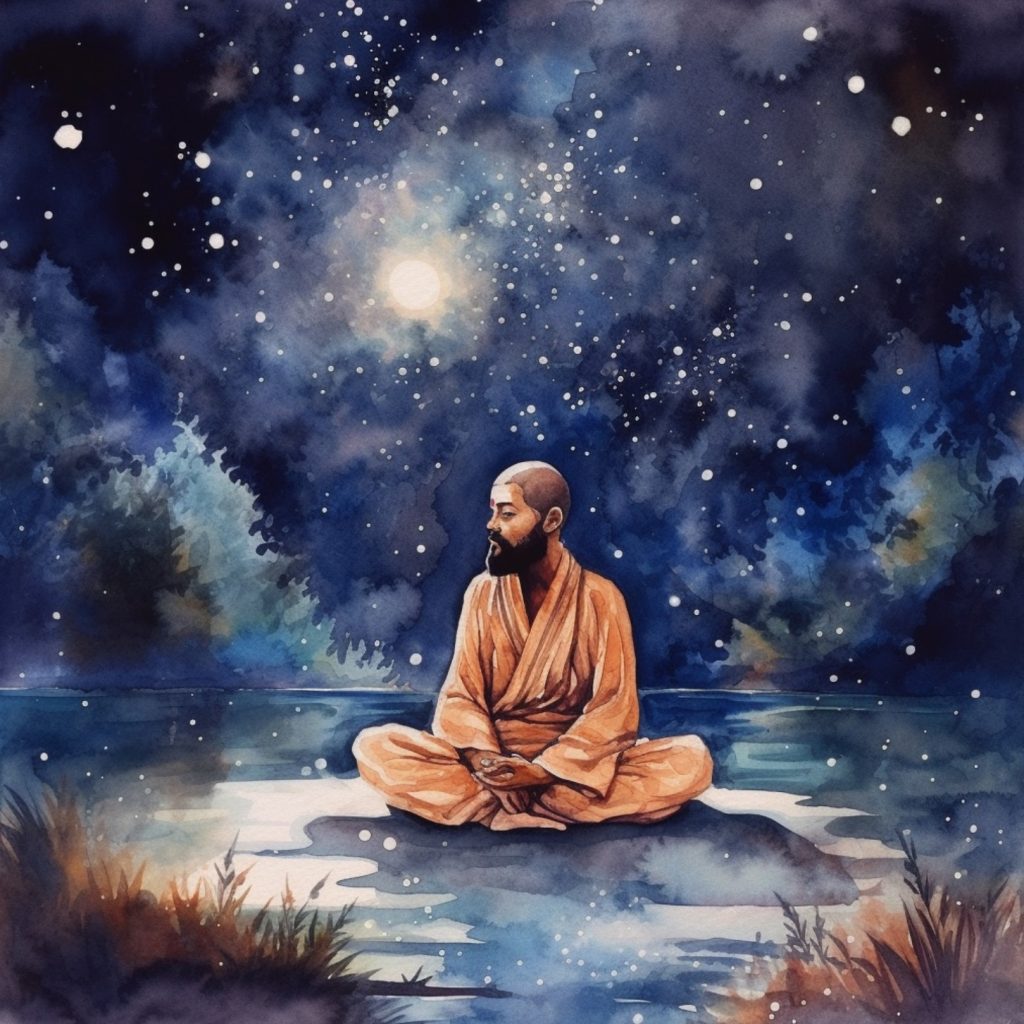
philosophy at Nagpur, she went straight to the Himalayas and stayed alone
for 75 days in the cave in Uttarkashi where siddha master Swami Rama
Tirtha had meditated. She did not even take a pot or pan. She sipped water
from the Ganges River, ate wild fruits and berries and meditated 16 hours
every day. At the end of it, she felt intoxicated by the mantras and
solitude and was astonished to gain some siddhis like seeing halos in
color behind some people and some powers not unlike
clairvoyance.
She then joined the Land-Gift Movement of Saint
Vinoba Bhave. For about 6 years, she walked on foot, from village to
village through practically every district of India from Kashmir to Tamil
Nadu - getting gifts of land from the rich and giving them to the poor.
She got up at 2:30 AM every day and walked 6 to 10 miles with Vinoba,
during which he would often recite and explain Ishavasyopanishad or some
other ancient holy text. It was a spiritual feast and a firsthand
discovery of India for Vimala.
Dazzled by J. Krishnamurti
In
1956, she listened to talks by J. Krishnamurti in Benares and met him
personally. She was spellbound and often sat alone in utter, deep silence
for a whole day after a talk. "The intensity throbbing in his words had
opened the doors to the irresistible presence of the Eternal," she
relates. "When two minds experience the same state simultaneously, they go
through a strange state of communion." The final stage of unfolding had
begun for Vimala.
From 1956 to 1959, she continued her incessant
travelling in India for the Land Gift Movement. Then she fell sick in
November 1959, with bleeding and pain in her left ear, fever and
headaches, sometimes becoming unconscious. A surgery on the ear did not
help, and it was decided to take her to England for another possible
surgery.
It was then that she met J. Krishnamurti once more. He
offered to help her and said his mother used to say that his hands had
healing powers. Vimala, at first reluctant, agreed to a trial. During six
sittings, Krishnamurti held his right palm on her head and left palm on
her left ear. Finally, her bleeding stopped, fever disappeared and her
lost hearing returned.
Her general health improved but the healing
"played havoc with my mind," she remembers. "Right from the first sitting,
something new and strange has been pulsating through every nerve - a very
strong and forceful current of vibrations passing through the head and the
whole body," she told Krishnamurti. "It is like the invasion of new
awareness, irresistible and uncontrollable. It has swept away everything.
It is strange to see the total mind being born anew." Krishnamurti
replied, "You have a serious mind. You were listening to the talks which
were sinking deep into your mind. They were operating all the time. One
day you realized the Truth."
Vimalaji wrote to her father. "A
tremendous tempest has swept away everything with one stroke. I wish I
could describe how I witnessed the ego being torn to pieces and being
thrown to the winds. The centre of thinking has dissolved into
nothingness."
She has tried to describe the undescribable explosion
in the following words: "My romance and search for the unknown ended
abruptly. There is the beginning of a new life which has no purpose,
direction or pattern. It is overwhelmingly fresh, unbelievably new, and
keeps one ever alert, keen and insecure."
Against Religious
Labels
Now 69, Vimalaji has been travelling in 40 countries during
the last 27 years - from Holland to Hong Kong and Argentina to Sweden,
giving guidance, group meditations and talks published in five European
languages. She also continues to visit and help in the trouble spots in
India - Assam, Punjab and Kashmir - and meets with Gandhian followers and
other peace-workers.
But she says she does not now belong to any
organization, any country or any established religion and does not want to
build any new organization or insist on any particular method or
technique. She feels that the Vedas and Upanishads have a message of
holistic approach to life, which is an indivisible totality. "If the
source of all the universe and the container of all creative energies is
nothingness and "no-beingness," she argues, "obviously we have to learn
and find out if we can live as "nothingness and nobody-ness" so that the
creative energy adds a new dimension to human life." "Religion is an inner
revolution," she insists. "To be religious is to be committed to living;
very few people are interested in living and discovering the meaning of
life, personally, first hand." She feels that if more people live in daily
meditation, civilization will pass on from an aggressive, violently
competitive society to a psychology of friendship and cooperation, leading
to a real authentic democracy. An expert in yoga, she gives guidance on
yogasanas, breathing diet and practicing silence in daily
life.
"Whether one is in India or elsewhere," she shares, "the
moments of total solitude and communion with the wholeness are the real
joys in life. The sense of connectedness with the wholeness is always
there, in every movement of life. But communion in solitude has its own
ecstacy! Incessant travelling becomes bearable due to this holy
communion."
Vimalaji's USA contact: Ian Surrey, 75 Bellevue St.,
Newton Center, Massachusetts, 02158.
Article copyright Himalayan
Academy.
Return to the Table of Contents
Return to Hinduism Today Home Page
|