![]() |
||
April/May/June 2003FROM THE VEDAS
"He who meditates on the Highest Person through this syllable Aum, consisting of three letters, becomes united with the effulgent sun. As a snake is freed from its skin, even so he is freed from sin." Atharva Veda, Prasna Upanishad 5.5
Meditating on A-U-M
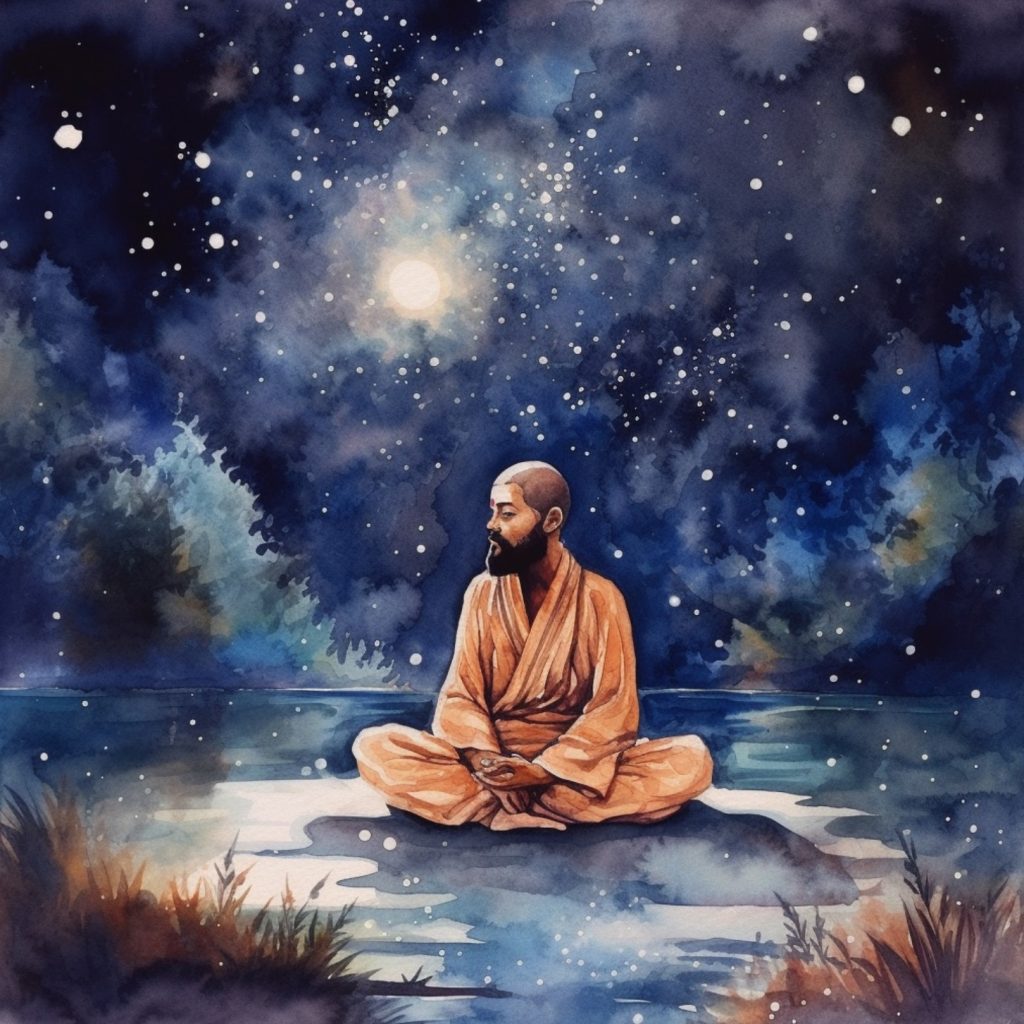
Rishi Pippalada shares secrets about the Primal Sound Satyakama, the son of Sibi, asked Pippalada: "Sir, if among men someone should here meditate on the syllable Aum until death, which world, verily, would he win thereby?" Pippalada replied: "O Satyakama, the syllable Aum is the Supreme Brahman and also the other Brahman. Therefore he who knows it attains, with its support, the one or the other. "If he meditates on one letter (matri), then, being enlightened by that alone, he quickly comes back to Earth after death. The Rig verses lead him to the world of men. By practicing austerity, chastity and faith, he enjoys greatness. "If, again, he meditates on the second letter, he attains the mind and is led up by the Yajur verses to the intermediate space, to the Plane of the Moon. Having enjoyed greatness in the Plane of the Moon, he returns hither again. "Again, he who meditates on the Highest Person through this syllable Aum consisting of three letters, becomes united with the effulgent Sun. As a snake is freed from its skin, even so he is freed from sin. "The three letters of Aum [used separately] are mortal; but when joined together in meditation on the total Reality and used properly on the activities of the external, internal and intermediate states, the knower trembles not. "The wise man, meditating on Aum, attains this world by means of the Rig verses; the intermediate world by means of the Yajur verses; and that which is known to the seers by means of the Sama verses. And also through the syllable Aum he realizes that which is tranquil, free from decay, death and fear, and which is the Highest." Atharva Veda, Prasna Upanishad 5.1-7, Translation by Swami NikhilanandaCommentary by Swami Nikhilananda Meditate: Meditation means the continuous flow of the mind toward Atman through the total exclusion of all ideas foreign to It. The aspirant should meditate on Aum with great love, regarding it as the symbol of Brahman, as a life-long vow ("until death"). Which World: Many are the worlds that spiritual seekers may attain after death. Aum is the symbol of both the Lower Brahman and the Higher Brahman. Brahman may be worshiped by the aspirant in both aspects. From the Lower Brahman he can attain the Higher Brahman by gradual stages. The Supreme Brahman, also called the Higher Brahman, is devoid of all characteristics and cannot be known through words or thought. Aparabrahman, or the lower, "other" Brahman, is the first manifestation of the Absolute, or Pure Consciousness, in maya. Brahman, being transcendental in nature, cannot be directly comprehended by the mind. Therefore, many indirect meditations on Brahman are laid down in the scriptures. One such is meditation through a symbol, or pratika, which means meditation on one aspect of an all-pervading entity, or on something associated with it, as the thing itself. Aum is the most immediate symbol of Brahman. It is much more effective than any other symbol. By contemplating the Supreme Brahman through Aum, one realizes the highest plane, and by using Aum as a symbol of the Lower Brahman, one attains a lower plane. Plane of the Moon: The second syllable, U, is the symbol of the verses of the Yajur Veda leading up to the Somaloka, Plane of the Moon, located in the space between Heaven and Earth where dwellers experience various supernatural glories ("greatness"). The mind is controlled by the Deity who governs the moon. It is associated with dreams, since dreams are creations of the mind. Dream experiences are projections of the mind. The after-death experiences in the Plane of the Moon are of the same nature as ideas and are therefore compared to dreams. Sama Verses: He is led up, by the Sama Veda verses, of which M is the symbol, to the World of Brahma. From this, which is the aggregate of all lives, he beholds the Supreme Purusha, higher than the High and pervading all bodies. This exalted plane is known also as Satyaloka. But When Joined Together: If the aspirant meditates separately on each of the three letters constituting Aum, he is born again in this world. This is because A, U, and M, taken separately, do not indicate Saguna Brahman, the realization of which alone enables one to transcend death. When the three letters are joined together to form the syllable Aum, that syllable should be used as the symbol of Brahman, or the Cosmic Reality. Trembles Not: As a result of meditation on Brahman, the aspirant realizes his oneness with Saguna Brahman, or the World Soul. Therefore, he has no reason to be afraid of anything. Attaining Brahmaloka, he overcomes death and rebirth. He who meditates on the entire syllable Aum, bearing in mind his identity with Brahman, attains Brahmaloka and ultimately final Liberation. Swami Nikhilananda (1895-1973), was founder and spiritual leader of the Ramakrishna-Vivekananda Center of New York from 1933 to his Mahasamadhi in 1973. His four-volume Upanishad translation was completed in 1959. The Vedas are the divinely revealed and most revered scriptures, sruti, of Hinduism, likened to the Torah (1,200 bce), Bible New Testament (100 ce), Koran (630 ce) or Zend Avesta (600 bce). Four in number, Rig, Yajur, Sama and Atharva, the Vedas include over 100,000 verses. Oldest portions may date back as far as 6,000 BCE. Return to the Table of Contents Return to Hinduism Today Home Page |
||
Express your gratitude for Hinduism Today by donating to the Hinduism Today Production Fund. Help provide complimentary copies to orphanages, libraries, temples and deserving individuals by donating to the Hinduism Today Complimentary Subscription Fund. Contact Us Copyright © 1979-2008 Himalayan Academy. All rights reserved. |