
A Yogic Departure
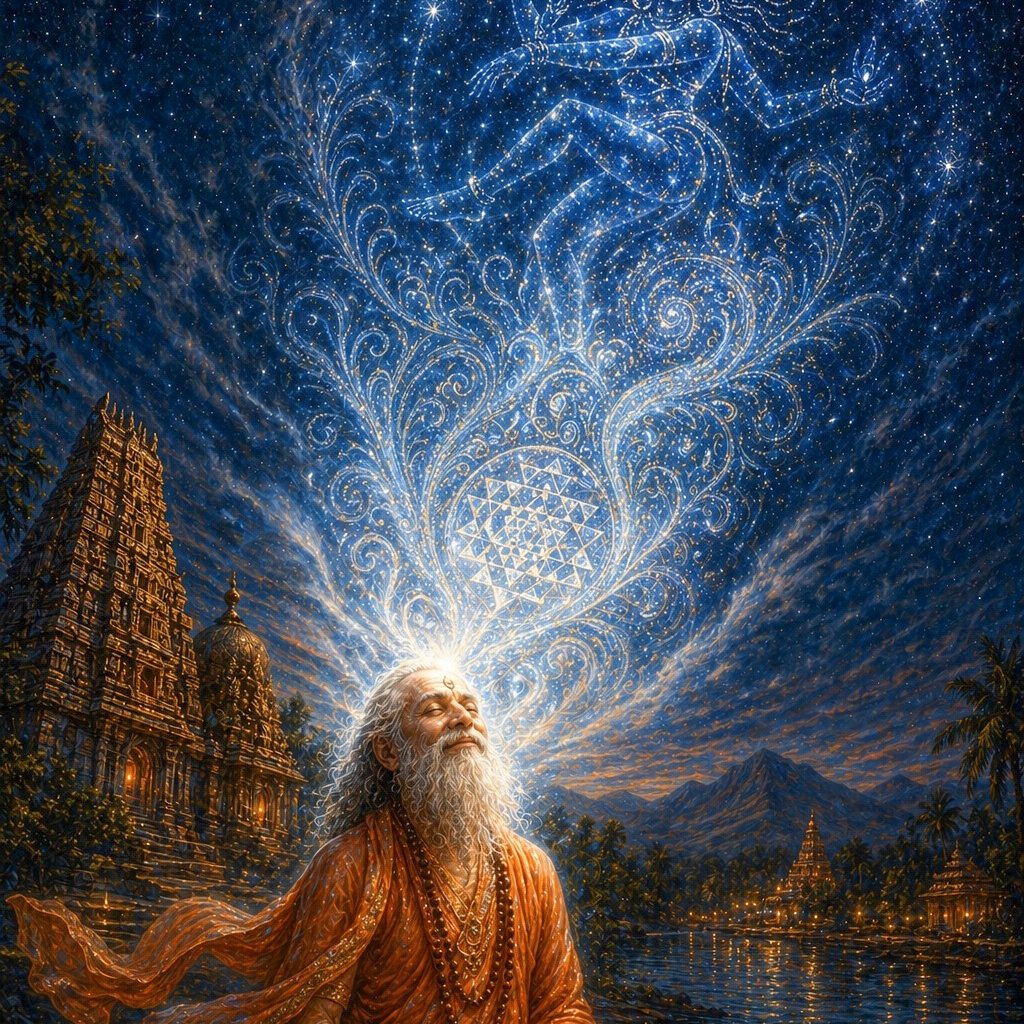
How adepts navigate the passage from embodiment into absorption
The following text is from chapter nine of the knowledge section of the Raurava Agama, Departure and Absorption of the Soul. The chapter discusses how the sadhaka, or sincere devotee of Siva, should approach death.
A perfect sadhaka is one who has known well Sivas astra—the piercing divine power of direct insight—related to the science of Sivayoga. He should be systematically worshipping Lord Siva, the sacred flame and guru. He should be firm and unassailed in his resolve. He should have thoroughly studied and contemplated the concepts set forth in the Agamas. Such a sadhaka, having seen inauspicious visions in his dreams—such as elephants, horses, chariots, unfavorable weapons and other bad omens, repeatedly—should understand that the proper time for the departure of his soul is fast approaching. 9.1
The sadhaka may be a householder or a king. Whatever be his order of life, his physical body has become resplendent with full growth and sound health. It is of the nature of the five cosmic elements: earth, water, fire, air and space. It is well refined with the disciplines of yoga and mantra. On knowing that the departure of his soul is imminent, he should perform fire-ritual, making oblations related to the five cosmic elements in the fire of consciousness created by astra mantra. 9.2-3
Having selected a proper place, he should purify himself well, his consciousness being sharpened by specific mantras. Having strewn sara grass and darbha grass over the selected ground and sat there, he should meditate on Rudra whose form is aligned with astra mantra, who is the creator and destroyer of the worlds, who is holding Brahma astra in his hand, and who is invincible. The sadhaka, who is well trained in meditation and well-skilled in the techniques of yoga, should contemplate the piercing form of astra with his yogic sight held in supreme consciousness. 9.4-5
He should assume a fitting and comfortable posture, either svastika or padmasana. He should keep the upper part of his body erect and his neck upright. He should hold his hands below in such a way as to display the specific yoga mudra known as kurma mudra. 9.6
Let him not press his rows of teeth together and let him keep his eyes half-closed. Having subdued the snake of deep attachment to worldly pleasures, he should restrain his five organs which are the vehicles for the senses related to the five elements. He should regulate the movement of inbreath and outbreath. Six inches above the navel, the heart-lotus shines forth with the brightness of the rising young sun. 9.7-8
At the center of the heart-lotus, there is the solar region (surya mandala), and at the center of the solar region there is the lunar realm (soma mandala). At the center of the lunar realm, there is the fiery region (vahni mandala) with its innate purity. At the center of the fiery mandala, the Great Lord Isvara is present. He presents Himself there with a luster comparable to pure crystal. 9.9-10
The sadhaka should install his consciousness, perfected and illumined by such specific discipline and astra mantra, at the center of the heart of Isvara. There within that heart-cave, it assumes by its own force, a form of astra which is purified with the fire of Siva. This astra-form assumed by the consciousness of the sadhaka rises to the head and then to the crest of the skull (brahmarandhra). Breaking open the seal there, it reaches the solar realm of Sivaloka within a fraction of a second. 9.11
Upon the head of the sadhaka who is the direct knower, a motionless, luminous light is formed. At this moment the sadhaka should draw out his soul in the form of astra (piercing, focused energy), contemplating Ekavira Rudra and His Shakti, and unite it with the brahmarandhra through the process of dharana yoga (perfect concentration). The soul drawn out in this way departs from his body. 9.12-13
All remaining energies of the soul depart from various parts of his body—such as legs and others—and accumulate again in the plane of brahmarandhra. Having departed through the brahmarandhra gateway, the soul swiftly passes through the outer region of the brahmanda (vast universe) known as lokaaloka (region of visible and invisible worlds). Separating itself from this region, and from the dual state of prakrti (material causation) and purusha (witnessing Self), this exalted and great soul assumes a resplendent subtle form and becomes one with all of existence by means of its all-pervasiveness. Finally, it enters into the Great Lord, Siva, who is very subtle. 9.14-15
At this stage, the attending sadhaka (who is an associate of the liberated sadhaka) should keep the body from which the soul has departed upon the stretch of darbha-grass and sara-grass designed in the form of astra and cover it with clothes and offer fragrant substances. He should touch the head of the body with the accompaniment of mantra samharaya bhutani hiranya. 9.16
Then the attending sadhaka should offer oblations into the fire with the mantras pertaining to the Lord of Vidyas (Siva as master of all sacred knowledge) and contemplate upon the departed soul as now being identical with the Supreme. In this way, the soul has been liberated from the bonds of the lower worlds through this discipline of astrasamayoga—the process of complete union. 9.17
Dr. S. P. Sabharathnam Sivacharyar of the Adisaiva priest lineage is an expert in ancient Tamil and Sanskrit, specializing in the Vedas, Agamas and Silpa Shastras. This excerpt is from his translation of the revered Raurava Agama.
Leave a Comment