
Realization in Hinduism

One cannot begin the spiritual path with God-Realization any more than he can start the study of mathematics with calculus
by Satguru Bodhinatha Veylanswami
A devotee recently submitted two questions to our weekly online Zoom satsang. Let me share the answers I gave plus some further thoughts on these topics.
First Question
In modern usage, self-realization is often understood as achieving ones goals or fulfilling ambitions. What term would you suggest to more clearly express the spiritual meaning of Self-Realization?
You are correct in stating that in a modern secular context, the concept of self-realization has a different meaning than it does in Hindu thought. Today, it is often used to mean fulfilling ones personal potential or achieving success in life. A life coach might use self-realization to describe clients turning aspirations into reality through structured training. This modern usage is strongly influenced by psychology, especially the work of Abraham Maslow, who described self-actualization as the highest stage of personal development. Over time, the term self-realization has been used interchangeably with that idea in popular writing, coaching and motivational literature.
In the yogic tradition, however, Self-Realization refers to something far more profound. It does not relate to outer achievements but rather to inner spiritual truths, not just understanding a truth intellectually but actually experiencing the truth being described. For example, ones soul nature can be experienced as a bright inner light, or atmajyoti. Intellectually comprehending that the soul can be experienced in that way is not realization. The actual inner seeing of atmajyoti is what is meant by realization.
To avoid confusion with the modern secular use of the term self realization, one solution is to use a Sanskrit word rather than an English word. The word that Satguru Sivaya Subramuniyaswami uses for spiritual realization in his writings is darshana. For example, Dancing with Siva Mandala One is entitled Self Realization—Paramatma Darshanam. Darshana has the meaning of vision or sight. To render paramatma darshanam in English, you could say mystical sight of the Self.
Second Question
What does realizing God and realizing the Self mean in Hinduism?
Realization of God or the Self has different meanings in different philosophical schools of Hinduism. In purely devotional schools of Hinduism, the term Self-Realization is sometimes used to refer to realizing ones true nature as the soul, distinct from the body, while God-Realization refers to direct experience of the Supreme Lord. In nondual traditions, however, the deepest Self is understood to be identical with Absolute Reality, so Self-Realization and God-Realization ultimately refer to the same attainment.
A verse from the Chandogya Upanishad contains the statement Tat Tvam Asi which is one of the four classic mahavakya that express the monistic view of Self-Realization. The verse translates as Thou art That. It declares the non-dual identity of the individual Self (Atman, thou or tvam) with Ultimate Reality (Brahman, That or tat).
When the monistic perspective is presented only in this way, it can strike one as an unreachable goal, something that only monks need to be concerned about. My guru, Sivaya Subramuniyaswami, offered a more reachable explanation. Self-Realization is in several stages. Realizing oneself as a soul (jiva or jivatma)—rather than a mind, an intellectual and emotional type, or a worthless person—gives satisfaction, security, and this is a starting point.
Realization of the Self as Satchidananda (Saguna Brahman) gives contentment, a release from all emotions and thoughts of the external world, and the nerve system responds to the energies flowing through the vishuddha and anahata chakras.
Realizing the Self that transcends time, form and space, Parasiva (Nirguna Brahman), is a razor-edged experience, cutting all bonds, reversing individual awareness, such as looking out from the Self rather than looking into the Self. This last stage is the Thou art That of the Upanishads.
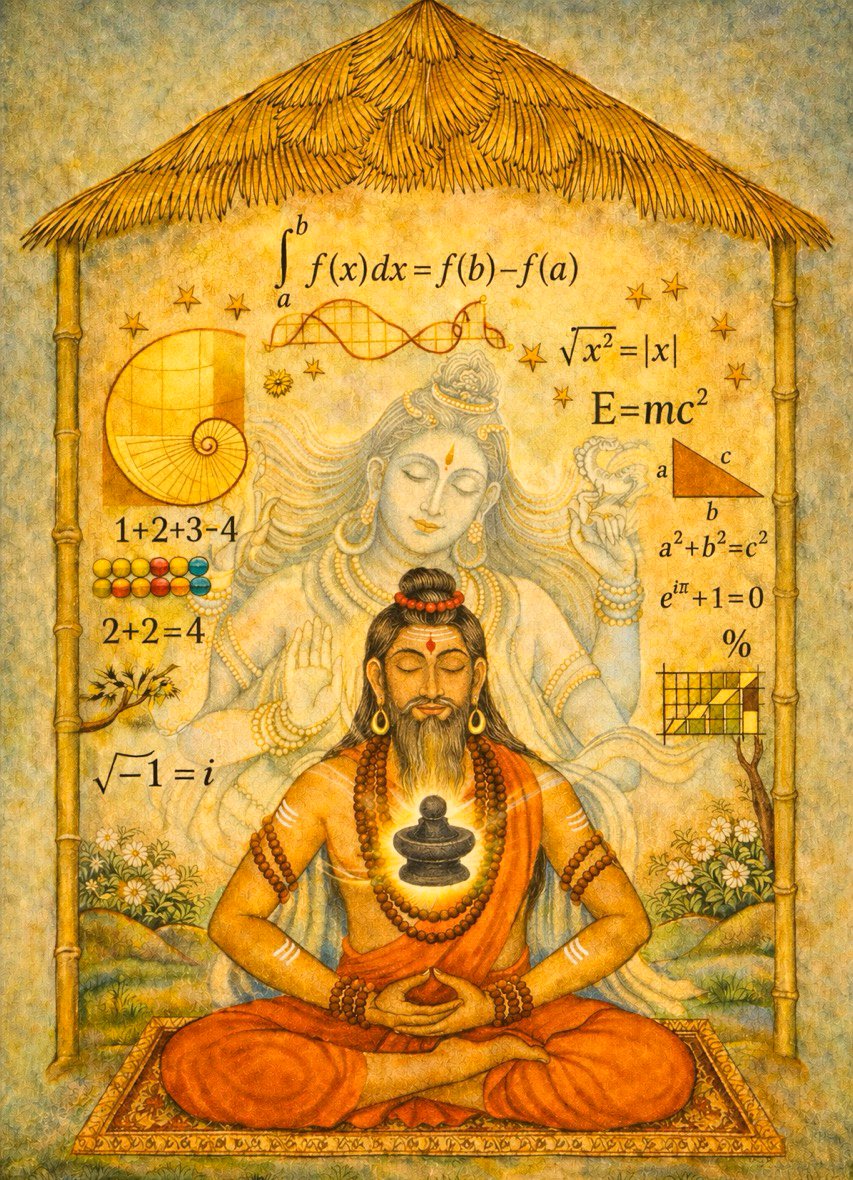
Photo: Dall-E
Gurudeva makes it clear that spiritual realization unfolds in three stages. First is realizing oneself as a soul, jiva. Second is experiencing the divine, all-pervasive consciousness known as Satchidananda. Third is the realization of Parasiva, the Absolute, beyond time, form and space—this is true Self-Realization. These three stages provide a helpful framework for understanding the progressive nature of spiritual attainment in the monistic schools of Hinduism.
Math Comparison
A comparison to the study of mathematics is helpful in understanding how best to approach realizing the Self. Typically the various aspects of mathematics are studied over a period of some fifteen years in a sequence from simplest to most complex. The main subjects are: 1) counting, basic arithmetic, fractions, decimals; 2) algebra, geometry, trigonometry; 3) calculus, statistics and probability.
In mathematics, one would not begin with calculus before mastering arithmetic and algebra. In the same way, Self-Realization unfolds progressively through three increasingly subtle levels of spiritual understanding. The first stage of Self-Realization—experiencing oneself as a soul—is like the elementary level of mathematics. Experiencing Satchidananda is comparable to the intermediate levels—algebra and geometry. The realization of Parasiva, the Absolute, beyond all qualities, is like the most advanced level of mathematics.
Who Am I?
In his published letters, Paramaguru Yogaswami presents the idea of experiencing ourselves as an individual soul, or jiva.
You are not the body. You are not the mind, nor the intellect, nor the will. You are the atma. The atma is eternal. This is the conclusion at which great souls have arrived from their experience. Let this truth become well impressed on your mind. But there is one thing to which you must give attention. Never swerve from the path of dharma. Let it be your practice to regard every life as the holy presence of God. He is both within and without. I remain, I am He.
To cease identifying with the body, mind, intellect and will, it is necessary to identify with something else beyond them. That something else is the witness, called sakshi in Sanskrit, the changeless, self-luminous awareness that witnesses the body, mind and all states of experience.
Swami Harshananda gives this description of sakshi in his A Concise Encyclopaedia of Hinduism: In Vedanta, the jivatman (individual Self) is called sakshi or sakshi-chaitanya since he is a witness to all the three states of consciousness, viz., jagrat (waking), svapna (dreaming) and sushupti (deep sleep).
My guru described sakshi as awareness standing apart from the mind and its activities. He wrote: That is why you strive for mastery of sadhana, mastery of concentration, your ability to hold awareness where you want it, when you want it for as long as you want it, and mastery of your ability to experience kaif, pure awareness aware only of itself, by taking awareness out of the entire context into just being aware….To attain and sustain kaif is a simple practice. You pull awareness out of the thought processes. You pull awareness out of the emotion processes. You pull awareness out of the bodily processes, and youre just completely on that pinnacle of being aware of being aware.
As this practice deepens, awareness becomes increasingly refined. Over time, the seeker moves from the initial perception of being a soul toward the deeper experience of the all-pervasive divine consciousness, or Satchidananda. People who are experiencing Satchidananda have a universal love for all beings. Life for them is a joyous, even blissful experience, with events happening in perfect timing. They hold the perspective that everything in the world is as it should be, that it is humanity working through its self-created karma. All the while, the third stage of realization, that of the Absolute, Parasiva, is still to be experienced, for most in a future life.

Leave a Comment