
Sivam Yoga Is Her Calling
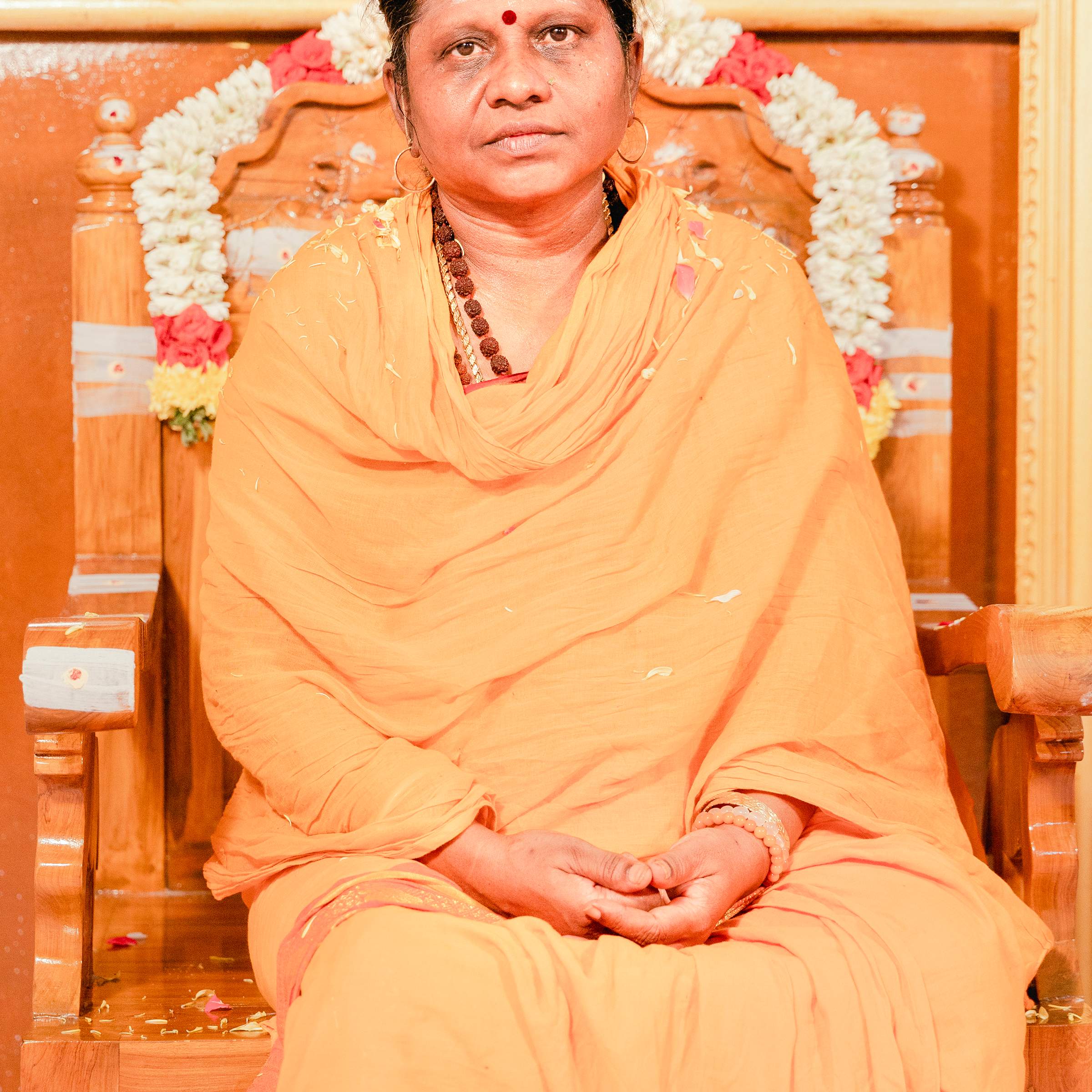
With Amma Thiyaneswar
By Erica Bassani
In the spring of 2024—while in tiruvannamalai, india, conducting interviews with teachers and leaders for the Women Awakening Project—one night I went to sit and meditate at the feet of Mouna Swami, an Indian man who took a vow of silence around thirty years ago. In a large warehouse, sitting on a simple wooden bed, he spends the whole day in contemplation, his long dreadlocks touching the floor, a swarm of silent people coming and going. To my surprise, on that day a big celebration was happening. As I was finding my way through the crowd, I saw Mouna Swami standing next to an Indian woman. When he bowed to her, and then put a garland around her neck, I got excited. Immediately someone close to me confirmed, That Amma is Mouna Swamis guru. I was so happy to have found a female guru! I couldnt wait to meet her, so after the event I went directly to her ashram. In the following month, I went several times to interview her. She speaks Tamil, so her assistant translated into English. Her sweet gaze and smile were just melting me as I tried to find out more about her ashrams practice of Sivam Yoga.
Amma, what is the Sivam Yoga tradition and its duration?
Sivam Yoga lineage starts from Lord Siva. Siva preached it to Parvati, Parvati to Nandi, Nandi to Tirumular and Tirumular to other gurus who were following Sivam Yoga. It has not been written, but it is passed on from guru to guru only through oral communication. The time period is not predictable. It starts from Siva, when He preached it and from that time onwards it is continuing for the betterment of human beings.
Can you please share with us what is Siva in your experience? Is it supreme consciousness?
Sivam is Yegam, which means the unique one. Its formless and nameless, but we call it Siva. The place of Yegam is beyond the universe. It is the supreme power, the greatest power. We cant see it with our physical eyes, because it is far beyond. In this world, we can see the formless one in the forms.
How did your spiritual journey begin?

I was born in 1962 in Tirunelveli, a small village in the Tamil Nadu region. My father worked at a railway station, and my mother was managing the kids. Due to the proximity of our house to the train tracks, I wasnt allowed to play outside and spent most of my time indoors. At that time, there were no televisions or newspapers, and I had limited knowledge of the world beyond my immediate surroundings. I was familiar only with my parents and Siva, the Divine. When my family acquired their first radio, a rare privilege, I was permitted to listen solely to devotional songs.
In the absence of external distractions, I found myself deeply absorbed in thoughts about God. At the age of six, I attended a temple festival with my grandfather. Witnessing a man in trance during the festival, I got profoundly curious and asked my grandfather why I couldnt also dance like that man. He explained to me that the Goddess of the temple was entering the mans body. So, I expressed my desire to dance like him and see God, and my grandfather replied, When and if God allows, Ill show you. This is how it all began.
How is it for a woman here in India to be a guru in this tradition, and what was the situation of women as you were growing up?
In all the time periods, women gurus are there, but they do face opposition. My mother had a high education level; she could read and write and that was considered to be more than enough. There were many restrictions for women as I was growing up. Giving women more freedom was felt as a threat that could break cultural norms. Women couldnt smile. Just as the tobacco leaf that loses its fragrance if it opens, likewise, a woman that smiled in public would lose her qualities. Women couldnt stand at the door of the house. It was customary at five in the afternoon to light a lamp in the house. Once the lamp was lit, she could no longer go out. If she had to, she could only do so accompanied by members of the family. These were the limits in which a woman was living back then.
How did your family respond to your becoming a guru at an early age?
For everything, God is the only reason. I received guru diksha from my grandfather, so he already knew about my whole life journey in this world, and my family was made aware of it. He knew I would get married and have children. After three years of marriage, my husband got Siva diksha, and he became a sannyasin and renounced the lay life. So, from that moment onwards my spiritual path became clearer. But for sure, a woman can have a family and be perfectly fulfilled spiritually, and you can become a guru even if you are living the marital life. You can realize Siva by renouncing the world or by staying and living an ordinary life in it.

How did you juggle motherly responsibilities on one side and your profound relationship with Siva on the other?
Its like riding two horses at the same time. If I learned it, it means it is possible for everybody, but practice is needed. Think of a person who can walk on a rope with a weight on his head. Its a great capacity of balance that doesnt develop overnight. Likewise, people that are leading an ordinary life should worship God whenever they have time, as well as while doing their duties, their work. Take a woman in a village who is walking a goat with a rope in one hand, her son in the other hand and a pot full of water on her head. And, she is also talking with the friend whos walking along with her. How is it possible for her to do all of these things at the same time? You see these things when you walk around in the villages. Its practice. Similarly, we have to think about God all the time.
Tiruvannamalai is known for the sacred mount Arunachala and for the ashram of Ramana Maharshi. The silence in this place is very tangible, incredibly powerful and beyond external noises. What is your relationship with silence?
Peace, silence, is the common base of all spiritual practice and has to be found within. If you find that peace, you can meditate also in the marketplace. When you are in front of the ocean you can hear the sound of the waves, sometimes it is very loud. And this is the daily life we live. But you know that if only you immerse in the ocean, you can find a silence that is always there. And that is the spiritual practice.
Since time immemorial people have been searching for the creator of this world. Even if the creator exists in all the creatures, their search is still continuing. Where peace exists, there is God. Wherever there is love, wherever there is dharma, God is there. But to abide in that, discipline and morality are necessary. The searching is not enough. It has to become a way of living. Then only, the realization can happen. We dont need to search for God here and there, but have absolute faith in His existence, so we can walk a path to reach Him. And one day the consciousness will let It shine through. If we have love and mercy, and if grace allows, we will realize It.
What about the many manifestations of that infinite one? How do we reconcile in our hearts the existence of that Supreme Reality and the smaller manifestations of it available to our eyes and senses?
Many years ago, during a satsang, someone asked me: You worship Arunachala (Annamalaiyar), and you keep a Sivalingam at your home, calling it Dyaneshwar. If everything is one, why are you worshiping the great Annamalaiyar as well as the small Dyaneshwar? I really didnt know what to say. The universe suggested to me: simply say that if Annamalaiyar is a laddu (a typical south Indian sweet ball), then Dyaneshwar is a bhundi (a piece of laddu). Everybody was happy with that answer.
About The Author
The Author: Erica Bassani is a copywriter, author and spiritual seeker since her early twenties. She’s combined her highest passion with her deepest love by founding the Women Awakening Project (www.womenawakeningproject.com), a space to gather interviews with female masters of all spiritual traditions.
Leave a Comment