
The Glittering Gold Heritage of Thanjavur’s Famed Art Lives on
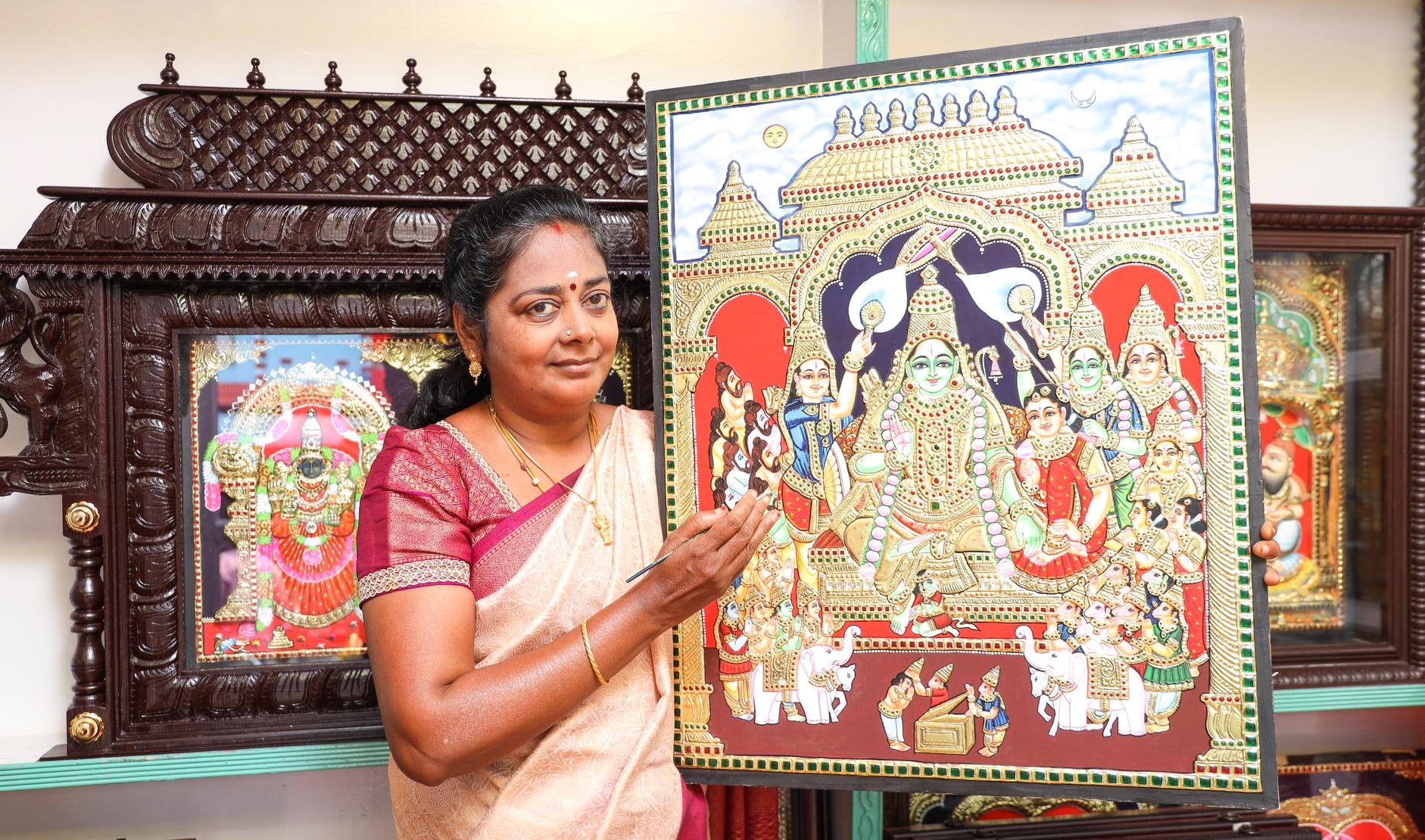
Generation after generation of artists have preserved this rare art form
By Padma Krishnan, India
Thanjavur is a city in south india with a rich cultural heritage. This fertile land, fed by the river Kaveri, flourished under the rule of the Tamil Cholas, Nayaks and the Marathas prior to British colonial rule. It has birthed many art and craft forms and boasts four government-recognized handcrafted products: Thanjavur painting, dancing dolls, brass plates and the Saraswati vina. Among these, Thanjavur painting, known locally as palagai padam (wooden plank picture), is the most popular.
We spoke with award-winning painters Vijayalakshmi Prabhakaran and Marimuthu Uthrapathi to learn of the fascinating history of this glittering art form and their journeys as artists. Both painters have received prestigious awards from the state of Tamil Nadu.
In the tradition of Thanjavur painting, images of Deities are drawn on canvas mounted on wooden boards. Gold foil, precious and semi-precious stones and crystals are applied along the lines to create depth. The resulting image is a type of bas-relief work.
The vivid colors, gold sheen and jeweled stones combine to create a striking beauty and deep religious sensibility. Gold is traditionally associated with Goddess Lakshmi and Lord Kubera, and golden Deities are auspicious for personal worship.
Such gilded works originally adorned royal palaces and temples. Under the patronage of Vijayanagara rulers, the art form thrived. After that dynastys demise, artists moved from the Vijayanagara region to Thanjavur, Mysore and Madurai in search of affluent patrons for their expensive art form. Many settled in Thanjavur, continuing their art under Nayaka and Maratha patronage, with rulers Raghunatha Nayaka (1600-1634) and Serfoji Maharaj (1777-1832), respectively, among its most ardent supporters. Serfoji Maharajs contribution in particular was immortalized by the artists, who sometimes gave him a place in their Ram Darbar paintings of Lord Ram and his family. Serfoji was depicted as a tiny figure with traditional royal headgear, distinct from the celestial beings present at Rams royal court (see three figures at bottom of above art).

The roots of Thanjavur painting can be traced to earlier temple murals. The walls of the Vijayanagara-era Virupaksha Temple in Hampi and the Chola-era Brihadeeswara Temple in Thanjavur showcase wall paintings similar to later Thanjavur paintings. Continuing from walls to the canvas, the art form has shown great resilience, surviving and thriving through many changes in the Indian subcontinent to the present day.
Thanjavur artisans have ingeniously adapted their craft by drawing inspiration from various cultures. They use elements of style and techniques from an array of regional craft forms, resulting in an art form unique to Thanjavur. This tradition, characterized by gold embossing, has earned Geographical indication status from the government of India.

Walking through Vijayalakshmi Prabhakarans studio is a journey through a centuries-old art form. From paintings that look like thousand-year-old murals in terms of colors and forms to the color-saturated calendar art and more contemporary portraits and personalized imagery of Deities, her work reflects how the artistic community continues to adapt to changing times.
A confluence of cultures is evident in these current Thanjavur paintings. We see the influence of folk art in the rotund central figures and the way animals are depicted in the backgrounds. In the Chola and Vijayanagara periods, mainly Deities were gilded; gilding portraits of real people came with Islamic and Maratha rulers.
A similar style, also with historical roots in the Vijayanagara Empire, is Mysore painting. Mysore paintings are low-relief works, while Thanjavur paintings are high relief works with embedded precious stones. The paste used in each is also different. Another distinctive feature of Thanjavur paintings is the use of thin strips of gold foil glued on the lines of the preliminary sketch. Rarely, silver is used.

Today, artists freely express their individuality through diverse color palettes and backgrounds. We noted the charcoal-gray head of a Devi in a gallery, a departure from the traditionally used colors—red, green, blue and yellow. Artists Marimuthu and Vijayalakshmi say they accommodate patrons choices of colors and backgrounds unless they fall well outside traditional norms.
Thanjavur means chubby figures, laughs artist Vijayalakshmi, showing us around her galleries in the busy streets of Pondicherry, where cherubic Bala Krishna, the infant form of Krishna, looks straight at the viewer from various angles. Rotund bodies and vivid colors are the hallmarks of Thanjavur paintings and are still widely followed. Earlier, natural dyes were used, but most commercial artists have switched to chemical colors; creating organic dyes is a time-consuming process and commercially not viable.

Subjects in high demand are celestial weddings, Ram and Shiva darbars, Tirupati Balaji, Krishna and Murugan. These are commissioned for temples and personal worship. Portraits of families and political figures are also in vogue.
The process of creating a Thanjavur painting is both time-consuming and labor-intensive. Each stage requires ample sunlight for the glue to dry. Artist Marimuthu says it takes a year to train apprentices. Each one has a specific task, from washing the coarse cotton cloth, staining it yellow, mounting it, polishing the board, tracing or drawing, mounting stones and glass pieces and applying paste over specific parts of the drawing to build up the bas-relief effect. Apprentices cut the fragile gold foil and paste the strips along the drawn lines, clean them and color the image.
Drawing the face is reserved for the master. Marimuthu and Vijayalakshmi emphasize its importance. They say the expressions that captivate the viewer are concentrated in the eyes, lips and the curve of the cheek. In one of their paintings, the round eyes of the cherubic Krishna follow us from any angle. That takes years of practice!

In addition to making new paintings, these artists are called upon from time to time to restore old ones. Its a task that takes time and patience. Vijayalakshmi recalls slowly restoring a 120-year-old painting that now adorns a temple wall.
In 2011, she completed a 24-hour Thanjavur painting marathon recognized by the Indian Book of Records and has also created large-scale artworks using seeds of various colors and shapes. These achievements were dedicated to events promoting religious harmony and world peace.

Similarly, Marimuthu and his team worked around the clock to complete the Ashtalakshmi project, eight large, intricate images of Goddess Lakshmi. Normally, it would take between a week and six months to complete a painting.
Until recently, Thanjavur artists did not sign their work, deeming it inappropriate, but now they add their contact details to the backs of frames.

The once-flourishing community of hereditary Thanjavur artists holds on precariously today. Though some continue the centuries-old tradition, financial stability in other professions lures the next generation away. Conversely, those driven by passion like Marimuthu and Vijayalakshmi have dedicated decades to honing their skills through professional training and working under seasoned teachers.
Today, they nurture new artists and are creating a new pool of talent. Both are hopeful of their children continuing their craft. They cite the significant costs involved in learning and practicing this art form as reasons for the high turnover in this field. However, resourceful artisans have found ways to make Thanjavur painting commercially viable by adapting their methods and materials to appeal to modern collectors. Jackfruit wood has been replaced by plywood, traditional tamarind seed paste by readily available glue. Gesso paste is now crafted with a mix of chalk powder, zinc oxide, gum arabic and even the popular Fevicol-brand white glue.
Both artists are concerned about imitations, where cheaper materials such as synthetic gold are used instead of real gold foil. These are hard to detect and do not last long. The artists appreciate the GI recognition, which raises awareness and helps combat imitations.

The demand for Thanjavur paintings has been growing steadily among both domestic and international art collectors. Like many small businesses in India, Thanjavur artists are also foraying into the digital world. They use social media channels to drive sales through online platforms. Marimuthus Instagram page and YouTube channel help him stand out in the cluttered market. Vijayalakshmi is setting up her website and plans to create her online store soon.
The spirit of innovation that created this unique art form continues today. Some artists are crafting 3d effects using thick plaster of Paris, creating paintings resembling low-relief sculptures. This living art constantly reinvents itself, yet manages to retain its heritage. Social-media DIY videos teaching Thanjavur art indicate it is flourishing and has garnered a wide audience.

The Tamil Nadu state governments Handicrafts Development Corporation takes these handicrafts to a global market under the brand name Poompuhar. Its impressive showrooms and production centers make the products accessible. For more information, visit nall.ai/poompuhar.com. Poompuhar offers training in various craft forms and helps artists with marketing and support services. It honors artisans annually—Marimuthu won the coveted award in 2017.
Many artists applaud various initiatives by the government, especially the Artisans Card. The card, signifying that they are a genuine handicraft artisan, enables them to showcase and sell their work all over India through an organized series of exhibitions in cities. It helps them to network, find talent, apply for grants and collaborate with other recognized artisans.
We asked the artists what the future holds for Thanjavur paintings. Vijayalakshmi, said she is very confident it will thrive and encourages others to enter the field. She says the fulfillment that comes after completing a painting cannot be described; it is a reward far beyond what it might fetch in the marketplace. Many of her paintings are not for sale. These are ones she cannot part with, as they gave her immense joy during their creation.
Echoing a similar positive outlook, Marimuthu says the heightened awareness of Thanjavur painting through media exposure in recent years has created a steady demand, and he feels the craft will last for the next fifty years, at least. His Murugan Art Gallery offers a thirty-year guarantee for its creations.
Machines encroaching on their field are a whispering concern in the painting community. But for now, both of our artists are confident that Thanjavur painting has a bright future for generations to come.
About The Author

Padma Krishnan is an independent journalist. She writes about travel, art, culture and books at
Leave a Comment